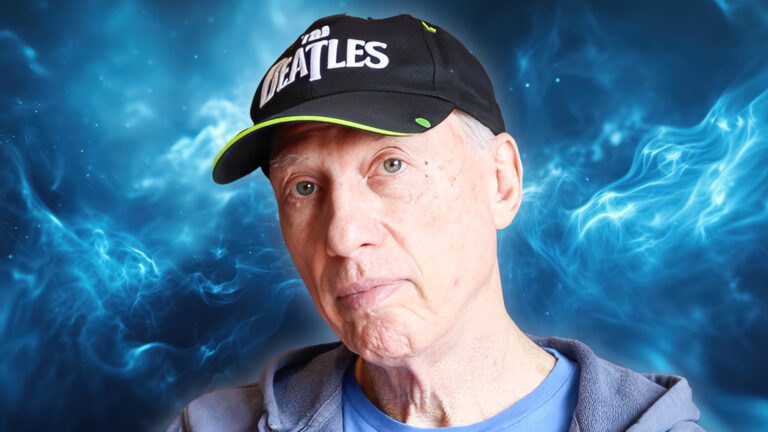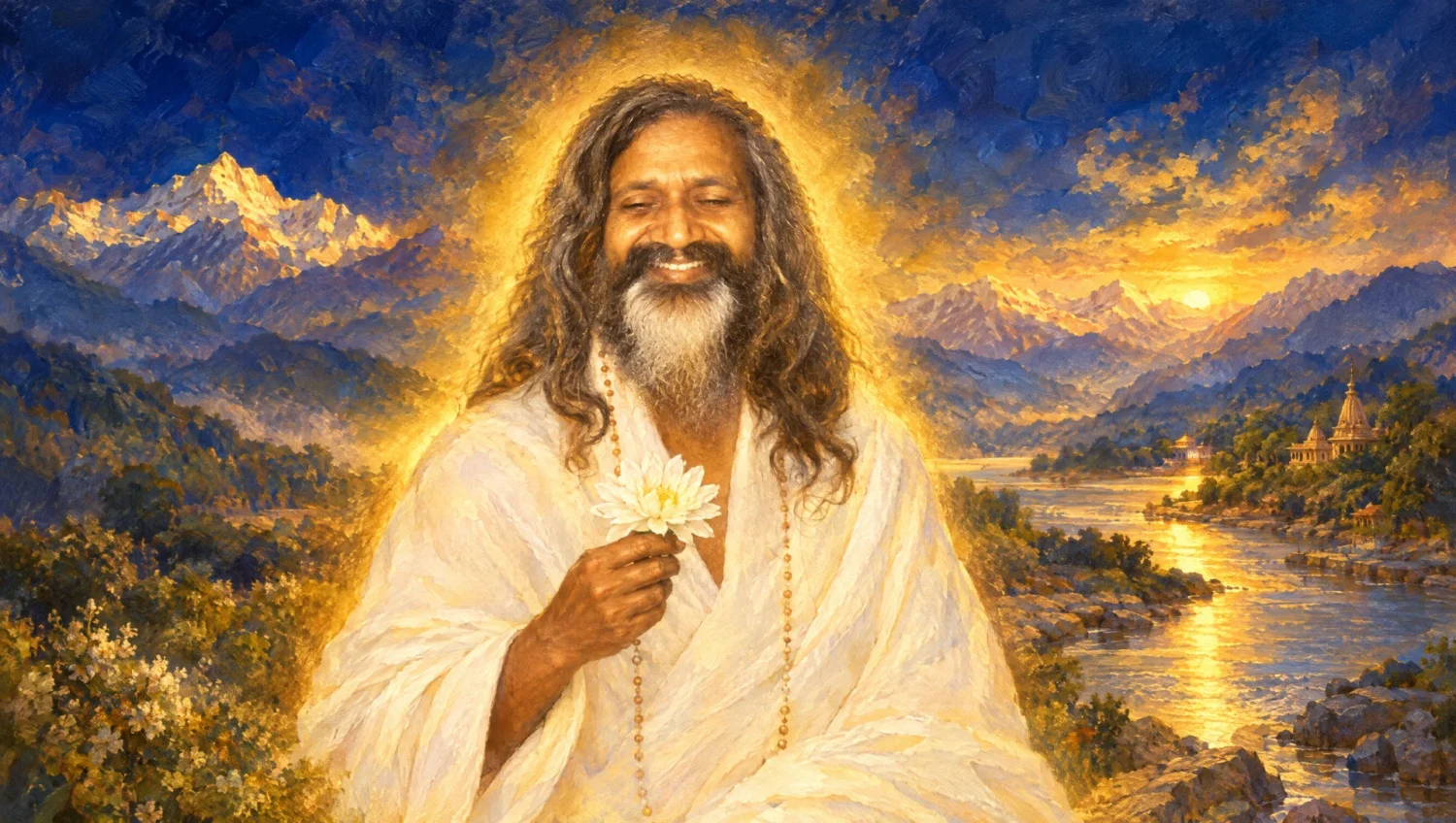
In 1959, a small, bearded man in white robes arrived in Hawaii with almost no money and a simple idea: that every person can touch a deep inner peace, and that it takes about twenty minutes, twice a day. Within a decade, the world’s most famous band was sitting at his feet. Within two decades, millions had learned to meditate in his way. Maharishi Mahesh Yogi remains one of the most influential, and most debated, Indian teachers of the twentieth century. He brought meditation to the modern West in a form people could actually practice. He also built a vast organization and made claims that many people question. This guide follows both the light and the questions: his story, the technique, the Beatles, the criticisms, and where he stands among the Ascended Masters.
Key Takeaways
- Who he was: Born Mahesh Prasad Varma (the year of birth is uncertain, between 1911 and 1918), a physics graduate who became the disciple of Guru Dev and the founder of Transcendental Meditation (TM). He died on February 5, 2008.
- His contribution: A simple, mantra-based meditation, taught worldwide, that helped popularize meditation in the West.
- Core teaching: Within everyone is a source of unbounded awareness and bliss. You reach it by effortlessly “transcending” thought, not by struggling to control it.
- Famous for: Teaching the Beatles in 1967 and 1968 and founding Maharishi International University, now Maharishi University of Management, in Iowa.
- Honest caution: Claims about “Yogic Flying,” world peace and crime reduction are disputed. His organization has been criticized for costs, scale and some of its claims.
- As an ascended master: Not a standard figure in Ascended Master teachings, though some honor him as a bridge-builder between Vedic wisdom and the modern world.
- Try it: A seven-day sitting practice inspired by his approach (not TM itself, which is taught by certified teachers).
In This Guide
- Who Was Maharishi Mahesh Yogi?
- What Is Documented and What Is Claimed
- Early Years and the Physics Degree
- Guru Dev: Brahmananda Saraswati
- A Mission Begins: From Kerala to the World
- What Transcendental Meditation Actually Is
- The Beatles in Bangor and Rishikesh
- The Seventies: Universities, Siddhis and Yogic Flying
- The Later Years: Vlodrop, Politics and Peace
- Final Years and Passing
- Core Teachings: Bliss, Transcending and an Unbounded Self
- Science, Research and Honest Evaluation
- How TM Compares to Other Meditation Paths
- Maharishi and the Ascended Masters: An Honest Answer
- Legacy: A Quieter World, a Louder Debate
- Honest Questions and Cautions
- A Practice: Seven Days of Effortless Sitting
- Books and Further Reading
- Who Will Connect with This Teacher
- Keep Exploring
- Frequently Asked Questions
Who Was Maharishi Mahesh Yogi?
Maharishi Mahesh Yogi (died 2008) was an Indian teacher who created Transcendental Meditation and led the movement built around it. The title Maharishi means “great seer.” Followers also called him His Holiness. Early television audiences remembered him as the “giggling guru,” because he laughed so easily.
He taught that anyone, whether a monk or a bank clerk, could reach a quiet and creative state of awareness through a simple daily practice. He was not interested in asking people to change religions or leave their jobs. He said that life should be lived in fullness, and meditation was a way to make that possible.
By the time of his death, he reportedly had trained tens of thousands of teachers and taught millions of people. He had schools, universities, health clinics, and a global network that he kept running into his late years. He had also been the spiritual advisor to the Beatles. Few Indian teachers have had such a public life.
Because he became so famous, he also became a target. Critics called him a businessman in robes. Admirers called him a mystic who gave the West a gift. We will try to hold both pictures honestly.
What Is Documented and What Is Claimed
Even basic facts about Maharishi are uncertain. Sources give his birth year as 1911, 1917 or 1918. One biographer places his birth on January 12, 1917, in Rajim in the Central Provinces; his passport said January 12, 1918. Even his birth name varies. Many accounts say Mahesh Prasad Varma; a university alumni list records another name. Ascetics in India often let their family details fade, and Maharishi was no exception.
The main sources include his own books, such as The Science of Being and Art of Living (1963), his commentary on the Bhagavad Gita, and Thirty Years Around the World (1986). Biographies by Paul Mason and William Jefferson, memoirs by former students, and news reports fill in the rest. The TM organization has also published a great deal. Critical studies, journalism and court records give another view. We try to indicate which is which.
Early Years and the Physics Degree
Mahesh studied physics at the University of Allahabad and graduated in 1942. He may have worked for a time at a gun carriage factory in Jabalpur. But he was drawn to a spiritual life, and in the early 1940s he became a student and personal secretary to Swami Brahmananda Saraswati, who held the title of Shankaracharya of Jyotir Math in the Himalayas. People called him Guru Dev, “divine teacher.”
The physics background matters. All his life, Maharishi liked to speak of consciousness in the language of science. He was fond of saying that meditation was not belief but experience. It would be a hallmark of his approach, and the source of both his reach and many of his controversies.
Guru Dev: Brahmananda Saraswati
Guru Dev was a revered monk in the Advaita Vedanta tradition, the line that traces back to the philosopher Shankara. Maharishi served him for about a dozen years. He said that his life truly began in 1940, at the feet of his master, when he learned a simple and rapid method of meditation. Guru Dev handled the master’s correspondence, traveled with him, and gave public talks.
When Guru Dev died in 1953, Maharishi could not succeed him, because he was not born a Brahmin and the post required it. Another monk was named. But, according to Maharishi, his master had charged him with a task: to take meditation to the masses. He withdrew to Uttarkashi in the Himalayas and lived in seclusion for about two years, much of it in silence.
He never stopped crediting Guru Dev. In January 2008, just weeks before his death, he said he was closing his “designed duty to Guru Dev.” The sentence tells you how he saw his whole life: as service to a teacher.
A Mission Begins: From Kerala to the World
In 1955, Maharishi came down from the mountains and began teaching what he first called Transcendental Deep Meditation, and later simply Transcendental Meditation. In southern India, he was introduced as Maharishi. He called his early movement the Spiritual Development Movement, and in 1957 it became the Spiritual Regeneration Movement.
In 1958, in Madras, he told a large crowd that he planned to take his teaching to the whole world. In 1959, he set out. Rangoon, Bangkok, Singapore, Hong Kong, Hawaii, and then California, New York and London. “I had one thing in mind,” he wrote, “that I know something which is useful to every man.”
The early years were slow. A San Diego woman named Beulah Smith was for a time the only TM teacher in America. But with TV appearances and lectures at Harvard, Yale and Berkeley, interest grew. In 1966, he founded the Students’ International Meditation Society, which set up centers on a thousand campuses by the 1970s.
What Transcendental Meditation Actually Is
TM is a silent mantra meditation, practiced for about twenty minutes twice a day while sitting comfortably with the eyes closed. A certified teacher gives each student a personal mantra, a sound that the organization says carries no meaning, used as a vehicle for the mind. The student does not concentrate or control thoughts. The practice is to think the sound easily, and when the mind wanders, to return to it without effort.
The goal is what Maharishi called “transcending”: letting the mind settle past ordinary thought into quieter and quieter levels, until it reaches a state of what he called pure consciousness or Being. He described this as a fourth state of consciousness, beyond waking, dreaming and deep sleep. In the Vedantic tradition, this corresponds to turiya.
Instruction takes place over several days, with a short ceremony in which the teacher offers thanks to the lineage of masters, including Guru Dev. This ceremony, called a puja, uses Sanskrit words and offerings of flowers and fruit. Its role is one reason a United States court in 1977 ruled that teaching TM in New Jersey public schools violated the separation of church and state. TM teachers say the technique itself is not religious.
Maharishi also described higher states. In his account, regular transcending leads to cosmic consciousness, in which the quiet of pure awareness continues alongside daily activity, and to higher stages that he called God consciousness and unity consciousness. These are stated in the language of Vedanta. They are teachings, not measurements. Treat them as a map offered by a tradition.
If you want a plain-language introduction to meditation in general, begin with our guide to how to meditate. For an overview of the Vedic world that TM comes from, our podcast conversation on how Transcendental Meditation can change the world with Dr. Tony Nader presents the movement’s own point of view. Dr. Nader is a neuroscientist who became Maharishi’s successor as leader of the Global Country of World Peace.
The Beatles in Bangor and Rishikesh
The story that made Maharishi a household name began in August 1967. George Harrison and his wife Pattie Boyd urged their friends to hear him speak at a London hotel. A few days later, the Beatles followed him to a training weekend in Bangor, Wales. While they were there, they learned that their manager, Brian Epstein, had died. Maharishi counseled them not to give in to grief.
In February 1968, the Beatles and their partners traveled to his ashram in Rishikesh, India, on the Ganges, where a teacher training course was in session. Other celebrities joined: Mia Farrow and her sister Prudence, Donovan, Mike Love of the Beach Boys. Ringo Starr left after about ten days. Paul McCartney stayed about five weeks. George Harrison and John Lennon stayed longest. Many of the songs on the White Album were written during those weeks, including “Dear Prudence,” named for Prudence Farrow, who meditated so intensively that friends coaxed her out of her room.
The visit ended in discord. The Beatles heard an allegation that Maharishi had made advances toward a woman at the ashram. In June 1968, they publicly distanced themselves from him. John Lennon wrote a bitter song, first titled “Maharishi” and then renamed “Sexy Sadie.” Years later, George Harrison called the story untrue and apologized for how Maharishi had been treated. Cynthia Lennon wrote that she hated leaving on a note of mistrust. Paul McCartney visited Maharishi in the Netherlands in 2007, and when Maharishi died, said his memories were joyful. The allegation was never substantiated, and several people who were there have since rejected it.
Photographer Paul Saltzman, who was at the ashram in 1968, tells his side in our conversation The Beatles’ Spiritual Journey with Paul Saltzman (also on Next Level Soul TV). His book The Beatles in India collects his photographs and recollections.
Their time in India changed the West. A generation that had barely heard of meditation suddenly wanted to try it. Our look at Hare Krishna: the mantra, the movement and the swami who started it all follows the other great wave of Indian teaching that reached the West in the same years.
The Seventies: Universities, Siddhis and Yogic Flying
After 1968, Maharishi moved his base to Seelisberg, Switzerland, and focused on training teachers on a large scale. He began to speak of a Science of Creative Intelligence (SCI), a course that placed meditation inside a broader theory of life, and it was offered at Stanford and many other universities in 1969 and after. He announced a World Plan in 1972 to open thousands of centers.
In 1974, Maharishi International University opened in Fairfield, Iowa, on the former campus of Parsons College. It later became Maharishi University of Management. He appeared on the cover of Time in 1975 and on The Merv Griffin Show, which brought tens of thousands of new practitioners.
In the mid-1970s he introduced the TM-Sidhi program, an advanced practice based on the siddhis or powers described in Patanjali’s Yoga Sutras. The best-known of these is “Yogic Flying,” in which practitioners, sitting in lotus posture, hop forward on cushions. The movement also described the “Maharishi Effect,” the idea that when a small percentage of a population meditates together, crime and conflict in the surrounding area decline. These are the most disputed parts of his legacy, and we return to them below.
The Later Years: Vlodrop, Politics and Peace
In the late 1980s and early 1990s, Maharishi’s organization expanded into health products, Ayurveda clinics, architecture based on Vedic principles, and even a political party. In 1990 he moved his European headquarters to a former Franciscan monastery in Vlodrop, in the Netherlands. In 1992 his followers founded the Natural Law Party, which ran candidates in dozens of countries. It was shut down by 2004.
In 2000 he founded the Global Country of World Peace and named leaders called rajas. He planned peace-creating groups of meditators around the world, as well as “Maharishi Vedic Cities,” including one near Fairfield, Iowa. Some projects, like his proposed amusement park, never happened. He spent his last two decades largely in seclusion, communicating by video.
Deepak Chopra, who had been one of his closest associates, left the movement in 1994 after what he described as a break with Maharishi. Indian tax authorities raided one of the organization’s offices in 1988. Critics have asked hard questions about the organization’s finances, its fees for instruction, and the corporate scale of what began as a simple meditation.
Final Years and Passing
In January 2008, Maharishi announced that he was stepping down from administrative work and going into silence to study the ancient texts. He died in his sleep of natural causes on February 5, 2008, at his home in Vlodrop. He was somewhere between 90 and 97 years old, depending on which birth year is correct. His cremation took place in Allahabad, near the meeting of the Ganges and Yamuna rivers, with state honors, in recognition of his place in the Advaita Vedanta tradition. David Lynch and other followers attended.
Paul McCartney said his memories of him would be joyful ones.
Core Teachings: Bliss, Transcending and an Unbounded Self
Maharishi had a few main ideas, repeated tirelessly.
- Bliss is the nature of life. He taught that within everyone is an unlimited reservoir of energy, intelligence and happiness. “Being happy is of the utmost importance,” he wrote in 1967.
- The mind wants to go within. If a mind is given a path to greater happiness, it naturally follows it. That is why meditation, he said, should feel effortless, not forced.
- Enlightenment is for householders, too. He rejected the idea that spiritual life requires renunciation. A person could work, raise a family and still grow.
- Experience comes first. His approach was to give people an experience, a taste of quiet, and let the philosophy follow.
- The individual affects the whole. He believed that a person’s inner peace radiates, and that groups of meditators could improve the atmosphere of a place. The scientific evidence for this is contested.
- Science and spirit belong together. He wanted Vedic knowledge to be tested, and he sponsored research on meditation.
His commentary on the Bhagavad Gita, written in the early 1960s, shows the roots of this teaching in the Vedantic tradition. For readers who want a reflective, non-technical introduction to the Vedanta behind it, our conversation on what non-duality is is a good place to begin.
Science, Research and Honest Evaluation
Maharishi pushed for research into meditation from the 1970s. Hundreds of studies have examined TM, many of them on stress, blood pressure and wellbeing. Some independent reviews have found modest benefits for stress and blood pressure, and the practice is now used in some schools, clinics and veterans’ programs. At the same time, critics point out that a large share of the early research was done by researchers affiliated with the TM movement and its university, and that the more dramatic claims, such as crime reduction by group meditation, have not been accepted by mainstream science.
This is not a medical guide, and we do not give medical advice. If you have a health condition, please talk with your doctor before changing your treatment. For the spiritual seeker, the more relevant question is whether the practice feels good and sustainable for you. Many people say yes.
Physicist Peter Russell, who trained as a TM teacher under Maharishi and later wrote about consciousness, is one voice who has tried to bridge science and mysticism. Hear him in Quantum Physics and Spirituality with Peter Russell.
How TM Compares to Other Meditation Paths
| Path | Method | Feel and effort |
|---|---|---|
| Transcendental Meditation | Silent personal mantra, twice daily, taught by certified teachers. | Effortless, with no concentration or watching of breath. |
| Mindfulness and Vipassana | Observing breath, body and thoughts with open awareness. | Active attention. See our guide to mindfulness practices. |
| Self-inquiry (Ramana Maharshi) | Tracing the sense of “I” to its source. | Directly looks at the sense of self. No object or sound. |
| Kriya Yoga | Breath and energy techniques, from the Yogananda lineage. | Structured and energetic. See our Kriya Yoga guide. |
| Prayer and contemplation | Devotional silence, repetition or listening. | Relational and heart-centered. |
There is no best method. Choose the one you will actually do tomorrow morning.
Maharishi and the Ascended Masters: An Honest Answer
Maharishi is not a central figure in Ascended Master teachings. Those traditions, which grew from Theosophy, focus on a different cast: Saint Germain, Kuthumi, Jesus and others. Maharishi came from a different current, the classical Advaita Vedanta line of Shankara and Guru Dev.
Within that line, he is honored as a recognized master, which is why his funeral had state honors in India. Some students and admirers go further and describe him as a realized soul or a great seer who is still present. That is a devotional view and cannot be tested.
Why include him in a series about masters at all? Because the word “master” can also mean one who masters a craft of teaching. Maharishi took a profound inner science and made it practical for millions of people. In that sense he belongs in the family of the teachers who bridge East and West, such as Paramahansa Yogananda. Our complete guide to the Ascended Masters puts all of them in context.
Legacy: A Quieter World, a Louder Debate
Even critics acknowledge that Maharishi helped move meditation from the margins into the mainstream. Before the Beatles, most people in the West had never heard of it. After him, schools, hospitals, workplaces and the military began to experiment. Teachers like David Lynch, who learned TM in 1973 and founded a foundation to teach it in schools and shelters, carry his influence.
His movement also shaped the New Age. Ayurveda, yoga, Vedic architecture and the idea of consciousness as a field entered popular conversation partly through his organization. The language of “coherence” and “collective consciousness” that many wellness teachers use today goes back to this period.
At the same time, his legacy is a case study in how a spiritual teaching can grow into a very large institution, and what is gained and lost along the way.
Honest Questions and Cautions
Is TM a religion or a cult?
Scholars have described the movement in different ways, from a new religious movement to a secular meditation organization. TM teachers say the technique is not religious, though the instruction includes the Sanskrit puja. Critics have accused the organization of cult-like features, including heavy pressure and secrecy. Many people, however, have practiced TM for decades without joining any group. Judge for yourself, ask questions, and notice how you feel.
Is it too expensive?
Fees for TM instruction have been a regular criticism. Maharishi raised them in 1993 and 2003. Prices today vary by country and by situation, and the organization offers scholarships. The same relaxation benefits can be found in many free practices. It is fine to explore alternatives.
What about Yogic Flying and the Maharishi Effect?
The “hopping” form of Yogic Flying is observable. The claim that group meditation lowers crime or prevented events like the end of the Cold War is not accepted by mainstream researchers. Many of the studies were done by researchers affiliated with the movement. We recommend treating these as beliefs of the organization, not as established science.
Did the Beatles leave because of misconduct?
The allegation was widely reported in 1968, and the Beatles distanced themselves from Maharishi. Later, George Harrison said it was untrue, and McCartney reconciled with him in 2007. It remains an unproven accusation, and we encourage reading multiple accounts.
Was he criticized by Indian teachers?
Yes. In 1967, Time reported that some Indian sages complained that his programs for spiritual peace without penance or asceticism went against traditional Hindu belief. Others thought he cheapened ancient practices. Admirers say he made a hard path accessible without watering it down.
Can I meditate without joining the organization?
Yes. Many mantra and sound meditations are available freely. TM itself is taught by certified teachers for a fee. If you want TM, learn from a certified teacher, not a book.
A Practice: Seven Days of Effortless Sitting
This is not TM, which is taught only by certified teachers. It is a simple sound meditation in the spirit of Maharishi’s message that meditation should be easy. You need a chair, fifteen to twenty minutes, and a quiet room.
- Day 1, Choose a sound. Pick a soft, neutral sound such as “one,” “peace” or the traditional “so-hum.” Sit with eyes closed for five minutes and let it float by itself in your mind. Do not push.
- Day 2, Ten minutes. Sit comfortably. Think the sound lightly. When you notice you have wandered, return gently, as if taking a bow to an old friend.
- Day 3, Let it change. The sound may become faint, fast or slow. Allow it. Do not try to hold it in a fixed shape.
- Day 4, Fifteen minutes. Do the practice twice today, morning and early evening. Sit still for a minute with eyes closed afterward.
- Day 5, No grading. Do not judge the session. A restless sitting is as useful as a still one. Write one line about how your day felt afterward.
- Day 6, Gaps. Notice any moments between thoughts where there is no sound at all. Do nothing with them.
- Day 7, Twenty minutes. Sit for twenty minutes. Come out slowly. Open your eyes after a minute. Notice your body and mood.
If you find it enjoyable, keep going for a month. If you are interested in the full TM instruction, seek a certified teacher. Our audio course The Inner Path (10 lessons, plus an introduction) explores the layers of mind that meditation touches.
Books and Further Reading
- Catching the Big Fish, by David Lynch. The filmmaker’s short, personal account of meditation and creativity.
- Strength in Stillness: The Power of Transcendental Meditation, by Bob Roth. A modern introduction by a longtime TM teacher.
- The Beatles in India, by Paul Saltzman. Photographs and recollections from the 1968 ashram.
- Maharishi Mahesh Yogi on the Bhagavad-Gita: A New Translation and Commentary, Chapters 1 to 6. His own commentary on the Gita.
- The Science of Being and Art of Living, by Maharishi Mahesh Yogi. His first major book, from 1963.
If you buy through these links, it supports our work at no extra cost to you.
Who Will Connect with This Teacher
Maharishi may speak to you if you are a practical person who wants a daily practice without a lot of philosophy, if you are curious about the bridge between science and meditation, or if you grew up with the Beatles and always wondered about the man behind the music. He is also a good fit for busy people who need a short, repeatable method. If you prefer a path with deeper devotional content or dramatic inner techniques, you might lean toward Kriya Yoga or the devotional path of Hare Krishna.
Keep Exploring
To go further, explore our guide to spiritual enlightenment across traditions, the plain-language mindfulness in daily life and guided meditation for anxiety. For the lineage that brought meditation West in a different form, see our guide to Paramahansa Yogananda and the film Awake: The Life of Yogananda, available on Next Level Soul.
Two audio courses fit. The Inner Path offers 10 lessons, plus an introduction, on the planes of consciousness and intuition. The World Within offers 24 lessons on stillness, presence and self-awareness. Both are included with Next Level Soul membership. You can also explore the wider Next Level Soul Mastery courses or begin with our free masterclasses.
Hear Dr. Tony Nader on Transcendental Meditation
Dr. Tony Nader carries Maharishi’s Transcendental Meditation work forward today. In this conversation on the Next Level Soul Podcast he talks about TM and consciousness.

You can also read the full episode page or watch the interview on Next Level Soul TV.
The Beatles and India, on Next Level Soul TV
The Beatles famously studied with Maharishi in Rishikesh in 1968. See that story on screen in The Beatles and India, the film, and The Beatles’ Spiritual Journey with Paul Saltzman.
Watch Ascended Masters, Channeled on Next Level Soul TV
An eight-episode series in which renowned channeler Genevieve Taeger brings through Buddha, Mary Magdalene, Athena, Mother Mary, Jesus, Saint Germain, Yogananda and Kuan Yin. Each episode is a channeled message, offered as spiritual guidance and not as historical record.
Episodes that connect with this guide: Ascended Master Yogananda and Ascended Master Saint Germain.
Frequently Asked Questions
Who was Maharishi Mahesh Yogi?
Maharishi Mahesh Yogi was an Indian teacher who founded Transcendental Meditation and led a worldwide movement. He studied physics, became a disciple of Guru Dev, and began teaching in 1955. He is best known in the West as the spiritual advisor to the Beatles. He died on February 5, 2008.
When was Maharishi Mahesh Yogi born?
It is uncertain. Sources give 1911, 1917 or 1918. One biography says January 12, 1917, in Rajim, in present-day Chhattisgarh. His passport gave January 12, 1918.
What is Transcendental Meditation?
TM is a silent mantra meditation practiced for about twenty minutes twice a day. A certified teacher gives each student a personal mantra. The goal is to settle the mind effortlessly into a quiet state that Maharishi called transcendental consciousness.
Who was Guru Dev?
Guru Dev was Swami Brahmananda Saraswati, the Shankaracharya of Jyotir Math in the Himalayas. Maharishi served him for about a dozen years and credited him with the teaching. Guru Dev died in 1953.
Why did the Beatles go to India?
After meeting Maharishi in London and Bangor in August 1967, the Beatles traveled to his ashram in Rishikesh in February 1968 for a teacher training course. They wrote many White Album songs there. They left disillusioned after a controversy, though several later made peace with him.
Is Maharishi an ascended master?
Not in the usual Ascended Master teachings, which come from Theosophy. He belongs to the Advaita Vedanta line of Guru Dev, and is honored in India as a recognized master. Some admirers regard him as a realized soul, which is a devotional view.
Is TM scientifically proven?
Hundreds of studies exist, and some independent reviews show modest benefits for stress and blood pressure. Critics point out that much early research came from affiliated researchers, and claims like crime reduction by group meditation are not accepted by mainstream science. This is not medical advice.
Is Transcendental Meditation a religion?
The organization says it is a technique, not a religion. Instruction includes a Sanskrit ceremony honoring the lineage, and a 1977 US court ruled that teaching TM in New Jersey public schools violated the separation of church and state. People of many faiths practice it.
How is TM different from mindfulness?
Mindfulness asks you to observe breath, body and thoughts. TM uses a silent mantra and does not ask you to watch or control the mind. Both are valid. Choose the one you will practice.
Can I learn to meditate without paying for TM?
Yes. Many free and low-cost methods exist, including mindfulness, breath meditation and simple sound meditation. TM itself is taught by certified teachers for a fee. Our seven-day practice in this guide is a free alternative.