
Anthony de Mello (1931 to 1987) was an Indian Jesuit priest, retreat leader and writer who taught that most of our suffering comes from living half asleep, and that paying calm, honest attention to ourselves and the people around us is how we wake up. He is best known for the books Sadhana, The Song of the Bird, One Minute Wisdom and Awareness, and for short stories from many traditions that make a point with a smile. This guide covers his life, his ideas, every book he wrote, the 1998 Vatican notification, and how to try his practices on an ordinary day.
Key Takeaways
- Who he was: A Jesuit priest born in Bombay in 1931 who died in New York in 1987. He founded the Sadhana Institute in Pune and led retreats in India, the United States and Latin America.
- Core idea: Most people live on autopilot. Waking up begins with watching your own thoughts, feelings and reactions without judging them.
- Best first book: Awareness for his ideas in his speaking voice, Sadhana: A Way to God for guided exercises, One Minute Wisdom for short stories.
- The Vatican notification: In 1998 the Congregation for the Doctrine of the Faith said some of his positions, mostly in later works, are incompatible with Catholic faith. Readers and fellow Jesuits have disagreed about it ever since.
- How to use him: Take what helps your daily attention and kindness, read the criticism fairly, and keep what fits your own path.
Who Was Anthony de Mello?
Some writers explain a spiritual idea. Anthony de Mello made you laugh first, and then you noticed he had pointed at something uncomfortable and true about the way you live. He was a Catholic priest in the Society of Jesus, a trained counselor, a retreat director and a storyteller. Born in Bombay (now Mumbai) in 1931, he spent most of his working life in India, then in the 1980s drew large crowds in the United States and Latin America. He died suddenly in 1987, at 55, while in New York to teach.
His message fits in a sentence. We are asleep, we do not know it, and the way out is attention. Attention to the sensation in your hands right now, the irritation you felt in the grocery line, the label you quietly stuck on your neighbor. From that plain starting point he built exercises, hundreds of short stories and retreat talks that his readers still pass around decades later.
People search his name for different reasons. Some have read one book, perhaps Awareness, and want to know the man behind it. Some heard about the Vatican notification and want a fair account. Some are choosing among a dozen titles and want a reading order. This page covers all three, and it is written to be useful whether you come from a Catholic background, another faith, or none.
Anthony de Mello at a Glance
| Question | Quick answer |
|---|---|
| Full name | Anthony de Mello, also called Tony de Mello (Society of Jesus, S.J.) |
| Born | 4 September 1931, Bombay, British India |
| Died | 2 June 1987, New York City, of a heart attack, aged 55 |
| Background | Oldest of five children in a Konkani Goan Catholic family |
| Training | Jesuit seminary near Bombay; philosophy in Barcelona from 1952; theology at De Nobili College, Pune; ordained March 1961; counseling studies at Loyola University Chicago (per Jesuit sources) |
| Institute | Founded the Institute of Pastoral Counselling in 1972, later the Sadhana Institute of Pastoral Counselling, in Pune |
| First major book | Sadhana: A Way to God (1978) |
| Best-known book | Awareness (1990, published after his death) |
| Teaching in one line | Wake up from illusion and attachment by observing yourself without judgment |
| Vatican notification | 24 June 1998, Congregation for the Doctrine of the Faith |
| Languages | His books have been translated into dozens of languages |
Sources are listed at the end of this guide. Where they differ, such as on the year of a book, the text says so.
The Life of Anthony de Mello
A biography of de Mello is a story of three places: Bombay, Pune and the retreat halls of the West. Following them in order explains a lot about why his teaching sounds the way it does, with Christian prayer on one side and Eastern attention practices on the other.

Early Years in Bombay
Anthony de Mello was born on 4 September 1931 in Bombay, the oldest of five children of Frank and Louisa de Mello. The family was Konkani Goan Catholic. Growing up as a Catholic in Bombay, one of the most mixed cities in Asia, meant that Hindu, Muslim, Parsi and other traditions were part of the surrounding culture, which fits the wide range of stories he later told.
At 16 he entered the Society of Jesus at the Vinalaya seminary on the outskirts of Bombay (Encyclopedia.com dates his entry to 1947). The Jesuits are a Catholic order known for education and for the Spiritual Exercises of Ignatius of Loyola, a month-long program of prayer built around imagination, reflection and honest self-examination. That training turned out to matter: the structure of de Mello’s own exercises borrows from it again and again.

Jesuit Formation, Spain and Ordination
In 1952 the young Jesuit was sent to Spain to study philosophy in Barcelona. He then returned to India for theology at De Nobili College in Pune, where he was ordained a priest in March 1961. Jesuit and encyclopedia sources add that he studied counseling at Loyola University Chicago, and Encyclopedia.com also lists work in spiritual theology at the Gregorian University in Rome. The mix is worth noticing. He was formed as a priest, but he also learned the vocabulary of modern psychology, which gave him a plain language for talking about fear, desire and habit.
His early assignments were in seminaries. In 1968 he became rector of Vinalaya, the seminary where he had begun.
The Sadhana Institute in Pune
In 1972 de Mello founded the Institute of Pastoral Counselling in Poona (now Pune), later renamed the Sadhana Institute of Pastoral Counselling. The word sadhana is Sanskrit for a disciplined practice or a path toward a spiritual goal, and the choice of that name told visitors what to expect. The Institute trained priests, religious sisters and lay people in counseling and in prayer methods that used the body, the breath and the imagination.
Out of the courses and workshops that ran there came his first major book, Sadhana: A Way to God, published in 1978. Encyclopedia.com describes it as growing out of scattered retreat and workshop notes and reports that it was eventually translated into around forty languages. Goodreads describes it as a guide to contemplative prayer built from 47 exercises. The book is the clearest picture of the Pune years: practical, a little experimental, and respectful of both Ignatius and the Eastern traditions he was borrowing from.
A fellow Jesuit, Michael Barnes, writing in the Jesuit journal Thinking Faith, describes Sadhana as combining Buddhist mindfulness, learned from the Vipassana teacher S. N. Goenka, with Christian prayer, including Ignatian imaginative contemplation and the medieval text The Cloud of Unknowing. Barnes argues that de Mello treated the Buddhist exercises as preparation for listening to God, rather than ends in themselves. That reading is one interpretation, and a generous one, but it matches the structure of the exercises in the book.
Retreats in India, the United States and Latin America
By the mid-1970s de Mello had become known in the United States as a retreat leader and workshop teacher with a talent for humor. In the 1980s he led many retreats in the West and in Latin America, often at Jesuit universities such as Fordham in New York. Wikipedia notes that a fellow Jesuit credited him with popularizing the full 30-day Ignatian retreat in India.
Encyclopedia.com describes his method as teaching mainly through suggestion and self-deprecating humor, without forcing his views on retreatants. IgnatianSpirituality.com notes that much of what we have of his teaching was reconstructed from notes taken by people who attended his talks. That detail matters when you read the later books, because many of them were assembled after his death from recordings and transcripts, not written as finished books.
His Death in 1987
On 2 June 1987, de Mello died of a heart attack in New York City, aged 55. Encyclopedia.com reports that he was giving conferences at Fordham University at the time, and the Irish Jesuits say he was in New York to teach a course. A fellow Jesuit found him. The suddenness of his death meant that a great many talks and notes were still unpublished, and the next decade brought a stream of posthumous books under his name, some carefully edited by his colleagues and some, according to his Indian publisher, produced without his authorization.
Anthony de Mello’s Teaching: Awareness, Attachment and Waking Up
Read enough of de Mello and the same handful of ideas keeps returning in different clothes. Here they are one at a time, in plain words, with a note on where each one comes from.
Waking Up from Sleep
The central image in his work is sleep. Most of us, he says, move through life like sleepwalkers, reacting to the same triggers in the same ways and calling that living. The publisher’s description of Awareness puts it this way: awareness is the key to spiritual life, and it asks readers to stop living in a distracted, materialistic way and to wake up by engaging with the needs of the people around them at home and at work.
This version of waking up has a practical edge: it is about catching yourself mid-reaction. You are halfway through snapping at someone, and for a second you see yourself doing it.
Illusion
De Mello uses the word illusion for the mental world we mistake for reality: the story that this person ruined my day, that I cannot be happy until the promotion comes through, that my worth depends on what others think. The publisher’s summary of The Way to Love says that obstacles like illusion get in the way of love, and that love begins with seeing another person as they really are, then seeing yourself without the distortion of your own needs, desires, memories, prejudices and projections.
The point is gentle but demanding. If a great deal of what upsets us comes from our interpretations, then the first job is to notice interpretations as interpretations. He invited readers to test this by watching their own minds.
Attachment
The second recurring idea is attachment, and his definition is practical. As readers summarize his talks, an attachment is the belief that you cannot be happy without a particular thing: a person, a result, a reputation, a habit. Attachment is different from caring. You can love your family, enjoy your work and want good things for your life. The attachment is the extra clause, the inner statement that says I will fall apart if this goes away.
This echoes Buddhist teaching on craving and Hindu teaching on non-attachment in the Bhagavad Gita, and de Mello knew both. He also found a Christian counterpart in the Ignatian idea of indifference, a freedom to choose what leads toward God without being gripped by preferences. Readers who want to explore the Eastern side can see our guide to non-duality, which explains how several Eastern traditions describe the mind letting go of grasping.

Dropping the Label
A third theme is labeling. We meet someone and instantly file them: difficult, lazy, brilliant, boring. After that we mostly interact with the file. De Mello encouraged people to notice the label as it forms and to drop it, which means looking at the actual person in front of you for a moment, without the running commentary. The same goes for labels we put on ourselves.
A label can be partly accurate and still blind us. Your coworker may well be disorganized. The practice is to see that fact alongside everything else about him, and to notice what your own mind does when it has a convenient category to hide in.
The Observer
To see any of this you need a place to stand, and de Mello’s answer is the observer: the part of you that can watch thoughts and feelings pass without being swept away by them. Many readers know this from mindfulness teaching, and the family resemblance is real. Our guide to mindfulness in daily life covers the same basic move from a general perspective.
In de Mello’s version the observer stays warm. Watching your anger means feeling it in the body, letting it run its natural course, and noticing that you are bigger than the anger. That spirit sits behind the 2021 compilation Stop Fixing Yourself, whose publisher says that awakening does not require years of struggle, and that watchful awareness lets false patterns drop away.
Where His Teaching Came From
De Mello’s sources were wide, and he never hid them. They include:
- Christian mysticism and Ignatian prayer. The Spiritual Exercises, contemplation of scenes from the life of Jesus, and texts such as The Cloud of Unknowing.
- Buddhist mindfulness. Barnes names the Vipassana teacher S. N. Goenka as a source for the body-awareness exercises in Sadhana.
- Hindu thought and practice. Breathing exercises, the vocabulary of sadhana, and an ease with the idea that the self we cling to is less solid than it looks. Readers interested in a classic Hindu approach to the same question can read about Ramana Maharshi and self-inquiry.
- Folk and wisdom stories from many traditions. According to Wikipedia, his parables came from Christian, Sufi, Hindu, Buddhist and Islamic folklore.
- Modern psychology. His counseling training gave him the language of projection and conditioning.
Famous De Mello Stories and What They Teach
Stories are the signature of his writing. He rarely argued a point when he could tell a two-minute tale that let the point arrive on its own. Most of the stories are older than he is: Sufi tales, Zen anecdotes, desert-father sayings, folk legends. His gift was selection and timing. Below are a few of the best-known shapes, retold here in my own words rather than quoted, with what each one is usually taken to teach.
The Eagle Raised Among Chickens
A young eagle hatches in a farmyard and grows up with the hens. It pecks at the ground, flaps a few feet and believes it is a chicken. A visitor insists it is an eagle, carries it up to a high place, and over several attempts the bird finally notices the wind under its wings and rises. De Mello retold the tale, which has older roots in folk tradition, as a picture of how we take on identities from our surroundings. The lesson is about borrowed self-images. What other people called you at eight years old may still be running your Tuesday at forty-eight.
The Fish Looking for the Ocean
In this family of tales, a fish asks around for the ocean, having heard that everything depends on it. The other fish tell it that it has been swimming in the ocean all along. It is a story about looking everywhere except where we are standing. It also explains why he talked so often about the present moment: the thing you are searching for may be the medium you are already in, and the searching itself keeps you from noticing.
The Bears That Kept Pacing
The publisher of The Heart of the Enlightened describes a story in which caged bears continue to pace the same small stretch even after the bars have been removed, because they are afraid to leave their familiar limits. It is one of the clearest pictures of attachment in his work. The bars are gone, and the habit of the bars remains. Readers often recognize a job, a relationship or a belief about themselves that they keep pacing inside long after anything external requires it.
The Master and the Disciple
Many of his shortest pieces, especially in One Minute Wisdom, Awakening and One Minute Nonsense, feature an unnamed Master and students who ask earnest questions. The Master answers sideways, with a joke, a task or a silence. According to Spirituality and Practice, the Master of One Minute Nonsense is a composite teacher who could belong to many traditions, and the book’s themes include becoming a zero, accepting not-knowing, living with paradox, treating ideologies with suspicion and turning life into play. The humor is part of the method. A laugh loosens the grip of an idea faster than a lecture does.
How to Read Them
A few habits make the stories work better:
- Read one, then stop. The stories are built to be chewed, not binged.
- Ask where you are in the story. Are you the hen, the eagle, or the person insisting on the sky?
- Notice your first irritation. If a story annoys you, that is useful information about what you are attached to.
- Hold the details loosely. The same story appears in many traditions with different animals and different names, and de Mello was open about being a collector and reteller, not the inventor of every tale.
Anthony de Mello’s Practices
De Mello was a practical teacher, and the exercises matter as much as the ideas. Several of them appear in Sadhana, and the publisher of Wellsprings says its exercises move from the intellect to the body and from thought to imagination and emotion. Goodreads describes the 47 exercises in Sadhana as covering awareness of bodily sensations, stillness, the healing of painful memories and awareness of self and world. What follows are simple, secular-friendly versions in the spirit of his work, written in my own words. If you are a person of faith, they sit alongside prayer without replacing it.
Awareness of Body Sensations
Sit or stand, and spend two minutes simply noticing physical sensation: the weight of your feet, the pressure of your seat, the temperature of your hands, the movement of your breath in your chest. When your attention drifts, which it will, notice that it drifted and return. The only goal is to practice coming back. Barnes notes that this kind of body-based attention in Sadhana was taken from the Buddhist mindfulness tradition and placed in a prayer setting.
Observing Without Judging
When a strong feeling arrives, such as irritation, envy or worry, try three quiet steps. Name it in plain words: this is irritation. Find it in the body: tight jaw, hot face. Let it be there for a few breaths without arguing with it or acting on it. Then see what happens. The aim is to practice being the one who sees the feeling, which is the observer he kept returning to.
The Attachment Audit
Once a week, finish this sentence five times on paper: I would be happy if only ______. Then read the list and ask which of these are preferences and which are demands. A preference says I would like this. A demand says I cannot be okay without it. Do not try to fix anything. Just see which ones have the grip, and notice that simply seeing them often loosens them a little.

Drop the Label
Pick one person you find difficult. For one day, each time your mind supplies the usual word for them, silently add: and also a person who is tired, scared of something, loved by someone. The point is to see the full picture long enough to respond instead of react, and bad behavior can still be addressed. Try the same exercise on the labels you use for yourself, which are often harsher.
Imaginative Prayer with a Gospel Scene
For Christian readers, the Ignatian side of his work offers another path. Pick a short Gospel scene, such as the wedding at Cana, and imagine it with all your senses: the room, the smell of the food, the voices, the person you most resemble in the scene. Spirituality and Practice describes Praying Body and Soul, adapted by Gabriel Galache from de Mello’s methods, as a guide that uses relaxation, bodily awareness and visualization to enter scenes from the life of Jesus. If you do not pray this way, you can skip this one without losing the rest.
Solitude and Silence
The publisher of Wellsprings highlights one of his lines: “in solitude your self is given back to you.” Ten minutes of quiet with no screen, no music and no task is a modest version of that. If you want more structure, our collection of guided meditations offers audio you can follow while you practice the same basic skills of settling and returning.
This is a spiritual and reflective practice and not treatment. If you are dealing with distress that feels hard to carry, please talk with a doctor or licensed counselor alongside any spiritual work.
How to Use De Mello on a Normal Tuesday
Ideas about waking up are easy to nod at and forget by lunch. Here is a small plan for one ordinary workday. You do not need to do all of it. Choose two or three pieces and see what you notice.
| Time of day | Practice | What to look for |
|---|---|---|
| First five minutes after waking | Feel your feet on the floor and take three slow breaths before you reach for your phone | How quickly the mind begins to plan and worry |
| Commute or first coffee | Notice sensations in your hands and the taste of the first sip | The urge to be somewhere else in your head |
| A meeting or call | When a coworker annoys you, name the feeling and find it in your body before you reply | The gap between the irritation and the response |
| Mid-afternoon slump | Drop one label you have been using about someone, even for ten minutes | How the same person looks with the label set aside |
| Dinner | Eat the first few bites with full attention | How rarely we taste the food we are eating |
| Evening | Write one sentence: where was I attached today? | Which preference turned into a demand |
Take the meeting row. Suppose a colleague interrupts you for the third time. The old pattern is a flash of heat, a sharp reply, an hour of replaying it. The practice is smaller. You notice the heat, you say silently, this is irritation, you feel your hands on the table, and you take one breath before speaking. You may still say something firm. The difference is that you chose it.
The evening sentence works the same way. If you wrote, I was attached to being praised for the report, you are collecting data about your own mind. Over a few weeks the same patterns tend to return, and a familiar pattern is easier to catch while it is happening.
If you want a wider frame for this kind of daily attention, our guide to spiritual awakening describes how people across traditions talk about the same experience of seeing more clearly, and what it can look like over months and years.
Anthony de Mello Books: The Complete List
De Mello wrote a handful of books himself and left behind a large number of talks, which editors turned into many more. That makes the bibliography confusing. Titles change between countries, some books are the same material under two names, and publication years vary by source. The list below follows the order of first publication, uses Wikipedia’s years as the starting point, and notes where Goodreads or the publisher gives a different date for a particular edition. Every purchase link goes to the Amazon page for the edition I checked.
A caution from his own publisher is worth knowing before you buy. According to the National Catholic Register, his Indian publisher Gujarat Sahitya Prakash said that nine books were official and that other titles carrying his name were not written by him. When in doubt, choose editions from established publishers such as Image (an imprint of Penguin Random House) or Loyola Press, and prefer titles in the list below.
Sadhana: A Way to God (1978)
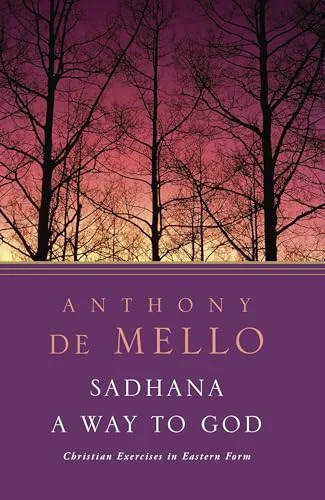
1978 · Prayer exercises
Sadhana: A Way to God
What it is: 47 exercises in contemplative prayer, from body awareness to stillness.
Best for: Anyone who wants practice rather than theory.
Details: First published in 1978 (Wikipedia, Goodreads, Encyclopedia.com). Christian exercises in Eastern form. The Image edition on Amazon is a paperback of roughly 144 pages according to Goodreads.
What it covers. Goodreads describes 47 exercises in contemplative prayer, covering awareness of bodily sensations, stillness, the healing of painful memories and awareness of self and the world. The exercises draw on Scripture and on teachers from both East and West.
Who it is for. Anyone who wants practice rather than theory. It suits Christians who find prayer dull or hard, and it also suits readers from other backgrounds who are comfortable with a Christian frame. It is a workbook, so it works best a little at a time.
Notable ideas. Starting with the body is the book’s quiet innovation. Before you pray or think about God, you land in your feet, your hands and your breath. Barnes reads this as Buddhist mindfulness serving Christian listening.
The Song of the Bird (1982)

1982 · Short stories
The Song of the Bird
What it is: Short stories from many traditions, each a small puzzle for the reader.
Best for: First-time readers who like stories more than instructions.
Details: First published in 1982 according to Wikipedia and Goodreads; Image edition. IgnatianSpirituality.com lists it with Sadhana and Wellsprings among his best-loved titles.
What it covers. A collection of short stories drawn from many traditions, each one a small puzzle for the reader.
Who it is for. First-time readers who like stories more than instructions, and people who enjoy reading aloud to a friend or a group.
Notable ideas. The pleasure is in letting a story sit. De Mello does not explain every tale away.
Wellsprings: A Book of Spiritual Exercises (1984)
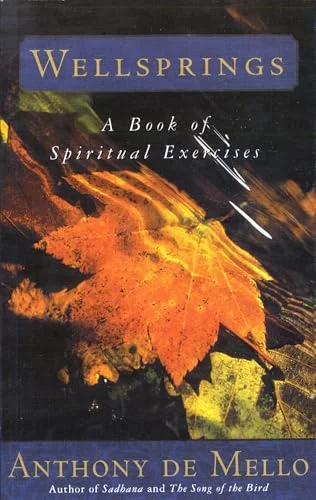
1984 · Spiritual exercises
Wellsprings: A Book of Spiritual Exercises
What it is: Exercises that move from thought to imagination and emotion.
Best for: Readers of Sadhana who want more structured practice.
Details: Wikipedia gives 1984. Penguin Random House lists the Image paperback at 240 pages with a publication date of 3 September 1986, so the first edition and the paperback differ by a couple of years.
What it covers. A set of spiritual exercises that, according to the publisher, move from the intellect to the body and from thought to imagination and emotion. The aim is to bring heart, mind, body and soul into balance.
Who it is for. People who liked Sadhana and want a second helping of structured practice. The publisher presents it as suitable for any age, faith or culture.
Notable ideas. Wellsprings leans on imagination. You are invited to picture, feel and rehearse as well as think. The emphasis on solitude is memorable, and the publisher quotes de Mello as saying that in solitude your self is given back to you.
One Minute Wisdom (1985)
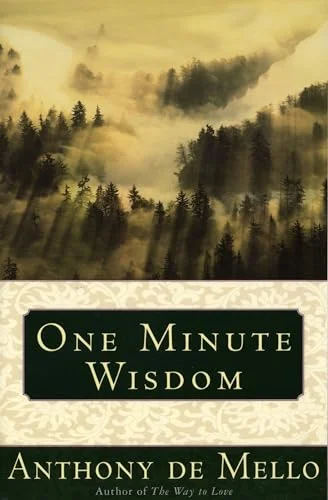
1985 · Parables
One Minute Wisdom
What it is: More than 200 short parables and lessons on living fully and simply.
Best for: Busy readers who want one small page a day.
Details: Wikipedia gives 1985. Penguin Random House lists the Image paperback (224 pages) as published 1 February 1988, and Goodreads shows 1988 for that edition.
What it covers. The publisher describes more than 200 short parables and lessons on living fully and simply, drawing on Gospel teaching and the mystical traditions of East and West. It is presented as useful for readers of any faith or none.
Who it is for. Busy readers, and anyone who wants one small page to read with morning coffee.
Notable ideas. The format is a Master and his disciples, with sayings that run about a minute. The brevity is part of the lesson: what you need to know often fits in a few lines, and what stops you is rarely a lack of information.
The Heart of the Enlightened (1987)

1987 · Story meditations
The Heart of the Enlightened
What it is: More than 200 story meditations from Buddhist, Hindu, Islamic and Christian traditions.
Best for: Readers who know the one-minute style and want longer tales.
Details: Wikipedia gives 1987 (Doubleday). Penguin Random House lists an Image paperback of 192 pages dated 3 October 1997. Wikipedia notes that this title and Taking Flight correspond to the two volumes of The Prayer of the Frog in Indian editions.
What it covers. The publisher presents it as a sequel to Taking Flight with more than 200 story meditations from Buddhist, Hindu, Islamic and Christian traditions, on relationships, human nature, service, spirituality and enlightenment. The caged bears that keep pacing appear here.
Who it is for. Readers who already know the one-minute style and want longer, more reflective tales.
Notable ideas. The publisher says the stories are meant to be read slowly. The unifying idea is freedom from self-imposed limits, such as the bars we keep respecting after they have gone.
Taking Flight (1988)
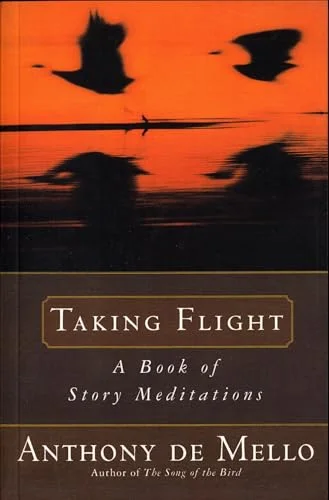
1988 · Short stories
Taking Flight
What it is: More than 250 short stories grouped by theme, from prayer to truth.
Best for: Readers who want more than One Minute Wisdom.
Details: Wikipedia gives 1988. Penguin Random House lists the Image paperback (192 pages) as 1 July 1990.
What it covers. More than 250 short stories grouped by themes including prayer, awareness, religion, grace, saints, self, love and truth, drawn from many countries and cultures. The publisher says each is built to dismantle mental barriers to self-knowledge.
Who it is for. A good bridge for readers who want more than One Minute Wisdom but are not ready for an essay-style book. The themed grouping makes it easy to dip in by topic.
Notable ideas. Because the stories are grouped, you can read all the awareness stories in a sitting and notice the variations.
Awareness (1990)
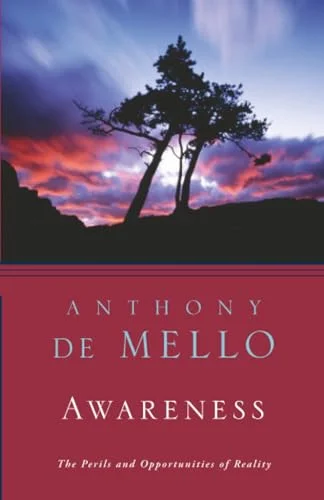
1990 · His central teaching
Awareness
What it is: Short chapters from his talks on waking up, illusion and attachment.
Best for: Almost everyone. The best first book.
Details: Published in 1990 (Wikipedia, Goodreads, Penguin Random House). Edited by J. Francis Stroud, S.J., from his talks, and published after his death. The Image paperback runs 192 pages per the publisher. Amazon’s catalog title for this edition sometimes shows a different subtitle, so match the ISBN 9780385249379.
What it covers. Short chapters drawn from de Mello’s talks, blending Christian, Buddhist and Hindu strands with psychological insight, according to the publisher. It argues that awareness is the key to spiritual life, and it keeps pulling attention back to the people around us.
Who it is for. Almost everyone. It is the best single place to hear his central argument about waking up, illusion and attachment, and it is the title most readers mean when they search for him.
Notable ideas. Because it comes from spoken talks, the book reads like a conversation, with provocations meant to be argued with. Some of his boldest statements about religion and belief appear in his later talks, so it deserves a patient reading alongside the critique in the Vatican section below.
Contact with God (1991)
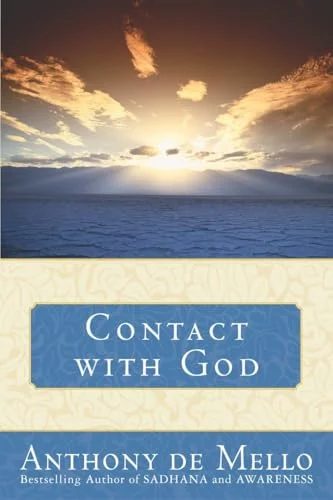
1991 · Retreat talks
Contact with God
What it is: Retreat talks with guidance on styles of prayer and on making a retreat.
Best for: Readers who want him in retreat-leader mode.
Details: Wikipedia gives 1991 (Loyola Press). Penguin Random House lists the Image reissue as 21 October 2003.
What it covers. The publisher describes transcripts of retreat talks, with guidance for getting the most out of a retreat, a look at different styles of prayer, and de Mello’s own anecdotes and parables.
Who it is for. Readers who want to see him in retreat-leader mode, and anyone planning a personal retreat at home. It is more explicitly Christian than Awareness.
Notable ideas. The strength of the book is its sense of a leader making space. He invites people into silence, names the traps that make prayer feel hollow and keeps returning to attention. It may be the best choice for a Christian reader who wants to start with his gentler side.
The Way to Love (1991 or 1992)

1991 or 1992 · Meditations on love
The Way to Love
What it is: Thirty-one meditations on love, built around his favorite stories.
Best for: Readers thinking about a marriage, a family tension or a friendship.
Details: Sources disagree on the first date. Goodreads gives 1991 and Wikipedia gives 1992. Penguin Random House lists a 2012 Image edition of 160 pages, an earlier 1995 paperback and an ebook. Goodreads uses the subtitle “The Last Meditations of Anthony de Mello”.
What it covers. Thirty-one meditations on love, built around his favorite stories. The publisher summarizes the argument: illusion blocks love, love begins with awareness of another person as they are, and the second step is seeing yourself without the distortion of your needs, desires, memories, prejudices and projections.
Who it is for. Readers thinking about a marriage, a family tension or a difficult friendship. The publisher says this kind of seeing can be painful, which is an honest note.
Notable ideas. This is the most relational of his books. It treats attention as the practical form of love: you cannot love who you have not looked at.
One Minute Nonsense (1992)

1992 · Paradox stories
One Minute Nonsense
What it is: Master-and-disciple stories that teach through paradox.
Best for: Readers who enjoy paradox and open endings.
Details: Published by Loyola University Press in 1992 (Wikipedia; Amazon lists it as A Campion Book).
What it covers. A sequel in spirit to One Minute Wisdom, with stories of a Master who teaches through paradox. Spirituality and Practice notes recurring themes of becoming a zero, accepting not-knowing, opposing ideologies and treating life as play.
Who it is for. Readers who enjoy paradox, and anyone who can tolerate a story that refuses to resolve. A good book for people who feel cornered by certainty.
Notable ideas. Play is the surprising center here. De Mello leans on the Hindu idea of leela, the play of God, and suggests that work becomes spiritual when it turns into play. It is an invitation to hold your own seriousness a little more loosely.
More One Minute Nonsense (1993)

1993 · Paradox stories
More One Minute Nonsense
What it is: A second volume of Master-and-disciple stories in the same mood.
Best for: Readers who finished One Minute Nonsense.
Details: Published by Loyola Press in 1993 (Wikipedia; Amazon lists it as A Campion Book).
What it covers. A second volume of Master-and-disciple stories in the same mood as the first.
Who it is for. Readers who finished One Minute Nonsense and wanted more. It has less to offer someone who has not read the first.
Notable ideas. The same ideas return with fresh jokes. If the first book made you laugh, this one rewards the same relaxed attitude.
Call to Love (1996)

1996 · Meditations, Indian edition
Call to Love
What it is: A volume of meditations from his Indian publisher.
Best for: Long-time readers who want the Indian editions.
Details: Wikipedia gives 1996 for the Gujarat Sahitya Prakash edition. Amazon lists it as Call to Love: Meditations.
What it covers. A volume of meditations published by his Indian publisher. Goodreads shows a Spanish edition of the same title subtitled with the words awareness, freedom and happiness.
Who it is for. Collectors and long-time readers who want the Indian editions. Read The Way to Love first.
Notable ideas. Treat this as a book for readers who already know his voice. I did not find a detailed publisher description to quote, so I am keeping the summary short.
Awakening: Conversations with the Masters (1998 or 2003)
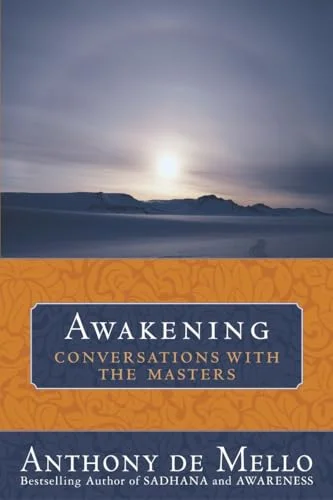
1998 or 2003 · Daily meditations
Awakening: Conversations with the Masters
What it is: 365 short meditations written as lessons from a master to a pupil.
Best for: People who want a daily reading practice.
Details: Goodreads shows a first publication of 1998. Wikipedia gives 2003 for the Image edition, and Penguin Random House dates that paperback to 21 October 2003, with an ebook in 2009.
What it covers. The publisher describes a reissued set of 365 meditations, one for each day of the year, written as lessons from a master to a pupil. The parables are short, sometimes puzzling and often funny, and they aim to prompt insight more than to teach facts. The publisher notes that de Mello’s books have sold over two million copies.
Who it is for. People who want a daily reading practice.
Notable ideas. One page a day for a year is a slow, steady way to build the habit of noticing.
Seek God Everywhere (2010)
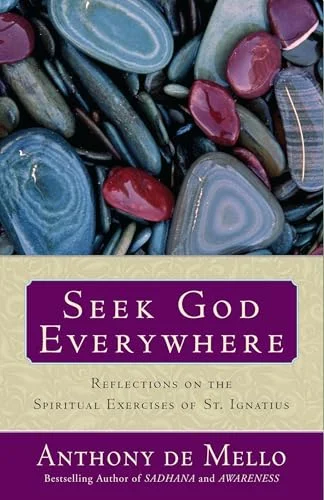
2010 · Ignatian retreat
Seek God Everywhere
What it is: A four-week retreat built on the Spiritual Exercises of Ignatius of Loyola.
Best for: Christians, and anyone curious about his Ignatian roots.
Details: Published 2 February 2010 by Image (Penguin Random House, 224 pages).
What it covers. According to Spirituality and Practice, it adapts a 1975 course de Mello taught on the Spiritual Exercises of Ignatius of Loyola, arranged in four parts for a four-week retreat: sin and repentance, the life of Jesus, the passion and death, and the resurrection. Themes include silence, adoration, spiritual maturity and finding God in all things.
Who it is for. Catholics and other Christians who want to make the Spiritual Exercises approachable, and anyone curious about the Ignatian roots of his thinking.
Notable ideas. This is the book that shows how much of de Mello was Jesuit. Seen through it, his later vocabulary of awareness looks like a creative extension of Ignatian attentiveness, which is a useful corrective to the idea that he left his tradition behind.
Rediscovering Life: Awaken to Reality (2012)
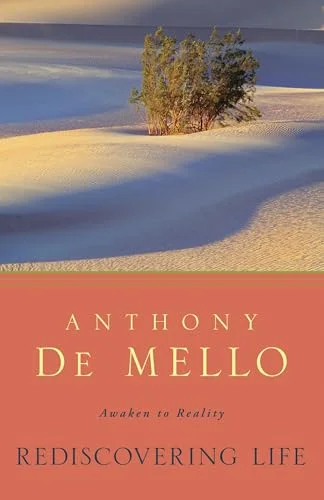
2012 · Late lecture
Rediscovering Life: Awaken to Reality
What it is: A short companion to Awareness, from a lecture he gave months before he died.
Best for: Readers who have finished Awareness.
Details: Goodreads gives 2012. Penguin Random House lists the Image paperback (128 pages) as 12 June 2012 and says it was released for the 25th anniversary of his death.
What it covers. Described by the publisher as a companion to Awareness, based on a lecture he gave months before he died and possibly his final published work. It looks at repetitive, habitual patterns in our thinking and offers a new way of seeing the world and God.
Who it is for. Readers who have finished Awareness, and anyone who prefers a short book they can finish in an evening.
Notable ideas. At 128 pages it is the quickest way to hear his late voice. It returns to the idea that a pattern becomes easier to loosen once you recognize it as a pattern.
Stop Fixing Yourself: Wake Up, All Is Well (2021)
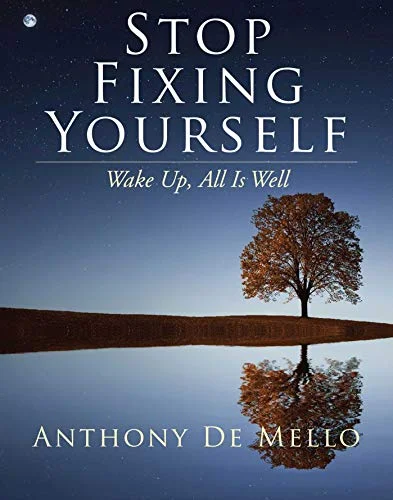
2021 · Posthumous compilation
Stop Fixing Yourself: Wake Up, All Is Well
What it is: A teaching that awakening needs watchful awareness, not years of struggle.
Best for: People worn out by self-improvement.
Details: Published 13 April 2021 by Beyond Words (216 pages) as part of The Anthony De Mello Legacy Library.
What it covers. The publisher describes a teaching that awakening does not require years of struggle. By cultivating watchful awareness, the reader lets go of false and neurotic patterns and notices the love, peace and beauty already present.
Who it is for. People who feel worn out by self-improvement and want a gentler frame. It is also an easy entry for readers who have not met him before.
Notable ideas. As a posthumous compilation, its title and arrangement come from editors, so approach it as a selection of his themes. The emphasis on ending the exhausting project of constant self-correction is a fair summary of his tone in many talks.
Walking on Water (2019)

2019 · Thematic collection
Walking on Water
What it is: Chapters on silence, peace, happiness, prayer and clarity.
Best for: Readers who like themed chapters over daily meditations.
Details: Listed by Crossroad Publishing with a publication date of 1 September 2019 and 176 pages. The full Amazon title is Walking on Water: Simple Certainties to Live By.
What it covers. A reflective collection with chapters on silence, peace, happiness, prayer, liberation and clarity, drawing on monks, rabbis, soldiers, fairy tales, legends, jokes and Zen sayings, according to the publisher’s description.
Who it is for. Readers who like thematic chapters over daily meditations.
Notable ideas. I could not confirm which original talks it draws on, so treat it as a curated selection.
Praying Body and Soul (1997)

1997 · Guided Christian prayer
Praying Body and Soul
What it is: Relaxation, body awareness and visualization for praying with scenes from the life of Jesus.
Best for: Christian readers who want to pray with imagination.
Details: Encyclopedia.com lists a 1997 publication (New York). Spirituality and Practice notes it was adapted and enlarged by Gabriel Galache from de Mello’s methods.
What it covers. A Christian contemplation guide using relaxation, bodily awareness and visualization to enter scenes from the life of Jesus, such as his birth, the wedding feast and the raising of Lazarus.
Who it is for. Christian readers who want to pray with imagination and the body.
Notable ideas. Since it was adapted by another author, it is best read as a guide to his methods, not as de Mello’s own words.
Anthony de Mello: Writings (1999)
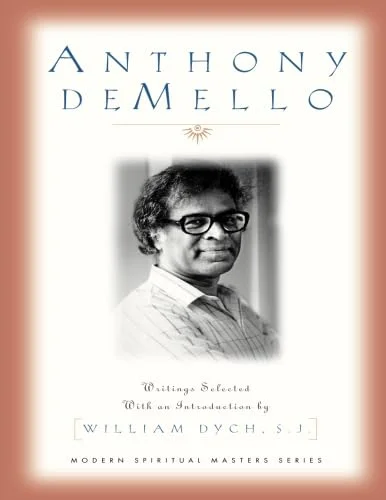
1999 · Anthology
Anthony de Mello: Writings
What it is: A selection of his work with an introduction, designed as an overview.
Best for: Readers who want one volume that surveys his thinking.
Details: Edited by William Dych, S.J., in the Modern Spiritual Masters series (Encyclopedia.com lists Maryknoll, 1999).
What it covers. A selection from his work with an introduction, designed as an overview.
Who it is for. Readers who want one volume that surveys his thinking before choosing individual titles, and students who need an anthology.
Notable ideas. Unlike the posthumous compilations, this one is arranged by an editor with an academic introduction, which makes it useful for seeing the whole range at once.
Where to Start: A Reading Order for Anthony de Mello Books
There is no single correct order, but the table below groups the books by what you are looking for. If you are not sure, start with Awareness and see whether the voice suits you.
| If you want… | Start with | Then read | Why |
|---|---|---|---|
| His main ideas | Awareness (1990) | Rediscovering Life (2012) | Spoken-style talks on waking up and attachment, then the late companion |
| Practices to do | Sadhana: A Way to God (1978) | Wellsprings (1984) | Structured exercises with the body and imagination |
| Stories first | One Minute Wisdom (1985) | Taking Flight (1988) | Short, easy, shareable |
| A daily reading | Awakening (365 meditations) | One Minute Nonsense (1992) | One page a day, with humor |
| Love and relationships | The Way to Love | Awareness | Treats attention as the practical form of love |
| A Christian retreat | Contact with God (1991) | Seek God Everywhere (2010) | Retreat talks and the Ignatian Exercises |
| Gentle encouragement | Stop Fixing Yourself (2021) | Walking on Water (2019) | A softer, edited voice for tired self-improvers |
| An overview | Anthony de Mello: Writings (1999) | Any of the above | An editor’s survey of the whole body of work |
One practical tip. Because several books overlap, buying all of them is unnecessary. A reasonable starter set is Awareness, Sadhana and One Minute Wisdom. Together they give you the ideas, the exercises and the stories.
If you are building a wider shelf, our list of top spiritual books places de Mello alongside other classics.
Other Titles and Where They Fit
A few more entries show up in Wikipedia’s list or in catalogs and are worth a brief note, because they explain some of the confusion in search results.
- The Prayer of the Frog, volumes 1 and 2. Wikipedia says these Indian editions correspond to the English Taking Flight and The Heart of the Enlightened. If you see them listed as separate books, they are the same material under another title.
- Wake Up! Spirituality for Today. Wikipedia describes this as about 90 minutes of talks before a live audience. It consists of recorded talks and stands apart from his standard books.
- Foreign-language collections. Many titles you see in Spanish, German, Italian and other languages are regional compilations of the same talks. They can be good, but they follow their own title and edition logic.
The 1998 Vatican Notification, Explained
No account of Anthony de Mello is complete without the 1998 Notification, and no account of it is useful unless it is accurate and calm. Here is what the document says, based on the text published on the Vatican website, followed by what happened around it.
What It Is
The document is titled a Notification concerning the writings of Father Anthony de Mello, S.J. It is dated 24 June 1998 and was issued by the Congregation for the Doctrine of the Faith, the Vatican office responsible for matters of doctrine. It is signed by Cardinal Joseph Ratzinger, the prefect (later Pope Benedict XVI), and Archbishop Tarcisio Bertone, the secretary. It states that Pope John Paul II approved it and ordered its publication. According to the National Catholic Register, it was released to the public in August 1998, eleven years after de Mello’s death.
It addresses his writings. De Mello had died more than a decade earlier.

What It Says in His Favor
The text opens by noting that his books have been widely translated and that not all of them were authorized by him. It then recognizes positive elements. It says his stories offer some valuable Eastern wisdom that can help with self-mastery, freedom from inner bonds and serenity in difficulty. It also says that his early writings stayed within Christian spirituality, covering prayer and contemplation of the life of Christ, and that he described himself as a disciple of Jesus.
What It Objects To
The central section lists doctrinal concerns, mostly in his later works. Paraphrased and grouped, the concerns are these:
- On God. The document says that later writings move away from the God revealed in Christ toward a formless intuition of God, sometimes a pure void, and that they appear to teach that nothing can be said about God or that asking whether God exists is nonsense. It says God is presented as a vague cosmic reality and not as a personal God.
- On Scripture. It says the Bible is treated as pointing toward silence and that sacred texts are said to dull common sense and foster cruelty.
- On Jesus. It objects to presenting Jesus as one master among others, distinguished mainly by being awake and free, and not as the Son of God.
- On religion. It says religions, Christianity included, are described as major obstacles to truth, and that belief in one’s own religion’s God as the only God is called fanaticism.
- On the afterlife and morality. It says the human end is described as dissolving into an impersonal God, that the question of life after death is treated as irrelevant, and that good and evil are described as mental judgments with no objective moral rules.
- On the Church. It objects to claims that belief or profession of faith blocks access to truth, and to accusations that the Church idolizes Scripture and has lost its authority to teach.
The conclusion declares that these positions are incompatible with the Catholic faith and can cause grave harm. The stated purpose is the protection of the faithful.
What Happened Next
The published text, as far as I can read it, is a declaration and does not itself list penalties. Reporting in the National Catholic Register adds the practical side. It says Cardinal Ratzinger wrote to bishops’ conferences asking them to enforce the notification, and that the Vatican asked that copies be withdrawn where possible or that the notification accompany any de Mello book sold. The Indian publisher Gujarat Sahitya Prakash, which holds the copyright to his official books, stopped selling them for a time after receiving the directive, and added a clarification to new editions. The publisher had already, in January 1997, required translators to add a page explaining that the books were written for people of other religions, agnostics and atheists, and were not Catholic doctrinal manuals.
Many editions carry a similar caution today. Wikipedia and Goodreads both note that some later editions include a statement that the books were not intended as manuals of Catholic doctrine.
The Wider Context
Barnes, in Thinking Faith, places the notification within a period in which the Vatican scrutinized several theologians in Asia and in which questions about religious pluralism were pressing. He links it to the later declaration Dominus Iesus (2001) and to the case of the Jesuit theologian Jacques Dupuis.
Wikipedia notes that the Indian magazine Outlook saw the move as an attempt by Rome to rein in Asian clergy at a time of growing tension with the Asian Church. Others, including Jesuit leaders quoted by the Register, accepted that the Vatican had reason to act. The next section sets those voices side by side.
Critics and Defenders: An Honest Look
De Mello divides readers more than most spiritual writers, and it is useful to hear each side in its own terms. What follows summarizes the main arguments, attributed to the people and sources that made them.
The Critics
The most formal critique is the Notification itself, summarized above. Its authors argue that de Mello’s later work departs from central Christian claims about a personal God, the divinity of Jesus, the authority of Scripture and the afterlife. Encyclopedia.com says the principal worry was indifferentism, the idea that all religious paths are equally valid for salvation. Catholic media outlets such as Women of Grace have published pieces under titles like “The Questionable Opinions of Anthony DeMello, S.J.”, quoting the Notification and warning readers.
A literary criticism also appears. Barnes remarks that de Mello’s later published collections were weaker than his spoken teaching. A talk shaped by laughter and silence can look flat or even harsh on the page, especially when an editor strings several provocative statements together.
There is also a question of attribution. De Mello’s Indian publisher said that titles beyond the nine official books were not written by him, and Fr. Lisbert d’Souza, president of the Jesuit Conferences of South Asia, told the Register that no complete list existed of the unauthorized books circulating in Spain and the Americas. A critic can therefore be responding to something he never wrote.
The Defenders
His defenders include fellow Jesuits. Barnes writes that friends and colleagues argued a retreat director and storyteller should not be judged by the standards of a systematic theologian, and he calls de Mello a “Catholic bodhisattva” who used skillful means to speak to individuals. Encyclopedia.com and the Jesuit sources report that friends and fellow Jesuits in India protested the notification, arguing it would hinder Christian dialogue with Eastern traditions. Encyclopedia.com also says many readers who had found their faith strengthened by his teaching received it poorly.
The Register quotes several Indian Jesuits with a more mixed view. Fr. Lisbert d’Souza said the Vatican was right to act because of possible misunderstandings, but also said that de Mello’s books were meant to help people of every belief, including atheists, find God, and that they were misread when taken out of context. Fr. Gispert Sauch, a Jesuit theologian in New Delhi, described the books as wisdom literature that teaches through stories and whose ironic, provocative style can scandalize readers who take it literally; he said the warning was justified. Fr. K. T. Mathew, manager of the publisher, said that withdrawing the books was difficult and that editing or explanatory notes would have been preferable.
A Fair Reading
Taken together, the record supports a few modest conclusions. The Church’s concerns are specific and are written down in the Notification, so any reader can check them against the books. His defenders argue from genre, audience and intention. The Notification itself says his early books stayed within Christian spirituality, so readers who want to judge his intentions can begin with those, Sadhana among them.
For a reader, that suggests a practical approach. If you are Catholic, you may want to read the Notification alongside his books and talk it over with a priest or spiritual director. If you come from another tradition, you can take the attention practices on their own merits and read the theological claims as one teacher’s view. Either way, check any quotation against a title you can name, because many quotes online come from unverified sources.
Legacy and Influence
More than three decades after his death, de Mello is still read, quoted and argued over. Penguin Random House notes that his books have sold over two million copies. Sadhana has been translated into dozens of languages, and book catalogs list a long tail of translations and compilations in Spanish, German, Italian, Slovak, Czech and other languages.
His influence runs in a few directions at once. Within the Jesuit world he is remembered as a popularizer of the full Ignatian retreat in India and as a bridge to Eastern practice. Within the wider world of spiritual writing, he is one of the people who brought mindfulness vocabulary into Christian settings before mindfulness became a household word. IgnatianSpirituality.com credits him with combining his psychotherapy training with Eastern and Western spiritualities, and wanting people to awaken to the reality around them.
Online, his talks circulate as recordings, with YouTube playlists and discussion threads on forums such as Reddit keeping the oral side of his work alive. In 2012, for the 25th anniversary of his death, his publisher released Rediscovering Life, and in 2021 the publisher Beyond Words launched Stop Fixing Yourself as part of an Anthony De Mello Legacy Library.
Many readers say the stories stay with them longer than the arguments. Someone who has heard the eagle story or the bears story has a small tool for noticing when they are repeating an old pattern.
If you want to follow the thread into present-day teaching, the guides on spiritual awakening and non-duality linked earlier in this article are good next steps.
De Mello Compared with Related Teachers
De Mello is easier to place when set beside other teachers who work on attention, the self and freedom. The table gives brief orientation. These are comparisons of emphasis, not rankings, and each teacher is rooted in a particular tradition.
| Teacher | Tradition and dates | Shared ground with de Mello | Where they differ |
|---|---|---|---|
| Ramana Maharshi | Hindu (Advaita), 1879 to 1950 | Looking at the sense of self closely, and the view that the mind’s habits hide what is already here | Ramana is known for one central method, self-inquiry, where de Mello offers many exercises and stories. De Mello wrote within a Christian frame. |
| Thich Nhat Hanh | Vietnamese Zen Buddhist monk, 1926 to 2022 | Attention to body and breath, and everyday mindfulness | His teaching sits inside a Buddhist ethical and community framework |
| Eckhart Tolle | Contemporary spiritual teacher, born 1948 | Watching the mind and living in the present moment | Tolle teaches outside any one institution and with a different vocabulary |
| Thomas Merton | Trappist monk and writer, 1915 to 1968 | A Christian contemplative who engaged with Eastern traditions | Merton is a monastic essayist; de Mello was a retreat leader and storyteller |
| J. Krishnamurti | Independent teacher, 1895 to 1986 | Observing the mind without judgment | Krishnamurti rejected organized religion and gurus; de Mello stayed a Jesuit priest |
| Ignatius of Loyola | Founder of the Jesuits, 1491 to 1556 | Imaginative prayer and honest self-examination in the Spiritual Exercises | Ignatius works within explicit Catholic doctrine; de Mello stretched the form |
Our Ramana Maharshi guide, linked earlier, is the closest NLS reading for the Hindu side of this conversation. I have not linked the other teachers because we do not yet have dedicated pages for them. The comparisons are mine, built from standard descriptions of each tradition, and they are meant as a starting point for reading and not as a claim of direct influence.
Common Misconceptions About Anthony de Mello
A few claims about him get repeated so often that they are worth checking.
- He left the priesthood. He remained a Jesuit priest until his death in 1987, according to all the biographical sources used for this guide.
- He was banned or excommunicated. The 1998 Notification concerns his writings, was issued after his death, and contains a declaration and no list of sanctions. He was not excommunicated.
- He taught people to stop caring about others. His writing on love treats seeing people clearly as the beginning of loving them. Detaching from the belief that you cannot be happy without something differs from detaching from the people you love.
- Every quote with his name on it is his. His own publisher said that books beyond the official nine were not by him, and internet quotes are often shortened or paraphrased. Look for a title and page.
- He was a Buddhist or Hindu teacher. He was a Catholic priest who borrowed freely from Buddhist, Hindu, Sufi and other traditions. How far he moved from Catholic doctrine is exactly what the Notification and his defenders debate.
- His exercises are therapy. They are reflective and spiritual practices. They do not replace medical or psychological care.
Go Deeper with NLS Mastery: Ancient Meditation for Inner Stillness
De Mello kept coming back to one thing: awareness. If you want to practice it, not just read about it, Acharya Shunya teaches Vedic meditation step by step in Ancient Meditation for Inner Stillness, part of NLS Mastery. Watch the course preview below.

Frequently Asked Questions
Who was Anthony de Mello?
Anthony de Mello (1931 to 1987) was an Indian Jesuit priest, counselor, retreat leader and writer. He was born in Bombay, founded the Sadhana Institute of Pastoral Counselling in Pune, and became known worldwide for books on awareness, attachment and spiritual practice.
What is Anthony de Mello best known for?
He is best known for Sadhana: A Way to God (1978), Awareness (1990) and his short story collections such as One Minute Wisdom. His central message is that people live asleep to their own habits and can wake up by observing themselves without judgment.
Which Anthony de Mello book should I read first?
Most readers start with Awareness for his main ideas, Sadhana for guided exercises, or One Minute Wisdom for short stories. Choose the format that matches how you like to learn.
What did the Vatican say about Anthony de Mello?
In a notification dated 24 June 1998, the Congregation for the Doctrine of the Faith said his writings contain valuable elements of Eastern wisdom but that some positions, mainly in later works, are incompatible with Catholic faith and can cause grave harm.
Was Anthony de Mello excommunicated or were his books banned?
No. He had died in 1987, and the notification concerned his writings, not his standing as a priest. Reporting at the time said the Vatican asked that copies be withdrawn where possible or sold with the notification, and many editions now carry a clarifying caution.
Was Anthony de Mello a Buddhist or a Hindu?
No. He was a Catholic Jesuit priest who drew freely on Buddhist, Hindu, Sufi and other traditions. How far his later work moved from Catholic teaching is the subject of the Vatican notification and of ongoing debate.
What is the Sadhana Institute?
It is the counseling and spirituality center he founded in Pune in 1972, first called the Institute of Pastoral Counselling and later renamed the Sadhana Institute of Pastoral Counselling. It trained priests, sisters and lay people.
How did Anthony de Mello die?
He died on 2 June 1987 in New York City of a heart attack, aged 55. He was there to give a course at Fordham University.
What does Anthony de Mello mean by waking up?
He means noticing the automatic thoughts, labels and attachments that drive daily reactions, and seeing them clearly enough to respond with more freedom and kindness. It is an everyday attention practice.
Are Anthony de Mello’s books only for Christians?
No. His publishers present many of them as useful to readers of any faith or none, and his stories come from many traditions. Some books, such as Contact with God and Seek God Everywhere, are more explicitly Christian.
How many books did Anthony de Mello write?
His Indian publisher said nine books were official, and many other titles were compiled after his death from talks and notes. Wikipedia lists around seventeen English titles, and some are the same material under different names.
Sources and Further Reading
- Anthony de Mello (Wikipedia)
- Notification Concerning the Writings of Fr. Anthony de Mello, SJ (Vatican, 24 June 1998)
- de Mello, Anthony (Encyclopedia.com)
- Anthony de Mello SJ by Michael Barnes (Thinking Faith, Jesuits in Britain)
- Anthony de Mello, SJ (1931-1987) (IgnatianSpirituality.com)
- Anthony de Mello (Irish Jesuits)
- Anthony de Mello, author page (Penguin Random House)