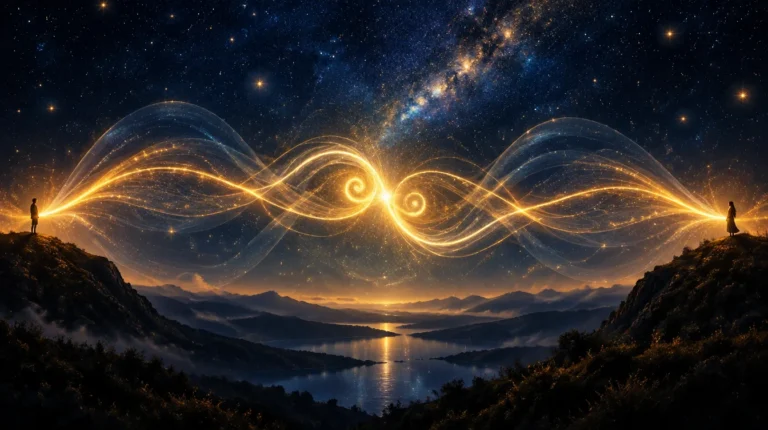
A twin flame is said to be the other half of your soul: one soul that divided into two bodies, then walked separate roads through many lifetimes so that each half could grow, forget, and finally remember. People who believe they have met one describe instant recognition, a pull that rearranges their whole life, and a mirror held up to everything still unhealed inside them.
It is one of the most searched ideas in modern spirituality, and one of the most misunderstood. Some people use it to make sense of a love that changed them forever. Others have used it to stay in relationships that hurt. This guide gives you the full picture: what a twin flame is, where the idea comes from, the signs and stages people describe, how a twin flame differs from a soulmate, what separation and reunion mean, and how to hold this teaching with an open heart and clear eyes.
Along the way you will meet real conversations from the Next Level Soul Podcast, from Matt Kahn on the soulmate we each meet within, to Scarlett L. Heinbuch on a love she says began beyond this world, to Nicky Alan on losing her soulmate and finding a way through.
Key Takeaways
- A twin flame is described as a mirror soul, one soul split into two bodies. The bond is said to be intense, transformative and aimed at awakening, not just romance.
- The term was coined by novelist Marie Corelli in 1886 and popularized by spiritual teacher Elizabeth Clare Prophet. The longing behind it goes back to Plato’s Symposium.
- A soulmate is a deep, harmonious bond between two whole souls. A twin flame is said to be a more intense mirror that triggers deep healing. You can read the full comparison in our guide to twin flame vs soulmate.
- People describe recognition, synchronicity, mirroring, emotional intensity and a sense of mission together. See the detailed list in twin flame signs.
- Popular teaching describes stages: recognition, intensity, challenge, separation, inner healing and, for some, reunion or a quiet transformation of the bond.
- Intensity is not proof. Love bombing, control and fear are red flags in any relationship, whatever label it carries. Your safety and wellbeing come first.
- Many teachers, including Matt Kahn, point to a deeper truth: the real union is within. You can become whole whether or not a twin flame ever appears.
What Is a Twin Flame?
A twin flame is a person said to share your soul’s origin. In twin flame teaching, a single soul divides into two bodies at the beginning of its journey. Each half incarnates again and again, living separate lives and learning separate lessons, until the two meet in a lifetime when both are ready to grow together. Because the two halves are said to share one source, the meeting feels less like meeting a stranger and more like remembering yourself in another person.
The common word for this is mirror. A twin flame mirrors your light and your shadow at once. Where a gentle soulmate may bring comfort and ease, a twin flame is said to bring a fire: attraction, recognition, and also the exact wounds, fears and patterns you came here to heal. Many teachers describe the purpose as spiritual rather than romantic. The relationship is a catalyst for awakening, and its deepest gift is who you become because of it.
Twin flame is a metaphysical teaching, and like every teaching it is best held as a lens rather than a rule. Its real value shows up in how it asks you to love, heal and grow.
Twin Flame, Twin Soul and Mirror Soul
You will see several names for the same idea. Twin soul is the older phrase and is used interchangeably with twin flame. Mirror soul stresses the reflective quality of the bond. Counterpart and other half speak to the sense of completion. Some modern teachers also use the phrase divine counterpart to describe a partner who mirrors your path in a spiritual partnership. The vocabulary shifts from teacher to teacher, but the core picture stays the same: two souls, one source, a shared mission of awakening.
Why a Flame?
The image of a flame carries the meaning. A flame is alive, it gives light and warmth, and it burns away what no longer serves. Two flames that meet do not become smaller. They burn brighter, and they also burn through illusion. This is why twin flame stories so often include periods of upheaval. The fire that illuminates also clears. If you want to explore how a spiritual fire is understood in other traditions, our guides to the white flame of Serapis Bey and the violet flame of Saint Germain show how the symbol of flame runs through the ascended master teachings.
Where the Twin Flame Idea Comes From
The longing for a lost half of the soul is ancient. The words twin flame are more recent. Understanding the history helps you see which parts of the teaching are timeless and which were shaped by the last two centuries.
| When | Source | What it contributed |
|---|---|---|
| c. 385 to 370 BCE | Plato, Symposium | The playwright Aristophanes tells a story of humans who were once double beings, split in two by the gods and forever searching for their other half. |
| Jewish mystical tradition | Zivug and bashert | Souls are described as divided into masculine and feminine aspects before birth and reunited in marriage. Bashert is the Yiddish word for a destined partner. |
| Hindu tradition | Ardhanarishvara | A form of the divine shown as Shiva and Shakti joined in one body, half and half, the union of masculine and feminine energy in one being. |
| 1886 | Marie Corelli, A Romance of Two Worlds | The English novelist is credited with coining the phrase “twin flame,” used interchangeably with “twin soul.” |
| 1880s onward | Theosophy and later ascended master teachings | Reincarnating souls, spiritual evolution and divine complements enter popular spiritual thought. |
| From the 1970s | Elizabeth Clare Prophet | The American spiritual teacher and author popularized the term, including through her book Soul Mates and Twin Flames. |
| 2000s to today | Online spiritual communities | The idea spreads worldwide, with stages, signs and reunion stories shared by thousands of people. |
Notice what is old and what is new. The longing is old: nearly every culture has a story of two halves seeking each other. The specific label is Victorian, and the detailed map of stages and signs is largely a product of the internet age. That does not make the experience less real to the people living it. It does mean you should be wary of anyone who claims there is one official rulebook. For a wider view of soul bonds across traditions, see our guide to soulmates, twin flames and soul groups.
Plato and the Split Souls
In the Symposium, Aristophanes tells a story about the first human beings. They were round, with four arms, four legs and two faces. They grew proud, so the gods split each one in half. Ever since, each half has roamed the earth looking for the other. It is one character’s speech at a dinner party, not Plato’s last word. Later in the same dialogue, Socrates shares a teaching he attributes to the priestess Diotima, in which love is not about finding a missing half but about climbing toward beauty, goodness and truth itself. Both ideas echo through twin flame teaching today: the sense of completion, and the sense that love is a path of ascent.
Marie Corelli and Elizabeth Clare Prophet
The phrase twin flame is credited to the English novelist Marie Corelli, who used it in her 1886 novel A Romance of Two Worlds. Her books explored reincarnation, astral projection and mysticism, and they were bestsellers in their day. About a century later, Elizabeth Clare Prophet, founder of the Church Universal and Triumphant, brought the term to a wide audience through her teachings on ascended masters, soul mates and twin flames. Much of what spiritual seekers now call twin flame lore grows from that lineage.
Twin Flame vs Soulmate: The Short Version
These two words are often used as if they were the same. In most teachings they are not. A soulmate is a soul you share deep harmony with. A twin flame is said to be a soul you share an origin with. The first tends to feel like coming home. The second is described as feeling like a mirror and a furnace at the same time.
| Soulmate | Twin flame | |
|---|---|---|
| Origin | A separate soul with deep affinity for you | The other half of your soul, or a soul of the same source |
| Feels like | Ease, comfort, recognition, a sense of home | Intensity, magnetism, recognition, being seen all the way through |
| Purpose | Support, joy, shared growth, companionship | Awakening, deep healing, spiritual mission |
| Challenge level | Normal relationship challenges, handled with care | Said to trigger deep wounds and shadow patterns |
| How many | Teachers often say you can have several | Usually described as one |
| Needs to be romantic? | No. Friends, family and mentors can be soulmates | Usually described as romantic, though some teachers say not always |
The most important thing to take from this table is that intensity is not a measure of rightness. A soulmate bond can be profound and peaceful. A twin flame bond, in the teaching, is deliberately stormy because its aim is transformation. Neither is better. Both ask you to show up with honesty. For a full side-by-side guide with more detail, read Twin Flame vs Soulmate: The Real Differences. If you are interested in the wider family of soul connections, including soulmates, karmic partners and soul groups, see our guide to soulmate connections.
Signs of a Twin Flame Connection
People who believe they have met a twin flame describe a recognizable cluster of experiences. None of them is proof on its own. Together they paint a picture that many find helpful. Here are the signs mentioned most often, in short form. Our full guide, Twin Flame Signs: How to Know, goes deeper into each.
- Instant recognition. A feeling of “I know you” on first meeting, even though you have never met.
- Mirroring. They seem to reflect your strengths and your wounds, sometimes in uncomfortable detail.
- Synchronicity. Repeating numbers, shared dreams, well-timed messages and meaningful coincidences gather around the connection. Carl Jung called meaningful coincidence synchronicity.
- Emotional intensity. Deep joy and deep pain can arrive on the same day.
- Telepathic moments. Thinking of each other at the same time, finishing sentences, feeling each other’s mood from a distance.
- A push to heal. Old patterns surface fast. Many people say they began therapy, shadow work or a spiritual practice because of the connection.
- A sense of shared purpose. A feeling that the two of you are meant for something beyond the relationship itself.
- Cycles of closeness and distance. Periods of union followed by periods of separation, often tied to inner work.
Healthy love also contains many of these experiences, which is why the second half of this guide spends time on discernment. A real sign of a twin flame bond, in the best teachings, is that you grow more honest, more loving and more yourself over time.
The Stages of a Twin Flame Journey
Popular twin flame writing outlines a series of phases. The names and numbers differ from teacher to teacher, but the arc is remarkably consistent. It begins with an intense recognition and attraction, moves into emotional turbulence and challenge that is read as an invitation to heal, and ends, in the teaching, when each person has done enough inner work for the bond to settle into a steady, mature form. Here is a simple seven-stage map you can use as a guide.
| Stage | What it is described as | What it asks of you |
|---|---|---|
| 1. Longing | A quiet sense that something or someone is missing. Often a time of spiritual searching. | Curiosity and self-honesty |
| 2. Recognition | The meeting. Instant familiarity, magnetic pull, synchronicity. | Presence. Do not rush to decide what it means. |
| 3. Honeymoon | Joy, closeness, the feeling of being completely seen. | Gratitude, and keeping your own life alive |
| 4. Crisis | The mirror turns. Old wounds, fears and patterns surface for both people. | Courage to look at your own part |
| 5. Separation | Distance, silence or ending. Often called the great test. | Self-care, healing, trust, no forcing |
| 6. Surrender and inner work | The focus turns inward. You become the person you hoped to find. | Honesty, boundaries, shadow work, forgiveness |
| 7. Union or integration | Reunion in some stories, a quiet transformation of the bond in others. | Love without grasping |
Our dedicated article on the twin flame stages and phases goes into each step. For now, keep in mind two truths. First, you do not need to pass through every stage in order. Second, a stage that lasts for years is not a failure. Healing has its own clock.
The Runner and the Chaser
One pattern comes up so often in twin flame communities that it has its own names. During the crisis and separation stages, one person is said to pull away, the “runner,” while the other reaches toward them, the “chaser.” In this teaching the runner pulls away because the intensity of the mirror feels overwhelming, and the chaser reaches because they feel the bond more consciously. The roles are said to switch over time.
It is a useful picture when you hold it lightly, because it reminds us that fear of intimacy and the urge to rescue are two sides of the same coin. It becomes harmful when it is used to excuse chasing someone who has said no, or to justify staying in a relationship that is unkind. Real love honors a clear no. If someone has asked for distance, giving it is the loving act, and the twin flame teaching itself points you toward inner work as the way forward.
Twin Flame Separation and Reunion
Separation is the stage people ask about most, because it is the one that hurts. In twin flame teaching, separation is not punishment and it is not the end. It is described as a necessary season in which each person returns to themselves. The mirror was so bright that neither could see clearly, so the bond steps back to give each person room to heal.
Why Separation Happens
Teachers give several reasons. The mirror may show wounds a person is not yet ready to face. One or both may be living in old patterns of fear, control or avoidance. Life circumstances, timing or other commitments may pull them apart. And in some views the soul itself arranges the distance, because lasting union requires two whole people rather than two people leaning on each other to feel complete. Notice that none of these reasons asks you to wait helplessly. Each points to something you can do with the time: tend your body, your boundaries, your friendships, your spiritual practice and your shadow.
What Reunion Means
Reunion is the most romanticized part of the story, and also the least predictable. For some people it means coming back together as partners. For others it means a reconciliation of the heart without a return to romance: peace, forgiveness, and a bond that continues in a new form. Many teachers say the real reunion is the moment you no longer need the other person to feel whole. Paradoxically, that is often when the bond softens and love can flow without fear.
Whatever shape reunion takes, it is not a prize you earn by suffering, and it is not guaranteed. Our article on twin flame signs and our guides to twin flame separation and twin flame reunion explore this in depth. If you are in the middle of it right now, the practices later in this guide are for you.
Twin Flame Telepathy and Synchronicity
Many people describe an uncanny sense of knowing what their twin flame is feeling, thinking of them at the very moment a message arrives, or dreaming the same dream. They also describe synchronicity: repeating number sequences, songs at just the right moment, chance meetings that arrive when they are needed. Carl Jung coined the word synchronicity for meaningful coincidences that seem to carry a message from beyond ordinary cause and effect. In the metaphysical view, two souls with one source stay connected across distance, so it is natural that their fields would speak to each other.
A word of balance. Matt Kahn, whose conversation on the Next Level Soul Podcast is featured below, describes a trap he calls spiritual critical thinking. In his words, the mind can piece together a series of “signs” that feels like guidance but is really a self-fulfilling story. His distinction is worth keeping close: a true sign is so obvious that your mind goes blank, while a constructed sign takes effort to assemble. Treat synchronicity as an invitation to pay attention, not as an order to act. For more on repeating numbers, see our guide to angel numbers.
The Mirror, the Shadow and the Inner Union
Strip away the stages and the signs and a single idea remains at the heart of twin flame teaching: the other person is a mirror. A mirror shows you what you cannot see directly. When a relationship reflects your longing, you feel love. When it reflects your fear, you feel pain. In both cases the mirror is giving you information about your own inner world.
Depth psychology has a parallel. Carl Jung described the anima and animus, the inner feminine and masculine aspects of the psyche, and he taught that we tend to project them onto the people we love. Projection is the mental process of attributing our own inner qualities, feelings or fears to someone else. Whatever your view of twin flames, the practical gift of the mirror idea is the same: when you feel an intense reaction to someone, there is something in you that wants your attention. That is the beginning of shadow work.
Divine Masculine and Divine Feminine
Many twin flame teachers speak of balancing the divine masculine and the divine feminine. This is not about gender. Every person holds both energies. The divine masculine is often described as the principle of direction, structure and action. The divine feminine is described as the principle of receptivity, intuition and flow. The Hindu image of Ardhanarishvara, the form of the divine that is half Shiva and half Shakti, is one of the oldest pictures of this balance in a single being. When the two energies are in harmony inside you, you no longer look to another person to complete you. You meet them as an equal.
On the Next Level Soul Podcast, Jon and Missy Butcher talk about balancing the divine masculine and divine feminine in their own lives and relationship, and about clearing away other people’s opinions so you can hear your soul’s song.
One Soul in Two Bodies, or Two Whole Souls?
Teachers disagree about what “split soul” really means, and the disagreement is worth knowing. There are three common views.
| View | What it says | What it means for you |
|---|---|---|
| Literal split | One soul divided into two at the start of its journey. Your twin flame is your other half. | You may feel a unique pull toward one person. |
| Same source, two whole souls | Two complete souls that came from the same divine source and share a deep resonance. Neither is incomplete without the other. | You are whole already. The bond is a gift, not a need. |
| The mirror within | The twin flame is a way of describing the divine counterpart inside you. The outer relationship points to the inner union. | The deepest love story is your own reunion with your higher self. |
You do not have to choose one. Many people move through all three as they grow. In the beginning, the first view is the most intoxicating. Later, the second brings relief, because it removes the pressure to hold on to someone to feel complete. In the end, many people arrive at the third, which sounds a great deal like the words of Matt Kahn: the real one both of us met was within ourselves.
Red Flags: When Twin Flame Language Hides Harm
This section matters. The label “twin flame” has been used to excuse behavior that would be unacceptable in any relationship. Please read it slowly.
- Love bombing. Love bombing is an attempt to influence a person through overwhelming displays of attention and affection. Early intensity can be genuine, but if it is followed by control, criticism or withdrawal, name it for what it is.
- Trauma bonding. A traumatic bond is a strong emotional attachment that forms between a person and someone who harms them, driven by cycles of reward and punishment. It can feel exactly like a twin flame connection, which is why discernment is so important.
- Control and isolation. A bond that cuts you off from friends, family, your work or your sense of self is not sacred. Love expands your life.
- “We are meant to be, so you owe me.” Destiny never cancels consent. No spiritual belief gives anyone permission to pursue, pressure or contact a person who has said no.
- Paid certainty. Be careful with anyone who charges money to confirm that a specific person is your twin flame or to promise a reunion. Some organizations built around twin flame teachings have been described as cults by former members, and a Netflix documentary series, Escaping Twin Flames, explored one of them.
If a relationship feels frightening, if you are being hurt, threatened or controlled, please reach out to someone who can help. In the United States, the National Domestic Violence Hotline offers free, confidential support at 1-800-799-7233 and online at thehotline.org. A licensed therapist can also help you sort out a bond that feels both magnetic and painful. This guide is not medical or psychological advice. If the intensity of a connection is bringing you anxiety, sleeplessness, obsessive thoughts or low mood, a doctor or mental health professional can support you, and doing so is a sign of strength.
Do You Need a Twin Flame to Be Complete?
No. The twin flame story can be beautiful, but it can also create a quiet pressure: the idea that without this one person, you are not whole. The deepest teachings say the opposite. You arrive whole. A relationship, even a miraculous one, is something you add to your wholeness, not something that creates it.
Matt Kahn says it plainly in his conversation with Alex. He describes searching for his beloved since he was about 14, then letting go of the fantasy of her and focusing on becoming the person he was meant to be. By the time he met his wife, he says, he had already stepped into being the soulmate, whether or not she ever showed up. His advice: if you are not sure, that is your answer for now. “I don’t know” means no, and only a clear yes deserves your leaning in. He also says that when the soul connects, it does not lean in unless it is a yes on every level, while the ego leans in as if it were a yes and hopes for the best.
You can hold the twin flame idea and keep your freedom. Stay open. Stay whole. Let love arrive as an addition to a life you already love.
Twin Flames, Past Lives and Soul Groups
Twin flame teaching sits inside a larger map of the soul’s journey. If souls reincarnate, then your closest bonds may stretch across many lifetimes. Teachers describe several kinds of connection: the soulmate, the karmic partner who arrives to complete unfinished lessons, the teacher soul who delivers one pivotal lesson and the soul group, a circle of souls who tend to incarnate together. In this view, a twin flame is one very particular thread in a much larger weave.
Our guide to reincarnation traces how different traditions understand the return of the soul, and understanding karma explains how unfinished lessons shape the relationships we meet. Both help explain why some bonds feel instantly familiar and others feel like a lesson in disguise.
On the podcast, Wendy Rose Williams describes what she says happened during a near-death experience in surgery: she met a group of beings who hugged her with unconditional love, and she was shown her past lives. Her account places connection at the center of the soul’s story, which is a theme that runs through all of the best twin flame teaching. The love is the point.
Twin Flames and Spiritual Awakening
Many people say their twin flame experience coincided with a larger spiritual awakening. Old beliefs fall away, intuition sharpens, sleep and energy shift, and life asks for a new direction. Some also describe sensations they associate with kundalini energy, such as heat, tingling or waves of emotion. These experiences deserve respect and care. If you are experiencing physical symptoms that worry you, such as chest pain, dizziness, panic or trouble sleeping, please see a doctor first. A medical check-up is a wise step on any spiritual path.
How to Work With a Twin Flame Connection
Whether your twin flame is beside you, far away or only an idea, the work is the same. These practices help you meet the connection from a place of strength.
1. Ground the Body
Intense bonds can leave you floating, anxious or ungrounded. Walk barefoot on the earth, eat warm food, drink water and sleep. Our guide to earthing and grounding offers simple ways to come back into your body.
2. Meditate on the Heart
A simple twin flame heart meditation:
- Sit comfortably and breathe slowly for a minute or two.
- Place a hand on your heart. Imagine a small flame of gold light there.
- With each exhale, let the flame grow until it fills your chest, then your whole body.
- Silently say: “I am whole. I send love to every part of me. I release what is not mine to carry.”
- If a person comes to mind, send them a quiet blessing and then return your attention to your own flame.
- Close by thanking your heart and your higher self.
The heart chakra is the traditional seat of love and compassion, and many people find it the natural place to start.
3. Journal the Mirror
Take ten minutes with these prompts:
- What do I admire most in this person? Where do I carry that quality in myself?
- What triggers me most? What old story does it echo?
- What am I afraid will happen if I stop reaching for them?
- What would it feel like to be whole today, with or without them?
- What is one loving, practical step I can take for myself this week?
4. Set Boundaries and Release Control
Boundaries are an act of love. Decide what contact is healthy, what you will and will not do, and what you will let go. If you notice yourself checking, chasing or bargaining, pause and return to the body. You cannot force a timeline. You can become someone who is steady in love no matter what comes.
5. Seek Support
Talk to a trusted friend, a spiritual mentor, a counselor or therapist. A good guide will help you hold the beauty of the experience and the realities of your life together. Our guide to communicating with your spirit guides offers another way to ask for inner direction.
When the Connection Ends or Is Lost
Not every soul bond is meant to last a lifetime in physical form. Some end in separation, and some end in death. Grief for a soulmate or twin flame can feel like losing part of yourself. On the Next Level Soul Podcast, psychic medium Nicky Alan shares her story of losing her soulmate. She says loss is the biggest, most profound silence you will ever face, and that she went through catastrophic loss in 2012 after a road accident. She says a council in spirit told her to get it out on paper, to write letters and to talk to her loved one, and that she recorded video diaries whose replays show how far she has come. Her path is a reminder that tenderness, expression and time are healing tools.
If your grief feels too heavy to carry alone, please reach out to a doctor, counselor or grief support group. Sharing the weight is not a failure of faith. It is wisdom.
Love That Crosses Worlds
Another voice worth hearing is Scarlett L. Heinbuch, author of We Met on the Other Side: A True Love Story. On the Next Level Soul Podcast she tells of a first near-death experience at age four and of an out-of-body moment during a healing session, when she took a man’s hand to say a prayer. She says he later told her he was going to marry her, and that their meeting felt like recognition, not chance. Her story is one reason many listeners come to this subject: the sense that some love is older than this lifetime.
Watch: Real Conversations on Soul Love and Soul Origins
These conversations from the Next Level Soul Podcast and Divine Encounters touch the ideas behind the twin flame story: soul groups, soul contracts and a love that reaches past this life.
Scarlett Heinbuch: A Love She Calls Forever
Scarlett Heinbuch shares what she says she experienced in a shared death experience, including a heavenly embrace and a love she calls forever. Watch the full episode and read the show notes.

Phillip Mountrose: Remembering Your Soul Contract
Author Phillip Mountrose talks about how guidance from the soul or higher self is often very simple, and how to tell what you are called to do. Watch the full episode and read the show notes.

Dr. Linda Backman: Soul Groups and Where Souls Come From
Psychologist and regressionist Dr. Linda Backman shares what she has learned about soul groups, free will and where our souls come from. Watch the full episode and read the show notes.

Panache Desai: The Wholeness Already Within
Panache Desai explores self-acceptance, inner freedom and the wholeness he says already exists within each of us. Watch the full episode and read the show notes.

Watch More on Next Level Soul TV
Next Level Soul TV has films on conscious love and the bonds between souls, including Conscious Love Stories and We Met on the Other Side. It brings together full episodes, courses, films, series and audiobooks, ad-free. Join Next Level Soul TV and keep exploring.
Books on Twin Flames and Soul Bonds
If you would like to read more, these books explore twin flames, soul mates and the life of the soul. They are starting points, and each author speaks from their own tradition.
- Soul Mates and Twin Flames by Elizabeth Clare Prophet. A look at twin flames and soul mates from the Ascended Master teachings tradition.
- Twin Souls: A Guide to Finding Your Spiritual Mate by Patricia Joudry and Maurie Pressman. A guide to the idea of twin souls and spiritual mates.
- Journey of Souls by Michael Newton. Case studies of life between lives, including soul groups and soul companions.
- Soul Mates: Honoring the Mysteries of Love and Relationship by Thomas Moore. A depth psychology view of intimacy and the soul in love, useful for any kind of deep bond.
As an Amazon Associate, Next Level Soul earns from qualifying purchases.
Go Deeper with Next Level Soul
- Twin Flame Stages and Phases: The Full Journey
- Twin Flame Separation: Why It Happens and How to Heal
- Twin Flame Reunion: Signs It Is Coming
- Twin Flame vs Soulmate: The Real Differences
- Twin Flame Signs: How to Know
- Soulmates, Twin Flames and Soul Groups
- Soulmate Connections: Signs, Types and Healthy Love
- Soulmate, Soul Group and Soul Contract in the glossary
- Spiritual Awakening Signs: 15 Signs You Are Awakening
- The full spiritual glossary
- Twin Flame in the Next Level Soul Glossary
Sources and Further Reading
- Twin flame (Wikipedia)
- Soulmate (Wikipedia)
- Symposium (Plato) (Wikipedia)
- Marie Corelli (Wikipedia)
- A Romance of Two Worlds (Wikipedia)
- Elizabeth Clare Prophet (Wikipedia)
- Ardhanarishvara (Wikipedia)
- Anima and animus (Wikipedia)
- Love bombing (Wikipedia)
- Traumatic bonding (Wikipedia)
- The National Domestic Violence Hotline
Spirituality for the Rest of Us™
Films, teachings and community on Next Level Soul TV.
Frequently Asked Questions
What is a twin flame?
A twin flame is described as the other half of your soul, or a mirror soul from the same source. The bond is said to be intense and transformative, with the aim of spiritual awakening and deep healing.
What is the difference between a twin flame and a soulmate?
A soulmate is a deep, harmonious connection between two souls, and you may have several. A twin flame is said to share your soul’s origin and to act as a mirror that triggers deep growth. See Twin Flame vs Soulmate for the full comparison.
How do you know if you have met your twin flame?
People describe instant recognition, strong mirroring, synchronicity, emotional intensity, telepathic moments and a push to heal. No sign is proof on its own. The best test is whether the bond helps you grow more honest, loving and whole. See Twin Flame Signs.
Where does the term twin flame come from?
The phrase is credited to English novelist Marie Corelli, who used it in her 1886 novel A Romance of Two Worlds. Elizabeth Clare Prophet later popularized it, and the longing behind it goes back to Plato’s Symposium.
Is a twin flame the same as a twin soul?
Yes. Twin soul is the older phrase and is used interchangeably with twin flame. Mirror soul and divine counterpart are related names for the same idea.
What are the stages of a twin flame relationship?
Teachers describe stages such as longing, recognition, a honeymoon, crisis, separation, inner work and, for some, reunion or integration. The order and number differ between teachers, and you may not experience every stage.
Why do twin flames separate?
The teaching says the mirror can be so intense that each person needs space to heal. Separation is read as a season of inner work, not a punishment. Life circumstances and fear of intimacy can also play a part.
What is the runner and chaser dynamic?
In twin flame communities, one person is said to pull away (the runner) while the other reaches toward them (the chaser). The roles can switch. Respecting a clear no matters more than any label.
Can you have more than one twin flame?
Most teachers say you have one twin flame, though some describe a larger family of related souls, called a soul group. Others teach that the idea of “the one” is less important than the quality of love you are able to give and receive.
Do I need a twin flame to be complete?
No. You arrive whole. A relationship adds to your wholeness; it does not create it. Many teachers, including Matt Kahn, say the real union is the one you meet within.
Is a twin flame always romantic?
Usually it is described as romantic, though some teachers say the bond can take other forms, such as a deep spiritual partnership or friendship. The core purpose is described as awakening, not romance alone.
Can a twin flame relationship be unhealthy?
Yes. Intensity can hide love bombing, trauma bonding, control or isolation. If you feel afraid, controlled or hurt, reach out to a trusted person, a therapist or, in the United States, the National Domestic Violence Hotline at 1-800-799-7233.
Does a twin flame reunion always happen?
Reunion is not guaranteed. For some it is a return to partnership, and for others it is peace, forgiveness and a bond that continues in a new form. Many teachers say the true reunion is when you no longer need the other person to feel whole.
Where can I learn more about love, soul bonds and conscious relationships?
Start with our guides to soulmate connections and soulmates, twin flames and soul groups. For a guided path, explore Anjie Hipple’s The Divine Law of Love on NLS Mastery.
Go Further: The Divine Law of Love
If this guide stirred your heart, Anjie Hipple teaches a guided path through the questions at the center of every soul bond, in her Next Level Soul Mastery course The Divine Law of Love. Across eight lessons she explores love versus fear, the difference between falling in love and real love, the childhood imprints that shape our beliefs about love, and how to step out of the “fear triangle” that fuels conflict in relationships.
Not ready for the full course? Watch Anjie Hipple’s free masterclass, or explore all free masterclasses and the full library of NLS Mastery courses.