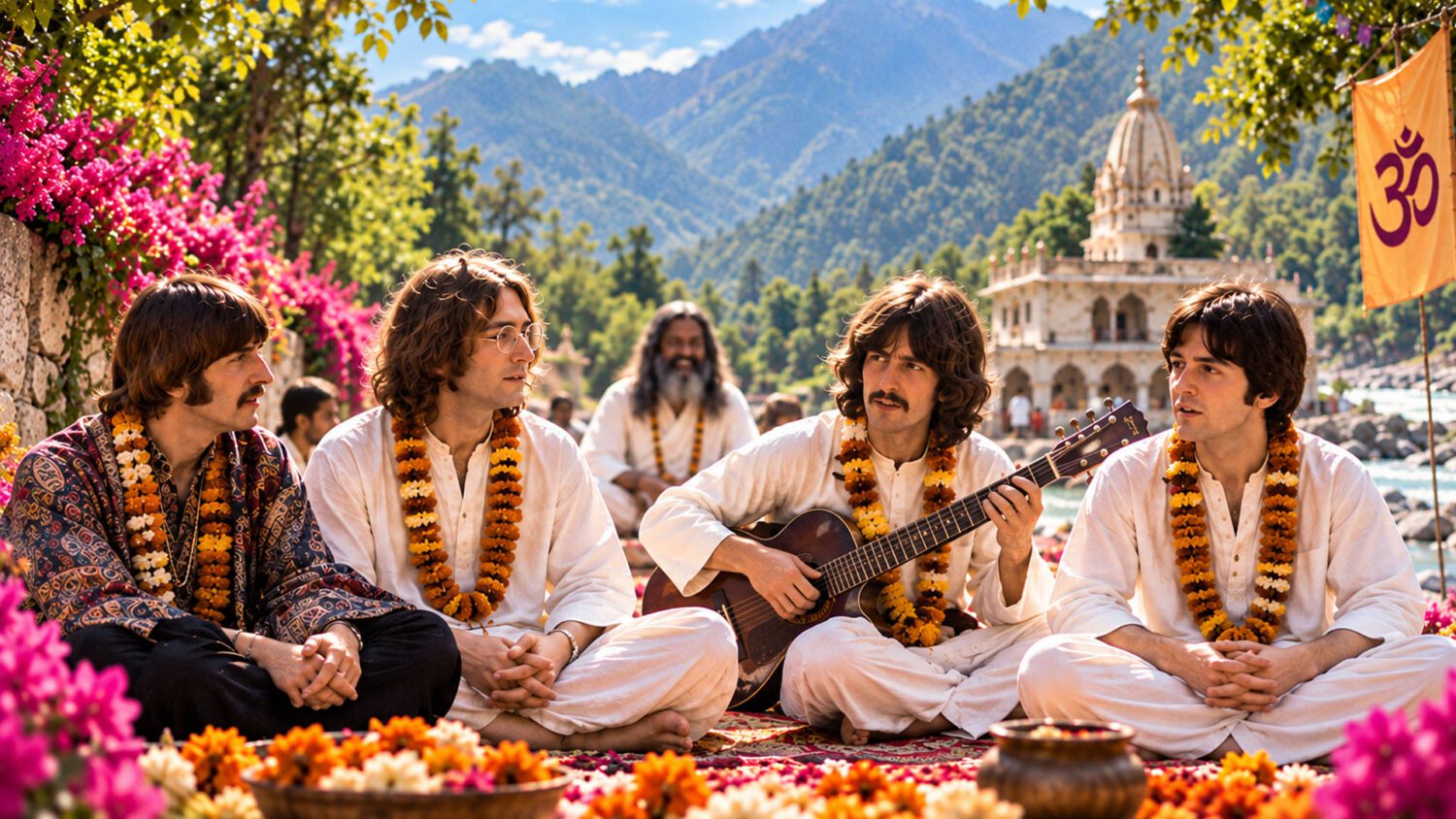
In the winter of 1968, the four most famous people on Earth walked into a walled compound in the Himalayan foothills, above the Ganges, and sat down to learn how to be still. The story of the Beatles in India is one of the most retold chapters in modern music, and one of the most misunderstood. It was not a publicity stunt, and it was not a failure. It was a real retreat with a real teacher, and it left behind dozens of songs, a few lasting friendships, one painful break and a quiet change in how the West thinks about meditation. This guide tells the whole story, from the first meeting with Maharishi Mahesh Yogi to the ashram as it stands today, and asks what the journey still has to say to a seeker.

Key Takeaways
- The Beatles first met Maharishi Mahesh Yogi in late August 1967. On 27 August 1967, during a seminar in Bangor, Wales, they learned that their manager, Brian Epstein, had died.
- In February 1968 the band, with their partners, traveled to the Maharishi’s ashram in Rishikesh, a 14-acre compound above the Ganges, to study Transcendental Meditation.
- Ringo Starr left after ten days, Paul McCartney after about five weeks. John Lennon and George Harrison left abruptly on 12 April 1968.
- The retreat was enormously productive. Songs written or sketched there include Dear Prudence, Across the Universe, Mother Nature’s Son, Julia and Sexy Sadie, and they shaped much of the White Album.
- The break followed an unproven allegation against the Maharishi, raised by Alex Mardas, known as “Magic Alex.” Harrison later said it was untrue and apologized.
- The Beatles did not abandon meditation. Harrison spent his life devoted to Indian spirituality, and McCartney and Starr performed at a 2009 benefit for TM programs.
- The old ashram, now called the Beatles Ashram, opened to the public in 2015.
In This Guide
- The Film: The Beatles and India
- Why the Beatles Went East
- Who Was Maharishi Mahesh Yogi?
- What Is Transcendental Meditation?
- Bangor, August 1967: A Meeting and a Loss
- The Road to Rishikesh
- Inside the Ashram
- The Cast of Seekers
- A Day in the Life of the Retreat
- What Each Beatle Took From It
- The Songs Born in the Himalayas
- Dear Prudence: A Song as an Invitation
- The Break: Magic Alex and the Allegations
- Sexy Sadie and the Aftermath
- Making Peace
- The Maharishi After the Beatles
- How the Beatles Changed the West’s Relationship with Meditation
- What the Beatles’ Journey Teaches Us
- Try a Simple Mantra Meditation
- Visiting the Beatles Ashram Today
- Watch and Listen on Next Level Soul
- Books for the Beatles in India
- Sources and Further Research
- Frequently Asked Questions
The Film: The Beatles and India
If this story has pulled you in, the film is the natural next step. The Beatles and India is a 95-minute documentary that follows the band’s bond with India, a bond that began more than fifty years ago. Using rare archival footage, recordings and interviews, it shows how India’s spiritual traditions shaped the music and the lives of the four men, and how they helped carry Indian philosophy, meditation and music to the West.
Reading about the ashram is one thing. Watching it unfold in its own images and sounds is another. The footage gives the story texture that retelling cannot match, and the voices of the people who were there give it a spine. You do not need to know the history first. If you already do, the film adds layers you will enjoy.
- Who it is for: music lovers, history buffs, and seekers curious about why meditation became so widely known.
- How to watch it well: turn the sound up, let the music have its say, and finish with five minutes of quiet.
Watch The Beatles and India on Next Level Soul.
Why the Beatles Went East
By 1967 the Beatles had lived through four years of a fame no one had experienced before. They had stopped touring, released Sgt. Pepper and become the face of a generation that was asking big questions. The questions were not new to them. The band had been exploring altered states, and they were beginning to notice something plain and a little unsettling: the experiences were vivid, but the peace did not last. They wanted something steadier. They wanted a practice.
India had been calling for a while. George Harrison had first picked up a sitar on a film set in 1965, and the instrument ended up on Norwegian Wood. He then sought out the sitar master Ravi Shankar, studied with him, and traveled to India in 1966 to learn from him in person. For Harrison, music was the door, and what he found behind it was a whole way of seeing: the idea that consciousness is the ground of everything, and that a person can learn to rest in it.
That is the backdrop to everything that follows. The Beatles did not go to India to be photographed. They went because the most successful people in popular culture were asking the oldest question there is: what is real, and how do I live in it?
Who Was Maharishi Mahesh Yogi?
The title Maharishi means “great seer.” The man who carried it is surprisingly hard to pin down. His birth year is given as 1911, 1917 or 1918 depending on the source, and his birth name is usually reported as Mahesh Prasad Varma. What is clear is the arc of his life. He earned a physics degree from Allahabad University in 1942, and in 1941 had become the secretary and student of Swami Brahmananda Saraswati, known as Guru Dev, the Shankaracharya of Jyotir Math in the Himalayas. He described his own life as beginning when he met his teacher.
When Guru Dev died in 1953, Mahesh withdrew for roughly two years of seclusion in Uttarkashi. In 1955 he began teaching publicly a method he first called Transcendental Deep Meditation and soon shortened to Transcendental Meditation, or TM. In 1957 he named his organization the Spiritual Regeneration Movement. In 1958 he announced a plan to bring the technique to the whole world.
The world tour began in 1959 and took him to Hawaii, California, New York and London. In 1961 he ran his first teacher-training course in Rishikesh, with about sixty students from a dozen countries. By the mid-1960s he had founded the Students’ International Meditation Society, and by 1967 he was lecturing at UCLA, Harvard, Yale and Berkeley. He had a gift for putting an ancient practice into the language of a modern audience, and he had a laugh that people remembered for decades.
Everything he taught, he said, came from Guru Dev. That is the meaning of the phrase the Beatles would soon be singing: Jai Guru Dev, a salutation of gratitude to the teacher who stands behind the teaching.
What Is Transcendental Meditation?
TM is a silent mantra meditation. A person sits comfortably with eyes closed, repeats a sound inwardly without forcing it, and lets the mind settle on its own, usually for twenty minutes, twice a day. The mantra is not meant to be concentrated on or fought for. The instruction is to be effortless, and to return to the sound gently whenever the mind wanders. The technique is taught personally by a trained teacher rather than from a book, which is part of its tradition and also part of what has made it controversial.
The tradition behind it is Vedic. The idea is that beneath the busy surface of thought, there is a quieter level of awareness, and that the mind naturally moves toward it when it is given something simple and pleasant to rest on. Practitioners describe the result as deep rest, clearer attention and a sense of spaciousness that carries into the day.
In 1970 the first scientific study on TM appeared in the journal Science, and research followed over the next decades. The picture is mixed in the way research on meditation often is. Meditation of many kinds shows real benefits for stress and wellbeing, and TM has a large body of study behind it, much of it produced by researchers connected to the movement. Independent reviewers have asked for more neutral replication. Some of the movement’s larger claims, including its TM-Sidhi program and “yogic flying,” have been called pseudoscience by critics. A fair reading holds both: a simple technique that many people find genuinely useful, and an organization that has sometimes claimed more than the evidence supports.
For the story of the Beatles, what matters is not the lab results. It is that in 1967 the most famous musicians in the world were handed a way to sit in silence, and they took it seriously.
Bangor, August 1967: A Meeting and a Loss
In August 1967, George Harrison and Pattie Boyd invited friends to hear the Maharishi lecture in London. The invitation grew into a weekend: the Beatles, with a crowd of friends and hangers-on, traveled to Bangor, in North Wales, for one of his seminars. They met him, began learning TM, and for a short while seemed delighted.
Then, on 27 August 1967, they learned that their manager, Brian Epstein, had been found dead in his London home. The weekend ended. The Maharishi consoled them, and the Beatles left Wales grieving and in shock. Many later said that the loss pulled them closer to the idea of going to India, even as it left the band without the one person who had held their business together.
In the autumn the band planned a trip to Rishikesh for late October. McCartney urged that it be postponed to the new year so they could finish Magical Mystery Tour. In the meantime, Harrison and Lennon appeared twice on David Frost’s television program to talk about meditation. A great many people first heard the word “TM” from them.
The Road to Rishikesh
In January 1968, Harrison flew to Bombay to record the soundtrack for the film Wonderwall, working with Indian musicians. The others followed in February. On 15 February, John Lennon and his wife Cynthia, George Harrison and Pattie Boyd, and Pattie’s sister Jenny arrived in Delhi. On 19 February Paul McCartney and Jane Asher and Ringo Starr and his wife Maureen landed. Starr had a reaction to an inoculation and needed a doctor, so the party stayed in Delhi overnight and reached Rishikesh early on 20 February.
They arrived about three weeks into a teacher-training course that was due to end on 25 April. A few had gone ahead. The actress Mia Farrow had come with the Maharishi in late January, and her sister Prudence was already deep into the practice.
The journey itself is part of the story. Rishikesh sits where the Ganges leaves the mountains and meets the plains. Since ancient times it has been a place where seekers come to meditate, and it is known as the Valley of the Saints. For a band that had been living inside a roar, the quiet must have been startling.
Inside the Ashram
The Maharishi’s International Academy of Meditation, also known as Chaurasi Kutia, covered about 14 acres of jungle on the east bank of the Ganges, roughly 150 feet above the river. It was fenced, wired and gated, and the gates were locked and guarded, a detail that fed later rumors that it was a place you could not easily leave. Inside were bungalows, a lecture hall, a dining area, a printing department and, at the heart of it, four stone-covered, dome-shaped rooms with raised platforms built for advanced meditation.
Life was simpler than the legend suggests, but not primitive. The Beatles’ bungalows had running water, toilets, electric heaters and English-style furniture. About forty staff worked there, among them cooks, cleaners, a joiner and a tailor who made the Indian clothes the students wore. Meals were vegetarian and eaten together. Monkeys and crows raided anything left out. Accounts of the food vary. Lennon called it lousy. Jenny Boyd called it delicious. Ringo Starr, famously, lived on eggs and a supply of Heinz baked beans he had packed.
The Maharishi had his own bungalow and held lectures from a flower-decked platform. Each of the Beatles had private time with him. After dinner the musicians gathered on the roof of Harrison’s bungalow to play, and the guitars they played there would soon become songs.
The Cast of Seekers
The ashram was not only the Beatles. It was a small village of people from many walks of life, each carrying a reason for being there.
- Mia and Prudence Farrow. Mia Farrow arrived with the Maharishi in late January. Her sister Prudence threw herself into meditation so completely that others worried about her. Mia left for London on 8 March.
- Donovan. The Scottish singer-songwriter recognized the Maharishi as the guide he had been looking for. He taught Lennon his finger-picking style and left because he felt he had a mission in music.
- Mike Love of the Beach Boys. He left on 15 March for tour commitments.
- Paul Horn. The jazz flautist, whose birthday celebration there was shared with Pattie Boyd on 17 March.
- Paul Saltzman. A young Canadian filmmaker who arrived at the ashram and spent time with the Beatles. Decades later he shared his photographs and memories in books and a documentary, and he tells the story in an NLS conversation, The Beatles’ Spiritual Journey with Paul Saltzman.
- Nancy Cooke de Herrera. A publicist and confidant of the Maharishi, who later wrote about the retreat from his side.
- Lewis Lapham. A writer for the Saturday Evening Post, who covered the retreat as a journalist.
- Alex Mardas, known as Magic Alex. A Greek electronics engineer in the Beatles’ circle, who arrived about four weeks after the Beatles, after McCartney had left. He becomes central to the end of the story.
- Neil Aspinall and Mal Evans. The band’s long-time aides, who made sure the guitars, tapes and tea kept flowing.
A Day in the Life of the Retreat
Days were built around meditation. Early lectures from the platform were later cancelled, and students were encouraged to meditate for as long as they could. Some sat for hours. Others struggled. The practice was not always blissful. It could bring up boredom, restlessness, old memories and a sense of how loud the mind actually is.
The Maharishi gave each person individual attention. Harrison later said he found something real in the practice. Lennon, restless by nature, threw himself in with a fierce energy, as he did with everything. Between sittings, people swam in the pool, wrote letters, read, napped and talked. In the evenings, the roof of Harrison’s bungalow became a salon. Harrison celebrated his 25th birthday on 25 February with communal chanting, a sitar performance and fireworks.
It is easy to forget that this was, at heart, a school. The Beatles were students among students. They were learning a technique, and they were learning what it was like to have nobody asking them for anything.
What Each Beatle Took from It
George Harrison
Harrison was the committed one, and India would become the center of his inner life. He had been traveling toward this place for years, through the sitar and through Ravi Shankar. After Rishikesh he kept meditating, deepened his study of Indian philosophy and, in the years that followed, moved toward devotional chanting and the Hare Krishna movement. His song My Sweet Lord (1970) and the Concert for Bangladesh (1971) both grew out of that road. You can read more about that movement in our review of Hare Krishna: The Mantra, the Movement, and the Swami Who Started It All.
John Lennon
Lennon threw himself into the practice, and he wrote more in India than he had in months. He was also the one who wanted answers, fast. His restlessness and his hunger for truth were the same thing. He left Rishikesh disillusioned with the Maharishi, but not with the idea of a spiritual search. In the years that followed he remained curious and openly questioning.
Paul McCartney
McCartney was the most skeptical and the most practical. He stayed about five weeks, enjoyed the quiet and wrote voraciously. Later he spoke warmly of the experience and of the Maharishi, and he never lost his respect for meditation. He and Ringo Starr would return to the story in 2009 for a TM benefit concert.
Ringo Starr
Starr left after ten days. He had trouble with the food, the insects and the unfamiliar routine, and he missed his children. He took away little drama and a lasting affection for the idea. He is the reminder that a spiritual path is not one size. The Beatles went to the same place and left with four different relationships to it.
The Songs Born in the Himalayas
The retreat was one of the most creative stretches of the band’s career. With no phones, no studios and no schedule, the four of them wrote constantly, and many of the songs that would define the White Album took shape there. Eighteen of those songs were recorded for The Beatles (the White Album), and two found their way onto Abbey Road. The following were written or developed in or around the ashram:
- Across the Universe (Lennon). Its refrain carries the Sanskrit greeting Jai Guru Deva, a standard salutation in the Maharishi’s movement. It stayed unreleased for over a year.
- Dear Prudence (Lennon). Written for Prudence Farrow, partly to coax her out of her long meditation.
- Child of Nature (Lennon). Inspired by one of the Maharishi’s lectures. It would later be reworked into a different song.
- Mother Nature’s Son (McCartney). Also inspired by a lecture of the Maharishi.
- Julia (Lennon). Built on the finger-picking style Donovan had taught him.
- Sour Milk Sea (Harrison). A song urging listeners toward meditation and illumination.
- The Inner Light (Harrison). Recorded largely in Bombay with Indian musicians, and released on the B-side of a single while the band was away.
- Don’t Pass Me By (Starr). His first solo composition, begun years earlier and finished there.
- The Continuing Story of Bungalow Bill (Lennon). Inspired by a fellow student who left the retreat to go tiger hunting.
- Sexy Sadie (Lennon). Written as the retreat ended. It was originally titled for the Maharishi, a detail we return to below.
The McCartney songs Back in the U.S.S.R. and Rocky Raccoon were also performed for the group in India as playful numbers. And Donovan’s Hurdy Gurdy Man, an Indian-flavored song, was shaped in conversations with Harrison there.
There is something quietly mystical about the speed of it. When a group of artists is given silence, they do not go silent. They begin to listen, and what they hear comes out as music.
Dear Prudence: A Song as an Invitation
Of all the songs, Dear Prudence tells the human side most clearly. Prudence Farrow had taken to meditation with an intensity that worried the people around her. She was spending days in her room, and few could get her to come out. Lennon and others tried to coax her back into the light. Lennon wrote a song to do exactly that, an open invitation to come out and play, and it worked as an act of friendship before it was ever a recording.
The song also hints at something true about meditation. Silence can be a doorway, and it can also be a place to hide. A good teacher, or a good friend, knows the difference. The invitation in that song, to come back out into the day, is one of the quieter lessons of Rishikesh.
The Break: Magic Alex and the Allegations
By early April the mood at the ashram had shifted. A film crew arrived, with the idea of making a movie about the retreat, and both Lennon and Harrison were reportedly unhappy about it. The Beatles were also tired. They had been away from the world for two months, and the world was starting to look through the gate.
Into that atmosphere came an old rumor and a new voice. Earlier, Mia Farrow had told some students that the Maharishi had made a pass at her. Accounts of what happened differ. Nancy Cooke de Herrera recalled that Farrow described him stroking her hair during a private puja, and that she told Farrow she had misread it. Farrow’s 1997 memoir describes him trying to put his arms around her in a private meditation space, and her sister Prudence told her it was an honor and a tradition. These are conflicting memories of an ambiguous moment, recorded decades later.
Then Alex Mardas arrived. He insisted that the Maharishi had had a sexual encounter with a young woman at the ashram. In some tellings she was a blond nurse from California. Another writer identifies her as a New York schoolteacher who was, in fact, having an affair with Mardas. On the Beatles’ final night he reported that he had seen the Maharishi and the woman in a compromising position.
Many people at the ashram did not believe it. Cynthia Lennon later said the allegation had gathered momentum without a single shred of evidence. Pattie Boyd doubted it, though she had a disturbing dream about the Maharishi and told Harrison she thought they should leave. Harrison later said that Lennon had wanted to leave anyway, in part to be with Yoko Ono. Deepak Chopra, who was not present, has said the Maharishi was displeased by drug use among the visitors and that Lennon and Harrison left at his request. In 2010 Mardas denied that he had turned Lennon against the Maharishi.
The night of 11 and 12 April. Lennon, Harrison and Mardas talked late into the night and agreed they should leave. Lennon was chosen to tell the Maharishi. When the teacher asked why they were going, Lennon answered, “If you’re so cosmic, you’ll know why.” The Beatles and their wives left hurriedly the next morning, 12 April 1968, in taxis. While waiting for those taxis, Lennon began the song that became Sexy Sadie.
Harrison had also planned to leave soon anyway, to join Ravi Shankar on a documentary called Raga. He returned to London on 21 April.
It is worth saying plainly, as every careful account does: the allegation was never substantiated. It is possible to hold two things at once. Spiritual teachers are human, and some do harm. And a band of exhausted, famous young people on their last night can be swept into a story that no one has proof for.
Sexy Sadie and the Aftermath
The first public explanation was polite. In Delhi, Lennon and Harrison said they had urgent business in London. Then the story leaked. On 14 May 1968, on The Tonight Show, Lennon said that the Beatles believed in meditation but not in the Maharishi and his scene, and that they had made a mistake because the Maharishi turned out to be human like the rest of us. That last remark is, in its own way, a spiritual statement, and it set the tone for how the band would speak about the episode.
The song, originally titled for the Maharishi, was renamed Sexy Sadie before release, a thin disguise that did not fool anyone. It is a bitter song, written in the heat of disappointment. Lennon would later say he had been bitter because he had found the Maharishi was human.
In June 1968, Harrison said the Spiritual Regeneration Movement was too much of an organization. That is a revealing complaint. He had no quarrel with meditation or with Indian spirituality. What he found, as many seekers do, was that a lively practice can be wrapped in a structure that feels heavy, commercial or crowded.
Making Peace
The rift did not last as long as the headlines. Harrison, in time, apologized for how he and Lennon had treated the Maharishi, and acknowledged that the allegation was untrue. In 1992 he played a benefit concert for the Natural Law Party, the political party the Maharishi’s movement had founded. McCartney and Starr performed at a 2009 benefit for the David Lynch Foundation, which funds TM instruction for at-risk students. McCartney, for his part, spoke of the retreat warmly over the years.
Lennon was killed in 1980 and Harrison died in 2001, so we cannot know how either would have told the story after another decade or two. What survives is a pattern many of us recognize. We meet a teacher. We project on them everything we hope for. We meet their humanity. We choose whether to throw away the practice with the person, or to keep what was true.
The Beatles, for the most part, kept what was true.
The Maharishi After the Beatles
The Maharishi’s story did not end at Rishikesh. In 1968 he announced that he would stop public tours and focus on teacher training, and he set up a headquarters in Seelisberg, Switzerland. In 1970 he led teacher-training courses in Maine and California for more than two thousand people between them. In 1972 he announced a World Plan for teaching centers across the globe. In 1974 Maharishi International University opened in Fairfield, Iowa. By the mid-1970s there were hundreds of TM centers in the United States.
In 1975 Time described TM as a full-blown craze, and the TM-Sidhi program, with its “yogic flying,” was introduced. Then the boom cooled. New learners fell from about 40,000 a month in 1975 to about 4,000 in 1977. In 1979 a US appeals court ruled that teaching TM in New Jersey public high schools violated the First Amendment. In 1988 Indian tax authorities raided his offices. In 1990 he moved his headquarters to the Netherlands. In 1992 the movement founded the Natural Law Party, which ran in dozens of countries until it closed in 2004. In 2000 he established the Global Country of World Peace.
He died on 5 February 2008, in his sleep, at his home in Vlodrop in the Netherlands. By his death, the movement reported more than 40,000 trained TM teachers and more than five million people taught the technique. That is a remarkable record for one man, and it sits alongside serious, continuing criticism of the organization’s finances, its claims and the culture around it. Honest history holds both. If you want a modern conversation with someone who leads the movement today, see How Transcendental Meditation Can Change the World with Dr. Tony Nader.
How the Beatles Changed the West’s Relationship with Meditation
Before 1968, meditation in the West was a curiosity for specialists, scholars and a few brave bohemians. After the Beatles went to India, it became a conversation at kitchen tables. Writers and historians have described the retreat as a turning point. Philip Goldberg, author of American Veda, has called it possibly the most momentous spiritual retreat since Jesus’s forty days in the wilderness, and others have credited the band with bringing Indian spirituality into everyday awareness.
The effects ran in several directions at once. Millions of people tried TM, then yoga, then other practices. Indian classical music reached audiences it never had. Words like mantra, karma and guru entered ordinary speech. Teachers from many traditions, from Kriya yoga to Zen, found students waiting. And the very idea that a person could study consciousness directly, without a church, became a respectable thing to say out loud.
It also had a cost. The craze produced its share of hype, commercialization and disappointment, and the Beatles’ own exit gave critics an easy story. Yet the deeper currents were already moving. Yogananda had brought Kriya yoga to the West decades earlier, as the film Awake: The Life of Yogananda shows, and his Autobiography of a Yogi had been quietly circulating for years. Harrison was among the many seekers who read it. What the Beatles did was turn a trickle into a river.
What the Beatles’ Journey Teaches Us
Strip away the fame and Rishikesh looks like something many of us have lived through, only on a smaller stage. A few lessons stand out.
- The teacher is a doorway, not the destination. The Beatles’ disillusionment with the Maharishi did not erase what they learned. The practice stayed true even when the person fell short of their picture of him. That is a hard and freeing distinction.
- Silence makes room. The band’s creative burst in India was not a coincidence. When the noise stops, the real material rises.
- Discernment is part of devotion. It is healthy to ask hard questions about a teacher, an organization or a method. Open-hearted does not mean uncritical.
- Leaving is allowed. Ringo went home after ten days. Paul stayed for five weeks. John and George left when it no longer felt right. A path is not a prison, and a seeker is free to choose their own pace.
- The power is within you. Every authentic teaching points back to the person sitting on the cushion. A teacher can offer a map, but the walking is yours.
Our own approach at Next Level Soul comes from the same place. Teachers, books and courses are guides to help you remember what you already carry. If you are looking for a place to begin, our guides to spiritual enlightenment, mindfulness practices and Kriya yoga meditation are good doorways.
Try a Simple Mantra Meditation
TM itself is learned from a certified teacher, so what follows is not TM. It is a simple, traditional mantra meditation in the same spirit, which you can try on your own.
- Sit comfortably with your back supported and close your eyes. Take three easy breaths.
- Choose a soft sound to repeat silently, such as so-hum or om. Let it be quiet and unhurried, like a thought rather than a sound you are making.
- When the mind wanders, and it will, return to the sound without scolding yourself.
- Continue for ten minutes. When the time is up, stop repeating the sound and sit in the quiet for a minute before you open your eyes.
- Keep a note of how you feel afterward, not how “well” you did.
Start with ten minutes a day for a week. If it helps, build up to twenty, which is the length the Maharishi taught. If you want to go further, our free guides are a good next step, and the NLS Mastery library offers deeper teaching from some of the world’s leading meditation and consciousness teachers.
Visiting the Beatles Ashram Today
After the retreat the ashram fell into disuse and the jungle began to reclaim it. In 2015 it was opened to the public and renamed the Beatles Ashram. Visitors walk among the crumbling meditation domes, the foundations of old bungalows and walls covered with murals and graffiti inspired by the band. It is quiet and slightly haunted, and it has the particular atmosphere of a place where something important once happened.
Rishikesh itself remains a pilgrimage town. The Ganges runs clear and cold from the mountains, the evening aarti on the riverbank draws crowds, and yoga and meditation teachers from around the world have set up studios there. If you plan to go, check current opening hours and entry arrangements before you travel, because they change.
Watch and Listen on Next Level Soul
These films and conversations on Next Level Soul tell the same story from different angles:
- The Beatles and India. A 95-minute documentary that blends rare archival footage, recordings and interviews to explore how India’s spiritual traditions shaped the band’s music and lives.
- How the Beatles Changed the World. A documentary on the cultural, social, spiritual and musical revolution that the band set in motion.
- Awake: The Life of Yogananda. The story of the master who brought Kriya yoga to the West. Read our film guide.
- Hare Krishna: The Mantra, the Movement, and the Swami Who Started It All. The road Harrison followed. Read our film guide.
- The Beatles’ Spiritual Journey with Paul Saltzman. An NLS conversation with a witness to the retreat. Read and listen here.
Books for the Beatles in India
- Autobiography of a Yogi by Paramahansa Yogananda. The classic account of a master’s life, widely read by seekers in the 1960s and since.
- The Beatles in Rishikesh by Paul Saltzman. Photographs and memories from someone who was there.
- American Veda by Philip Goldberg. How Indian spirituality changed the West.
- I Me Mine by George Harrison. His own words on his songs and his spiritual search.
Sources and Further Research
This guide draws on public reference works and published accounts. For the timeline and the full set of witness testimonies, see the Wikipedia articles on The Beatles in India, Maharishi Mahesh Yogi, the History of Transcendental Meditation and the Beatles Ashram. Accounts of the events of April 1968 conflict in places, and where they do, we have said so.
Frequently Asked Questions
When did the Beatles go to India?
The four Beatles and their partners traveled to Rishikesh in February 1968. Lennon, Harrison and their wives arrived in Delhi on 15 February, and McCartney, Starr and their partners on 19 February. They reached the ashram on 20 February.
Why did the Beatles go to India?
They wanted to study Transcendental Meditation with Maharishi Mahesh Yogi. They had met him in August 1967, and Harrison in particular had been drawn to Indian music and spirituality for years.
How long did the Beatles stay in India?
It varied. Ringo Starr left after ten days. Paul McCartney stayed about five weeks. John Lennon and George Harrison left on 12 April 1968.
Why did the Beatles leave the Maharishi?
They left after Alex Mardas claimed the Maharishi had acted improperly with a female student. The allegation was never substantiated, and Harrison later said it was untrue. Lennon and Harrison left on 12 April 1968.
Which songs were written in India?
Songs written or developed there include Across the Universe, Dear Prudence, Child of Nature, Mother Nature’s Son, Julia, Sour Milk Sea, Don’t Pass Me By, The Continuing Story of Bungalow Bill and Sexy Sadie. Many appeared on the White Album.
What is Sexy Sadie about?
Lennon wrote it as the retreat ended, while waiting for taxis. It was originally titled for the Maharishi and expressed his disappointment. The title was changed before release.
Did the Beatles keep meditating?
Yes, in various ways. Harrison remained devoted to Indian spirituality for the rest of his life. McCartney and Starr later supported TM programs, performing at a 2009 David Lynch Foundation benefit.
Can you visit the Beatles Ashram?
Yes. The old ashram was opened to the public in 2015 and is now called the Beatles Ashram. Check current opening hours before you travel.
Where can I watch The Beatles and India?
The Beatles and India is available on Next Level Soul. Watch The Beatles and India on Next Level Soul TV.