
Psychic Self-Defense is Dion Fortune’s 1930 handbook on what she calls psychic attack, how to tell it from ordinary trouble, and the methods she recommends for defending against it. The author draws on her work in the Western esoteric tradition and writes in a calm, case-by-case voice. This study guide walks through all 20 chapters in plain language, then hands you a workbook to try the ideas on your own life.
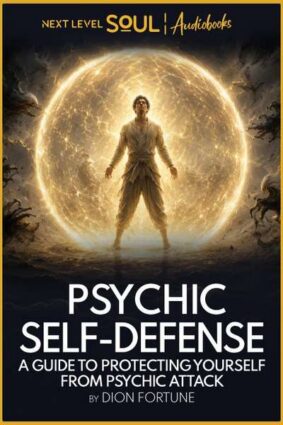
Listen While You Study
The audiobook is available on Next Level Soul TV. Play a chapter, then come back here for the notes and the workbook prompt.
Key Takeaways
- Look for ordinary causes first. The author urges careful diagnosis before assuming anything unusual is at work.
- Understanding comes before defence. Much of the book explains signs, types and motives so the reader knows what they are dealing with.
- Inner and outer are separated. She distinguishes an outside attack from a disturbance that arises within a person.
- The body matters. A chapter on the physical side shows why health and a steady routine are part of protection.
- Get qualified help when you need it. Mental or physical distress deserves a doctor or therapist, not only esoteric ideas.
The Book at a Glance
| Detail | What to Know |
|---|---|
| Author | Dion Fortune, the adopted name of Violet Firth (1890 to 1946) |
| First published | 1930 |
| Chapters | 20, plus a preface and a conclusion |
| Tradition | Western esoteric tradition |
| Audiobook | Available on Next Level Soul TV |
What Is Psychic Self-Defense About?
Psychic Self-Defense is the author’s guide to what she describes as harmful influence working through unseen levels of experience. She begins with signs and types, moves to how to tell a real attack from a personal disturbance, looks at motives, and ends with methods of defence.
The tone is careful and diagnostic rather than sensational. Read today, it is a window into early twentieth-century occult thinking, and a useful prompt to think about energy, boundaries and self-care. Treat it as the author’s teaching, and keep qualified medical and mental health care in your own plan.
The Board: 20 Chapters
Each square is a chapter. Tap one to jump to its study notes.
- 1Signs
- 2Nature of Attack
- 3Witchcraft Case
- 4Etheric Body
- 5Vampirism
- 6Hauntings
- 7Non-Human
- 8Ceremonial Risks
- 9Inner or Outer
- 10Ordinary Dangers
- 11Mind and Psyche
- 12Attack Methods
- 13Motives I
- 14Motives II
- 15Physical Aspect
- 16Diagnosis
- 17Defence I
- 18Defence II
- 19Defence III
- 20Defence IV
Chapter-by-Chapter Study Notes
These notes are our own summary, written to help you follow the book. Each one ends with a small practice you can try this week.
Signs of Psychic Attack
The opening chapter describes the signs the author associates with psychic attack. She says the first task is to recognize what is happening, and she urges the reader to consider ordinary causes before assuming anything unusual. The chapter sets her tone for the book: careful, observant and practical. Read it as the author’s framework, and see a doctor about any health concern.
Analysis of the Nature of Psychic Attack
Here the author steps back to explain what she believes psychic attack actually is. She describes it as a harmful influence working through unseen levels of experience, and she begins to lay out the concepts she uses throughout the book. This chapter gives the vocabulary for what follows. As with all of the book, it presents the author’s esoteric view, not a scientific finding.
A Case of Modern Witchcraft
The author turns to a case account, which she presents as an example of modern witchcraft. She uses the story to show how she reasons about a situation, step by step. Case accounts like this are a signature of her style. A modern reader can treat it as a period account that illustrates her ideas, and keep a healthy, curious distance from its claims.
Projection of the Etheric Body
In this chapter the author discusses the projection of what she calls the etheric body. She explains it as part of her picture of how a person is layered, and relates it to experiences of leaving the body. It pairs well with study of the astral plane and the aura. Read it as the author’s model of the subtle self.
Vampirism
Vampirism is used here in a psychic sense. The author uses the word for what she describes as a draining of vitality from one person by another. She discusses how it can happen and what she says to look for. Today many people use words like energy drain to describe something similar. Treat it as her framework for understanding why some relationships leave us exhausted.
Hauntings
This chapter takes up hauntings, which the author treats as one of the ways unseen forces can affect a place or person. She describes her view of what hauntings are and how they differ from other kinds of experience. As elsewhere, she writes from experience in the occult tradition of her time. Read it as the author’s account, and compare it with other views of the subject.
The Pathology of Non-Human Contacts
The author discusses contacts with beings she describes as non-human, and she approaches them through the lens of what she calls pathology, meaning how such contact can go wrong. She is cautious and diagnostic in tone. The chapter shows her habit of treating unusual experiences with careful observation and a sense of risk.
The Risks Incidental to Ceremonial Magic
Here the author looks at the risks she says can come with ceremonial magic. She writes as someone familiar with the tradition, and she argues for caution and preparation. The theme of the chapter is responsibility: practices that open the mind need grounding and care. Read it as the author’s warning about any intense spiritual practice done without preparation.
Distinction Between Objective Psychic Attack and Subjective Psychic Disturbance
This chapter draws a line between what the author calls an objective psychic attack and a subjective disturbance, meaning something that arises from within the person. The distinction matters in her method, because the right response depends on the cause. It invites honest self-examination before blaming outside forces. It is a good habit for any reader: pause, look inward first, and then look outward.
Non-Occult Dangers of the Black Lodge
The author discusses dangers she links with groups she calls the black lodge, and she stresses that some of these dangers are not occult in nature. She widens the view beyond the unseen to include ordinary, human harm. Read it as a reminder that practical caution and good judgment about people and groups belong alongside any spiritual work.
The Psychic Element in Mental Disturbance
In this chapter the author considers how the psychic and the mental may overlap in a disturbed state. She writes in the language of her time. For today’s reader this is the chapter that most needs care: mental distress deserves qualified help from a doctor or therapist, and the author’s ideas are best held as one historical perspective.
Methods Employed in Making a Psychic Attack
The author describes the methods she says are used to make a psychic attack. She frames the knowledge as protective, so that readers understand what they are guarding against. The chapter is descriptive rather than a how-to. It reflects her belief that understanding a danger is the first step to defence.
The Motives of Psychic Attack, Part I
This is the first of two chapters on motives. The author asks why anyone would make a psychic attack and what drives such behavior. She looks at human feelings and intentions behind it. The chapter treats motive as a clue, a way of making sense of events and deciding how to respond.
The Motives of Psychic Attack, Part II
The second chapter on motives continues the author’s inquiry into what lies behind a psychic attack. She extends her analysis with further kinds of motive and situations. Together with the first part, it shows that she treats human feelings as central. A useful takeaway is to look at the people and emotions in a situation first.
Physical Aspect of Psychic Attack and Defence
The author turns to the physical side of attack and defence. She links the body’s condition to a person’s vulnerability and to their ability to recover. The practical message is that health, rest and a steady daily routine matter. This is one of the most easily applied chapters, because good physical care helps anyone.
Diagnosis of the Nature of an Attack
Here the author explains how to work out what kind of problem you are dealing with. She emphasizes careful diagnosis before any response, and she asks the reader to rule out ordinary explanations. The chapter shows her method: observe, test your assumptions, and then act. It pairs naturally with the earlier chapter on subjective disturbance.
Methods of Defence I
The first of four chapters on defence begins the author’s practical teaching. She introduces the first group of methods she recommends for protecting yourself. This chapter marks the turn from understanding to action. Read it as the author’s starting toolkit, and add your own common sense and care. It is best read slowly, with a calm mind, and a willingness to test each idea.
Methods of Defence II
The second chapter on defence continues the author’s practical teaching. She adds further methods and explains how they build on the first group. The emphasis is on using the methods with a clear head and steady attention rather than fear. Read it as the author’s guidance, and keep it grounded. Take your time with it, and notice which parts feel steady and useful to you.
Methods of Defence III
In the third chapter on defence the author continues her instruction, building on the earlier methods. She shows how the pieces fit together as a way of life rather than a single act. The lesson is consistency: protection that is practiced calmly and often is easier to rely on than one that is used only in a crisis.
Methods of Defence IV
The final chapter on defence completes the author’s teaching on protecting yourself. She rounds out her methods and sums up how they work together. It closes the practical section of the book, and leads into a short conclusion. Take it as a prompt to choose what you will actually use, and to keep medical and professional support in the picture.
Key Ideas in Plain Language
| Idea | What It Means | Chapter |
|---|---|---|
| Psychic attack | The author’s term for harmful influence through unseen levels. | 1, 2, 12 |
| Objective vs subjective | An outside influence compared with a disturbance from within. | 9 |
| Etheric body | Her name for a subtle layer of the person. | 4 |
| Psychic vampirism | A draining of vitality from one person by another. | 5 |
| Hauntings | Unseen influences connected with a place or person. | 6 |
| Motives | Why someone might make an attack, in her view. | 13, 14 |
| Diagnosis | Working out the real cause before responding. | 16 |
| Physical care | Health and routine as part of protection. | 15 |
| Methods of defence | Her practical teaching on protecting yourself. | 17 to 20 |
Who This Book Is For
This book suits readers who are curious about the history of Western esoteric thought, about energy and boundaries, or about how earlier writers described spiritual risk. It is also useful for anyone who wants a calm, structured way to think about feeling drained or unsettled. Read it as a student of ideas, and seek qualified help for any real health or safety concern.
A 20-Day Way to Use It
- Days 1 to 5: read chapters 1 to 5, one a day, and do each Try it practice.
- Days 6 to 12: read chapters 6 to 12 and fill in the workbook as you go.
- Days 13 to 20: read chapters 13 to 20 and note which practices felt steady and useful.
- On day 21, reread your workbook answers and choose one practice to keep.
Your Workbook
Your answers save on this device as you type. They are not sent anywhere. Use the copy button to move them into your own notes.
Watch More on Next Level Soul TV
Next Level Soul TV brings together full episodes, courses, movies, series and audiobooks, ad-free. Join Next Level Soul TV and keep exploring.
Keep Going
- Astral Projection: What It Is, How It Works and How to Try It Safely
- The Astral Plane: Study Guide and Workbook
- The Human Aura: Study Guide and Workbook
- Ouija Board: What It Is, How It Works and Is It Dangerous
Sources and Further Reading
Go Deeper with NLS Mastery: Astral Therapy
Fortune writes about the unseen layers of a person and how to stay steady among them. If you want to take that idea further, Mariko Frederick teaches it in Astral Therapy, part of NLS Mastery. Watch the course preview below.

Frequently Asked Questions
What is Psychic Self-Defense about?
It is Dion Fortune’s guide to what she calls psychic attack. She describes signs, types and motives, explains how to tell an outside attack from an inner disturbance, and ends with methods of defence.
Who wrote Psychic Self-Defense and when?
Dion Fortune, the adopted name of Violet Firth, wrote it. Wikipedia says it was published in 1930 and was probably her most commercially popular book.
What kind of book is it?
It is an esoteric classic from the Western occult tradition. It is best read as the author’s teaching and as a window into early twentieth-century thinking about the unseen.
How many chapters are in the book and what do they cover?
There are 20 chapters plus a preface and a conclusion. They cover signs and types of attack, how to tell causes apart, motives, and finally methods of defence.
What does the book mean by psychic attack?
The author uses the term for a harmful influence she says can work through unseen levels of experience. She stresses careful diagnosis before assuming this is what is happening.
What is the difference between objective and subjective disturbance?
Chapter 9 separates an outside psychic attack from a disturbance that arises within the person. The author says the right response depends on telling the two apart.
Does the book replace medical or mental health care?
No. Chapter 11 touches on mental disturbance, and today any mental or physical distress deserves a doctor or therapist. Treat the book as a spiritual and historical teaching.
How should a beginner read this book?
Read one chapter a day and try the small practice that goes with it. Start with the signs and diagnosis chapters, which build a calm, clear approach before the defence chapters.
Is Psychic Self-Defense hard to read?
The ideas are explained in plain steps, but the language is from 1930 and some chapters discuss dark themes. Reading a chapter at a time with this guide beside you keeps it manageable.
How does this study guide and workbook help?
It gives you a plain-language summary of every chapter, a small practice for each, a table of key ideas and a workbook that saves your answers on your device. It is our own summary, not a replacement for the book.
Where can I listen to the audiobook?
The audiobook is available on Next Level Soul TV. Play a chapter, then return to this page for the notes and the workbook prompt.
What should I read or listen to next?
If the subtle body and energy chapters interest you, explore other classics on the astral plane and the human aura. If boundaries interest you, look for works on self-care and grounding.
Spirituality for the Rest of Us™
Movies, teachings and community on Next Level Soul TV.