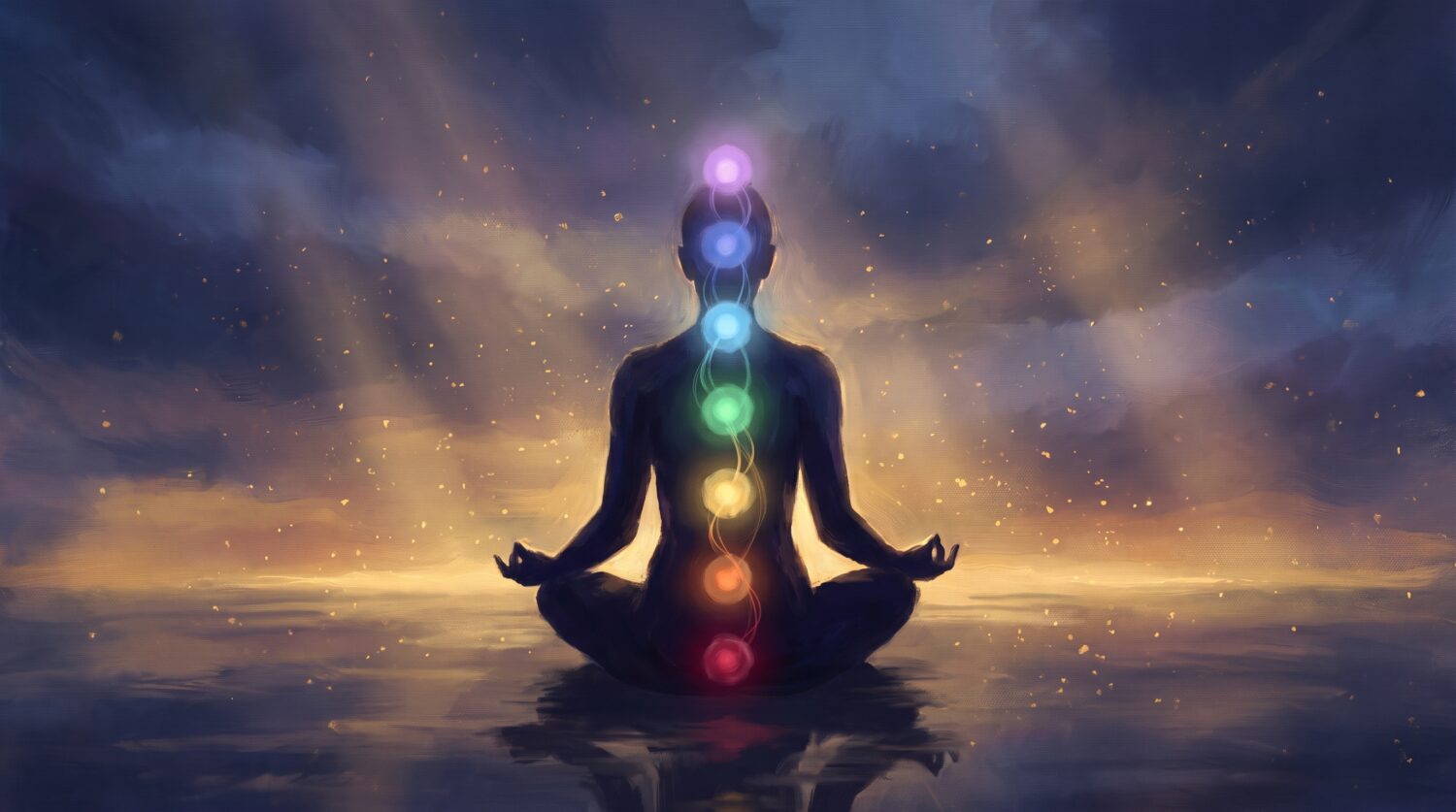
Maybe your shoulders have been up around your ears for a month. Or you feel flat for no reason you can name, or wound up, or cut off from the person you used to be. You are not broken. And you are not alone. For centuries, seekers have used one simple map to make sense of that kind of feeling: the chakras.
This is our complete guide to the seven energy centers. It explains what chakras are, where the idea comes from, what each center is said to govern, and how people work with them through breath, movement, sound, stillness and daily habits. It also does something many chakra articles skip. It tells you plainly what is tradition, what is modern invention, and what science has and has not shown.
Think of it as a hub. Read it straight through, or jump to the center that calls to you. Along the way you will find links to our deeper guides on chakra meditation, chakra yoga, chakra foods and chakra stones.
Key Takeaways
- Chakra means wheel in Sanskrit. The seven-center system is a map of body, emotion and spirit.
- The word is old. The seven-center map we know today was shaped over many centuries, with tantric texts and modern writers adding layers.
- Each center has a location, a theme, a color and a seed sound, and a balanced one is described as steady, open and clear.
- Breath, movement, stillness, sound, grounding and honest self-care are the simplest ways to work with the system.
- Chakras are a spiritual framework, not a medical one. See a doctor for physical symptoms.
What Are Chakras?
The word chakra is Sanskrit for wheel or disc. In yoga and tantric teaching, a chakra is a center of subtle energy, a spinning wheel of awareness that sits along the line of the spine, from its base to the crown of the head. Practitioners say these centers take in, store and move prana, the life force that traditions around the world describe under other names: qi, ki, spirit, breath.
Here is the part worth saying out loud. Chakras are not organs. You will not find them on an X-ray, and no surgeon has ever pointed to one. They belong to the language of the subtle body, a way of describing experience from the inside. Think of them the way you might think of a map. A map is not the land. But it can still get you home.
That is why the system has lasted. Each center lines up with something every person recognizes. Safety. Pleasure. Willpower. Love. Honest speech. Insight. A sense of belonging to something larger. When you feel stuck in one of those areas, the chakra map gives you a place to start looking, and a practice to try.
Two ideas sit underneath everything in this guide. First, flow. Teachers describe a healthy chakra as open and moving, neither shut down nor racing. Second, relationship. The centers are not seven separate rooms. They are one house, and what happens in one room is felt in the others. The power is within you, and the chakras are simply one of the oldest ways seekers have learned to listen.
Where the Chakra Idea Comes From
If you read older chakra articles online, you will often see a tidy claim: chakras were described in the Vedas, more than three thousand years ago, exactly as we know them now. The real story is more interesting, and a little more complicated.
The word cakra appears very early in Indian literature, mostly in its everyday sense of a wheel, a cycle or a circle. Wheels were powerful symbols in the ancient world, from the chariot wheel to the wheel of time, and the Buddhist wheel of the Dharma. Most scholars say the idea of energy centers inside the body developed later, in yogic and tantric traditions, with the seven-center system becoming widely described over roughly the last thousand years or so.
A few landmarks help. Tantric and hatha yoga texts describe a subtle body with channels called nadis and several wheels of energy joined by them. Some texts name different numbers of centers. Some describe five, some six, some many more, and a few speak of 114 junctions or points. One text often cited in modern writing is the Sat-Cakra-Nirupana, a sixteenth-century work on the six centers. John Woodroffe, writing as Arthur Avalon, translated it into English in 1919 under the title The Serpent Power, and that book helped carry the idea to Western readers.
Then the West added its own layers. Early twentieth-century Theosophical writers, especially Charles Leadbeater in The Chakras (1927), described the centers as vortices of subtle energy and gave them a more visual, clairvoyant flavor. Later, the rainbow color order we now take for granted (red at the base, violet at the crown) became popular through twentieth-century Western writers. In 1987 Anodea Judith’s Wheels of Life wove the chakras together with psychology and development, which is why so many people today read them as a map of emotional growth.
So what is ancient and what is modern? In short, the idea of subtle energy centers along the spine is rooted in Indian yogic and tantric thought. The seven-chakra rainbow, the one on yoga studio posters, is largely a modern synthesis. Neither fact makes the system useless. It simply means we should hold the details lightly, and treat any single teacher, ours included, as a guide and not the final word.
One more piece of the tradition is worth knowing. In many descriptions, a dormant potential called kundalini rests at the base of the spine, and spiritual practice is said to awaken it and draw it upward through the centers. If that part of the story interests you, our guide to kundalini energy goes deeper, and it also explains why going slowly is wise.
The Seven Energy Centers at a Glance
Before we walk through them one by one, here is the whole map. Each center is listed from the base of the spine to the crown, with its Sanskrit name, its place in the body, its theme, and the color and element usually paired with it.
- Root (Muladhara): base of the spine. Safety and belonging. Red, earth.
- Sacral (Svadhisthana): lower belly. Pleasure and creativity. Orange, water.
- Solar Plexus (Manipura): upper belly. Willpower and self-worth. Yellow, fire.
- Heart (Anahata): center of the chest. Love and connection. Green, air.
- Throat (Vishuddha): throat. Honest expression. Blue, space (ether).
- Third Eye (Ajna): between the brows. Insight and intuition. Indigo, light.
- Crown (Sahasrara): top of the head. Meaning and unity. Violet or white, pure awareness.
A simple way to hold it: the lower centers are about living well in a body on this earth, the middle center is about love, and the upper centers are about truth, vision and meaning. Most of us do not need to master all seven. We need to notice which one is asking for attention this season.
Try this now: sit comfortably and rest one hand on your belly and one on your chest. Take three slow breaths. Ask yourself, where in my body do I feel most held, and where do I feel most guarded? Keep that answer in mind as you read.
Root Chakra (Muladhara): Safety and Belonging
Location: the base of the spine, near the pelvic floor. Color and element: red, earth. Seed sound: LAM. Theme: survival, stability, home, the feeling that you have a right to be here.
Muladhara means root support, and that says it. This is the foundation the other six centers stand on. Teachers connect it with your first lessons about the world: Was there enough? Was it safe? Did someone hold you when you needed holding? Those early answers shape how steady you feel as an adult around money, work, health, your home and your body.
- When it is flowing: you feel grounded and steady, at home in your body, able to rest, able to trust that you will be okay.
- When it is blocked: practitioners describe constant worry, a sense of never having enough, restlessness, feeling spaced out or unrooted, or clinging hard to routine and possessions.
Notice that a stressful stretch, such as a job loss, a move, an illness or a loss in the family, can shake this center for almost anyone. That is not a flaw. It is a signal that you need steadiness, and steadiness can be built.
A practice for the root: go outside, take your shoes off, and stand on grass, soil or sand for five minutes. Feel your weight drop into your heels. Breathe slowly, and silently say, I am here, I am safe, I belong. Walking barefoot is the oldest grounding practice there is. For the longer story, read our guide to earthing and grounding.
Sacral Chakra (Svadhisthana): Pleasure and Creativity
Location: the lower belly, a few finger-widths below the navel. Color and element: orange, water. Seed sound: VAM. Theme: feeling, pleasure, desire, creative flow, healthy intimacy.
Svadhisthana can be translated as the dwelling place of the self. If the root is about having enough, the sacral is about enjoying what you have. It is the center of feeling itself: sensation, emotion, play, sensuality and the urge to make something. Water is its symbol because it moves, adapts and finds its way around obstacles.
For many of us, this is the center that went quiet first. Years of being responsible, of being useful, of pushing through, can leave us unable to tell what we actually want. If you have ever looked at a free Saturday and felt nothing, you know what a quiet sacral feels like.
- When it is flowing: you feel emotionally fluid, playful, creative and comfortable with pleasure, your own and other people’s. Change feels survivable.
- When it is blocked: traditions describe numbness, creative drought, guilt around enjoyment, rigidity, or swinging the other way into excess and dependence on quick pleasures.
A practice for the sacral: move your hips. Put on one song you love, close the door, and let your pelvis circle and sway for the full length of it, with no one watching. Afterward, write down one small pleasure you have been postponing, and schedule it this week. Sacral work is not complicated. It is permission.
Solar Plexus Chakra (Manipura): Willpower and Self-Worth
Location: the upper belly, between the navel and the base of the ribs. Color and element: yellow, fire. Seed sound: RAM. Theme: personal power, confidence, direction, boundaries.
Manipura is often translated as the city of jewels, or lustrous gem. It is the furnace of the system. In the body, this is where we feel nerves, gut feelings and the flutter before a hard conversation. In the chakra map, it is where your sense of who you are and what you are capable of takes shape.
This center is also where many of us carry the old message that we are not enough. Here is the truth, and it is worth repeating: you are already enough. Solar plexus work is not about becoming more impressive. It is about remembering that you get to choose, that your yes and your no both count.
- When it is flowing: you feel confident without needing to dominate, able to act on a decision, to hold a boundary kindly, and to follow through.
- When it is blocked: teachers describe self-doubt, perfectionism, people-pleasing, procrastination, or the opposite, an urge to control and to be right. Many people also feel tension in the belly when this center is under strain.
A practice for the solar plexus: try three rounds of kapalabhati, or skull-shining breath, if your doctor says it suits you (skip it if you are pregnant, have high blood pressure or a heart condition). Sit tall, inhale, then give short, sharp exhales through the nose, pulling the belly in gently each time. Do 20 pulses, rest, then repeat. A gentler alternative is simple: hand on the belly, slow breath, and the quiet sentence, I choose. Then do one thing today you have been putting off. Action is the real medicine for this center.
Heart Chakra (Anahata): Love and Connection
Location: the center of the chest. Color and element: green (some teachers also use pink or gold), air. Seed sound: YAM. Theme: love, compassion, grief, forgiveness, belonging with other people.
Anahata means unstruck, as in the sound that arises without anything striking it. It sits in the middle of the system for a reason. The three centers below are tied to the body and the self. The three above are tied to expression, vision and spirit. The heart is where the two halves meet, and in many teachings it is the doorway between them.
Almost every one of us has a story here. A loss. A betrayal. A relationship that ended, a parent we could not reach, a friend who drifted away. The heart does not need to be fixed. It needs to be tended, and given time to feel what it feels.
- When it is flowing: you feel warm toward yourself and others, you can give and receive, and you can forgive without pretending nothing happened.
- When it is blocked: practitioners describe loneliness, guardedness, difficulty trusting, resentment, grief that will not move, or giving until you are empty because you do not feel safe asking for anything.
A practice for the heart: place one hand on your chest and breathe in for four counts and out for six, so the exhale is longer. Think of one person or pet who is easy to love, and let that feeling grow with each breath. Then turn it, gently, toward yourself. Say, May I be kind to myself today. This is a loving-kindness practice, and it is one of the simplest ways to warm this center. If your heart has been closed for a long time, go slowly, and consider talking with a counselor you trust. Opening the heart is brave work.
Throat Chakra (Vishuddha): Honest Expression
Location: the base of the throat. Color and element: blue, space or ether. Seed sound: HAM. Theme: truth, voice, listening, communication.
Vishuddha means especially pure, and the word points to clarity. This is the center of voice, in both senses. It is the sound you make, and it is the truth you carry that wants to be spoken. It also covers listening, because honest expression only works if you can also hear.
Ask yourself a few plain questions. When did you last say what you truly meant? Do you swallow words to keep the peace? Do you talk to fill silence? Many people tell us the throat is where they feel their life most: the lump when they hold back, the tightness before they say no.
- When it is flowing: you speak simply and truthfully, you can say no without a speech, you listen well, and your words and your actions match.
- When it is blocked: teachers describe fear of speaking up, a voice that feels small, chronic over-explaining, gossip, interrupting, or saying nothing at all. People often notice tight shoulders, a clenched jaw or a tired voice.
A practice for the throat: hum. Sit comfortably, take a deep breath, and hum on the exhale, feeling the vibration in your throat, jaw and chest. Do it for two minutes. Then write for five minutes, finishing this sentence again and again: What I have not said is. Nobody needs to read it. You are simply giving the truth somewhere to land.
Third Eye Chakra (Ajna): Insight and Intuition
Location: between the eyebrows, slightly above. Color and element: indigo, light. Seed sound: OM. Theme: insight, imagination, inner knowing, clear seeing.
Ajna means command, or perception. In the tradition, it is where the lower and higher aspects of the mind meet, and where a teacher’s guidance was once said to arrive. In everyday language, it is the center of intuition. The quiet knowing that tells you something is off, or that a decision is right, before you can explain why.
It is also the center most easily misunderstood. Seekers sometimes chase visions or psychic experiences here, and forget that the real gift of Ajna is simple. It is clarity. It is seeing your life, your patterns and other people without so much fear and story laid over the top.
- When it is flowing: you feel clear-minded, imaginative and trusting of your inner voice, while staying practical. You can reflect without spiraling.
- When it is blocked: practitioners describe confusion, second-guessing, ignoring gut feelings, rigid thinking, a mind that never stops, or on the other side, getting lost in fantasy and losing touch with daily life. Many people also describe tension between the brows when they are overthinking.
A practice for the third eye: sit in a dim room and close your eyes. Rest your gaze softly toward the space between your brows. Breathe slowly and silently watch your thoughts like clouds passing. Do not chase anything. After five minutes, ask one clear question and notice what arises. For a full guide to this center, read our guide to awakening the third eye.
Crown Chakra (Sahasrara): Meaning and Unity
Location: the top of the head. Color and element: violet or white, pure awareness (some say thought, some say no element at all). Seed sound: silence, or OM. Theme: meaning, connection to something greater, a sense of oneness.
Sahasrara means thousand-petaled, and it is often drawn as a lotus opening at the crown. It is described as the place where the individual self meets the infinite, where the wave remembers it is the ocean. In the language of yoga, it is the seat of liberation.
Here is something practical to know. The crown is not a place you climb to by skipping the others. Teachers across traditions warn that the upper centers rest on the lower ones. A person who chases bliss while ignoring their body, their feelings and their relationships is likely to feel ungrounded, not enlightened. The crown opens, according to tradition, when the whole system is in relationship.
- When it is flowing: you feel a quiet trust in life, a sense of purpose that is larger than your to-do list, and moments of deep peace. Awe comes easily.
- When it is blocked: traditions describe a sense of disconnection from meaning, cynicism, spiritual numbness, or the reverse: spiritual pride, escapism, or feeling above ordinary life.
A practice for the crown: sit or lie down and let your body go still. Imagine soft light resting on the top of your head, like sunlight on water. Let the breath be easy. Don’t try to feel anything special. Stay for ten minutes, then end with gratitude for one thing that is plain and real. Meaning grows through attention, and attention is something every one of us can give. If you are curious about how different traditions describe this state, our guide to spiritual enlightenment is a good next step.
What Causes Chakra Blockages?
In chakra language, a blockage is any place where energy seems stuck, dulled or running too hot. The word is a metaphor, and a useful one. It describes what it feels like when part of your life stops moving. Nothing flows, nothing feels alive, and the same pattern keeps repeating.
Different teachers name different causes, but the lists tend to overlap. Here are the ones we hear most often.
- Chronic stress. Long stretches of pressure keep the body in alarm mode. The root and solar plexus are said to feel it first, though the throat and heart often follow.
- Unprocessed emotion. Grief, anger, shame and fear that never get felt tend to settle somewhere. Many people feel old feelings in the chest, throat or belly.
- Early experiences. The messages we absorbed as children about safety, worth, love and speaking up shape the centers for years. Tradition and modern psychology agree on that much.
- Trauma and loss. Big shocks can shut a center down. This is where working with a trained therapist matters, and chakra practices should support that work, not replace it.
- Beliefs that do not serve you. I am not enough. I must earn rest. My voice does not matter. These are old stories, and they can be rewritten.
- A body that is not moving, resting or being fed well. Poor sleep, long hours at a desk, skipped meals and no time outdoors all dull the sense of vitality.
- Your surroundings. A cluttered, loud or hostile environment, or a relationship that drains you, can leave you feeling off in ways that are hard to name.
Notice what this list is really saying. Almost every item on it is something a good friend, a good doctor or a good counselor would also recognize. That is a gift of the chakra framework. It gives ordinary human struggles a map, and invites you to respond with care.
Two honest cautions. First, physical symptoms need a physician. Many old chakra articles, including some we used to publish, linked specific illnesses to specific blocked centers. We no longer do that. Back pain, stomach trouble, headaches, fatigue, low mood and anxiety have many causes, and some are serious. See a doctor, and treat the chakra work as a companion. Second, be wary of anyone who tells you that you are blocked and they can fix it for a fee. Real teachers help you remember what you already hold. The power is within you.
Do this today: choose the one center from this guide that felt closest to home. Write down one habit that may be draining it, and one small habit that might nourish it. Start with the second.
How to Balance Your Chakras: Practices That Work
Here is the good news. You do not need special tools, a teacher with a title or an hour of free time. The oldest practices are the simplest, and they work with attention, breath and body. Use the ones below as a menu, not a checklist. Pick one or two, do them consistently, and notice what changes.
Meditation and Visualization
The classic chakra meditation moves your attention up the body, one center at a time. You rest on each for a few breaths, picture its color as a soft glow, and silently repeat its seed sound if you like. Ten minutes is plenty. It trains steady, gentle attention, which is useful no matter what you believe about subtle energy. Our full guide to chakra meditation walks you through it step by step.
Breathwork
Breath is the bridge between body and mind, and nearly every yogic text treats it as central. Slow belly breathing steadies the lower centers. A longer exhale calms the heart and nervous system. Alternate nostril breathing (nadi shodhana) is traditionally used to balance the two sides of the system. Keep any breathing practice gentle, never strain, and stop if you feel dizzy. If you want a teacher, our conversation with Niraj Naik on the art of spiritual breathwork is a warm place to begin.
Yoga and Movement
Poses have long been paired with centers. Mountain and tree poses for the root. Hip openers and gentle circles for the sacral. Boat pose and twists for the solar plexus. Camel or bridge for the heart. Shoulder or fish pose for the throat. Child’s pose for the third eye. Resting pose, or savasana, for the crown. Whatever the pose, the real teacher is attention. Move slowly and feel what is there. Our guide to chakra yoga gives a full sequence.
Sound, Mantra and Music
The seed sounds (LAM, VAM, RAM, YAM, HAM, OM) are chanted, hummed or whispered, one per center. Singing bowls, tuning forks and gongs are used for the same purpose. Many people find that sound softens the mind quickly, and that humming simply feels good. Pick sounds you enjoy, and treat the experience as the point.
You may also see specific frequencies in hertz, such as 396 for the root, 528 for the solar plexus, and 963 for the crown, matched to the chakras. This idea is modern. It draws on what are called Solfeggio tones, and the pairing with chakras is a recent popular convention, not an ancient yogic teaching. We have no reliable evidence that those numbers do anything special. Music you love, played at a comfortable volume, can still calm you. Use it that way.
Color, Candle and Light
Looking at a candle flame, or imagining a color glowing at a center, gives the mind something simple to rest on. Choose the color of the center you are working with, light a candle, and watch the flame for ten minutes while you breathe. Always keep the candle somewhere safe and never leave it unattended.
Grounding and Time in Nature
Walking outside, gardening, swimming, or sitting under a tree steadies the whole system, and especially the root. This one costs nothing, and you can start on your lunch break.
Affirmations and Journaling
Affirmations work best when they are believable. Rather than a grand claim, try a plain statement you can accept today: I am learning to feel safe. I can say no kindly. I am allowed to rest. Pair a sentence with a breath, or write it in a journal with a few lines about what comes up. Self-honesty beats positive talk every time.
Energy Work, Reiki and Touch
Reiki, a Japanese practice, and other forms of energy work use light touch or hands held near the body, with the intention of supporting relaxation and wellbeing. Many people find these sessions deeply restful. Scientific studies have not shown that Reiki moves energy through the chakras, so treat it as a calming experience and not a medical treatment. If you try it, choose a practitioner who is clear and kind about what they can and cannot offer, and who never asks you to stop medical care.
Stones, Oils and Foods
Stones, aromatherapy and food are the most popular ways to bring a center into daily life, through color, scent and ritual. Each can be a lovely reminder to pause and pay attention. None is a cure. Our guides to chakra stones and chakra foods explain what each tradition suggests, and help you choose what feels right.
The Foundation: Sleep, Food, Movement and People
No technique can outwork a life that has no rest in it. If you are exhausted, begin with sleep. If you are isolated, begin with a friend. If you have been sitting for days, walk. The chakras respond to ordinary care better than to any special trick.
Build a simple routine: five minutes of breath in the morning, a short walk at midday, and ten minutes of chakra meditation or journaling before bed. Do it for two weeks, and ask yourself at the end what has shifted.
How to Tell Which Chakra Needs Attention
You do not have to work on all seven at once. In fact, it works better if you do not. Here is a gentle way to find your starting place.
- Check in with the body. Where do you feel tension, heaviness or numbness right now? Place a hand there and breathe.
- Check in with the season of your life. A move or a money worry points toward the root. A creative drought points toward the sacral. A decision you cannot make points toward the solar plexus. A loss points toward the heart. Something unsaid points toward the throat. A feeling of fog points toward the third eye. A feeling of emptiness points toward the crown.
- Start low. When in doubt, begin with the root, then the sacral. A steady foundation makes every other practice easier.
- Choose one practice from this guide and do it daily for two weeks.
- Review. Ask what has become easier, and what still hurts. Then adjust.
Keep a few lines in a notebook as you go. Over time you will see your own patterns, and that self-knowledge is worth far more than any chart.
Chakras, Science and Honest Limits
Here is where we speak plainly, because you deserve it. There is no scientific evidence that chakras exist as physical or energetic structures, and no reliable evidence that they can be measured, scanned or photographed. Devices sold to read your chakras, including aura cameras and biofeedback gadgets, are not medically validated for that purpose, and the colorful pictures they produce should not be taken as proof of anything.
What research does show is more modest, and still encouraging. Practices that often sit alongside chakra work, such as mindfulness, slow breathing, gentle yoga and time in nature, have been studied widely, and many people find that they help with stress and wellbeing. We do not claim that any of them heals disease, and we do not claim that chakra practice does.
So how should a thoughtful seeker hold it all? Treat the chakras the way many people treat a good poem or a trusted map. They are a language for inner experience, handed down through centuries, that helps you notice yourself more honestly. If it helps, use it. If a particular claim does not ring true, leave it. Your own awareness is the real instrument here, and a good teacher will always send you back to it.
If you are living with a medical or mental health condition, let chakra practices sit beside your care, never in place of it.
A Short Glossary of Chakra Terms
Chakra writing is full of Sanskrit. Here are the words you are most likely to meet, in plain language.
- Chakra (cakra): wheel or disc. A center of subtle energy or awareness in the body.
- Prana: life force, the energy that practitioners say moves through the body and the breath.
- Nadi: an energy channel. Texts describe thousands. The three best known are ida, pingala and sushumna.
- Sushumna: the central channel, said to run along the spine, through which energy rises.
- Ida and pingala: the two side channels. Ida is cool and lunar, pingala is warm and solar. Alternate nostril breathing is used to balance them.
- Kundalini: a dormant potential, pictured as a coiled serpent at the base of the spine, that is said to rise through the centers with practice.
- Bija mantra: a seed sound, such as LAM or HAM, linked to a particular chakra.
- Mandala and yantra: a symbolic diagram. Each chakra is drawn as a lotus with a certain number of petals, used as a focus for meditation.
- Pranayama: breath practices that work with prana.
- Mudra: a hand gesture used to focus energy and attention.
- Bandha: a body lock, a subtle muscular engagement used in some yoga and breath practices.
- Subtle body: the non-physical layer of the person described in yogic thought, including the nadis and chakras.
- Aura: a term from Western esoteric writing for a field of light said to surround the body. It is not part of classical yoga.
- Balanced, open or blocked: the common modern shorthand for a center that is flowing well, running too hot, or shut down. Treat these as metaphors, not diagnoses.
- Muladhara, Svadhisthana, Manipura, Anahata, Vishuddha, Ajna, Sahasrara: the seven centers from root to crown, as described earlier in this guide.
Books on Chakras Worth Reading
If this guide has stirred your curiosity, these books go further. They are a mix of classic and modern, and each takes a different angle. Read with an open mind and a discerning heart.
- Wheels of Life by Anodea Judith. A popular modern guide that connects the chakras with psychology and personal growth.
- Eastern Body, Western Mind by Anodea Judith. The chakras seen through a therapeutic lens.
- Anatomy of the Spirit by Caroline Myss. A well-known look at energy, emotion and health.
- Chakras: Energy Centers of Transformation by Harish Johari. A traditional approach with symbols and mantras.
- The Serpent Power by Arthur Avalon (John Woodroffe). The translation of the classic tantric text. Dense, and best for the curious.
As an Amazon Associate, Next Level Soul earns from qualifying purchases.
Where to Go Next
You do not have to do everything in this guide. Choose one center. Choose one practice. Do it for two weeks. Then come back and choose again.
When you are ready for more, here are the next steps. Start with the chakra meditation guide if you want stillness. Try chakra yoga if you think best in motion. Explore chakra foods for the kitchen, and chakra stones if ritual speaks to you. For a deeper look at the upper centers, read about the third eye, kundalini energy and spiritual enlightenment. Or go deeper with Next Level Soul Mastery, our collection of in-depth courses. You are already enough to begin.
Spirituality for the Rest of Us™
Films, teachings and community on Next Level Soul TV.
Frequently Asked Questions
What Are Chakras?
Chakras are described in yoga and tantric traditions as centers of subtle energy along the spine, from its base to the crown of the head. The word is Sanskrit for wheel. They are a spiritual framework, not a medical or anatomical one.
How Many Chakras Are There?
The most popular system names seven main chakras: root, sacral, solar plexus, heart, throat, third eye and crown. Some traditional texts describe different numbers, and some name many more minor centers.
Where Do Chakras Come From?
The word cakra appears very early in Indian literature, and the idea of energy centers in the body developed in yogic and tantric traditions. The seven-chakra rainbow most people know today is largely a modern Western synthesis.
What Are the Seven Chakras and What Do They Mean?
Root is safety and belonging. Sacral is pleasure and creativity. Solar plexus is willpower and self-worth. Heart is love and connection. Throat is honest expression. Third eye is insight and intuition. Crown is meaning and unity.
What Does a Blocked Chakra Feel Like?
Practitioners describe a stuck or dull feeling in the theme of that center, such as constant worry for the root, numbness for the sacral, or fear of speaking up for the throat. These are metaphors for how life feels, not diagnoses.
How Do I Know Which Chakra Needs Attention?
Notice where you feel tension in your body, and which area of life feels stuck right now. When unsure, start with the root and sacral, since a steady foundation makes other practices easier.
How Do I Balance My Chakras?
Simple practices are the oldest ones: meditation, slow breathing, gentle yoga, humming or chanting, time in nature, journaling, and honest rest. Choose one or two, practice them daily for a couple of weeks, and notice what changes.
Can Chakras Heal Physical Illness?
No. There is no scientific evidence that chakra work treats disease. Chakra practices can support relaxation and self-awareness, but physical or mental health symptoms should be checked by a doctor or qualified professional.
Is There Scientific Proof That Chakras Exist?
No. Chakras have not been shown to exist as physical or measurable structures. Many people still use them as a symbolic language for inner experience, and related practices such as mindfulness and slow breathing have been widely studied.
Do Chakra Frequencies Like 396 Hz or 528 Hz Work?
The pairing of specific hertz values with chakras is a modern popular idea, not an ancient yogic teaching, and there is no reliable evidence that those numbers have special effects. Music you enjoy can still help you relax.
How Long Does It Take to Balance a Chakra?
There is no fixed timeline. Teachers suggest steady daily practice, even ten minutes, and many people notice a difference in how they feel within a few weeks. Think of it as an ongoing relationship, not a one-time fix.
Do I Need to Believe in Chakras for These Practices to Help?
No. Breath, movement, stillness, sound and self-reflection are helpful whether or not you hold any belief about subtle energy. Treat the chakra map as a tool, and keep what proves useful for you.