
Marketing the Messiah is a playful, well-researched film about how a small Jewish movement grew into the largest religion on Earth. This guide covers the film, what historians can say about Jesus, what he actually taught, the lost gospels, the mystical and channeled sources, and the myths that keep circulating.
Key Takeaways
- Marketing the Messiah is a 1 hr 43 min film on early Christianity, streaming on NLS TV.
- Jesus was a Jewish teacher from Galilee, and the core of his message is love, forgiveness and the kingdom of God.
- Early Christianity was many movements, not one. The Nag Hammadi texts show the debate.
- The Council of Nicaea did not choose the Bible, and reincarnation was not edited out of it.
- The “lost years” in India are a spiritual tradition, not proven history.
In This Guide
- What Is Marketing the Messiah?
- A Timeline of the Rise
- The Historical Jesus: What We Can Know
- What Jesus Taught: The Core Teachings
- The Kingdom Within: A Translation Puzzle
- The Lost Gospels and the Sayings of Thomas
- The Lost Years: India, Egypt and the East
- Mystical and Channeled Sources on Jesus
- Many Christianities
- How the Message Changed
- Myths vs Facts
- Why Christianity Spread
- How the Messiah Got His Look
- How to Read the Gospels Today
- A Seven-Day Practice: Live the Teachings
- Keep Exploring on Next Level Soul TV
- Books for Going Deeper
- Frequently Asked Questions
What Is Marketing the Messiah?
Marketing the Messiah is a playful, well-researched film about the surprising, messy and often misunderstood origins of early Christianity. It separates historical fact from long-held tradition, keeps the tone light, and leaves you with the sense that the real story is far more fascinating than the one most of us were taught. It runs 1 hour 43 minutes, is rated TV-14, and streams on Next Level Soul TV.
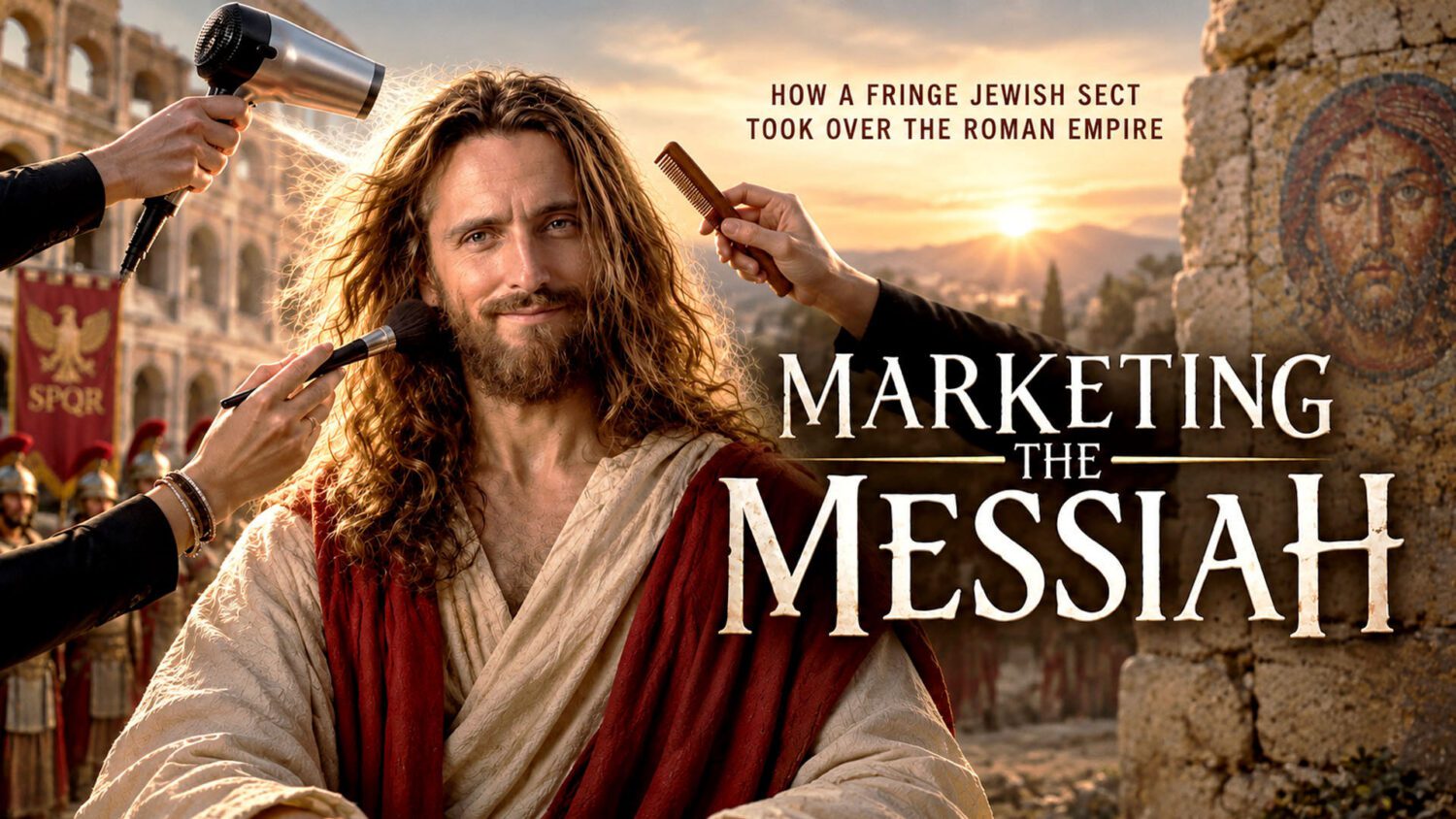
The title is a joke with a serious edge. Every movement that spreads needs a story, a symbol, a message and a messenger. The film’s cover art makes the point with humor. Jesus sits in a Roman setting while hands rush in with a hairdryer, a comb and a makeup brush. Image-making, even for a sacred figure, is a very old business.
Looking at how a message was shaped and carried does not make it false, and it does not make it true. It helps us see the human story around it, and it raises the question many seekers ask next: what did Jesus actually teach? This guide answers both.
A Timeline of the Rise
| Date | Event |
|---|---|
| c. 30 CE | Jesus is crucified in Judea under the Roman governor Pontius Pilate |
| c. 50 to 60 CE | Paul writes letters to early communities, the earliest Christian writings we have |
| 64 CE | Nero blames Christians for the fire of Rome |
| c. 70 CE | The Gospel of Mark is usually dated to about now, with Matthew, Luke and John following |
| c. 112 CE | Pliny the Younger writes to Emperor Trajan about how to handle Christians in his province |
| c. 180 CE | Bishop Irenaeus writes Against Heresies to defend one version of the faith over rivals |
| 303 CE | Diocletian begins the “Great Persecution” |
| 313 CE | The Edict of Milan grants religious toleration under Constantine |
| 325 CE | The Council of Nicaea meets to settle the nature of Christ |
| 367 CE | Bishop Athanasius lists all 27 New Testament books |
| 380 CE | Emperor Theodosius makes Nicene Christianity the empire’s official faith |
| 1945 | The Nag Hammadi library is found in Egypt |
Notice the gap. For roughly three centuries the movement grew with no official support, and for much of that time with real danger. Then it became the religion of the state.
The Historical Jesus: What We Can Know
Almost every historian, believer or not, agrees that Jesus of Nazareth lived and was crucified under Pontius Pilate. The evidence comes from several directions.
- Roman and Jewish writers. Tacitus (Annals, c. 116 CE) mentions “Christus” executed under Pilate. Josephus (c. 93 CE) mentions James, “the brother of Jesus who was called Christ.” Part of another passage in Josephus is thought to have been touched up by later copyists.
- Paul’s letters. Written around 50 to 60 CE, they are the earliest Christian texts and treat the crucifixion as recent history.
- The four gospels. Written roughly 40 to 70 years after his death, in Greek, by authors who were not eyewitnesses. Matthew and Luke seem to have shared a lost collection of sayings that scholars call Q.
The search for the man behind the stories is called the quest for the historical Jesus. It runs from Albert Schweitzer’s 1906 book to the Jesus Seminar, founded by Robert Funk in 1985, which voted on which sayings sound authentic. Scholars such as Geza Vermes (Jesus the Jew, 1973), E. P. Sanders, John Dominic Crossan and Bart Ehrman have painted different portraits: a Galilean healer, a wisdom teacher, an apocalyptic prophet, a social reformer. Most agree on this much: he was a Jewish teacher from Galilee who spoke Aramaic, and he was most likely known as Yeshua.
What Jesus Taught: The Core Teachings
Across the gospels, and across scholars with very different views, a set of teachings keeps coming up. Many sit inside the Sermon on the Mount (Matthew 5 to 7) and its shorter cousin in Luke 6.
| Teaching | In plain words |
|---|---|
| The kingdom of God is near | A new way of living is available now, not only after death |
| Love God and love your neighbor | Named as the greatest commandments |
| Love your enemies | Respond to hostility with care, not revenge |
| The Golden Rule | Treat others as you want to be treated |
| Forgive freely | Release others, and you are released |
| The last will be first | Humility over status; care for the poor and outcast |
| Look within | Judge your own heart before judging others |
| Pray simply and sincerely | The Lord’s Prayer, not showy piety |
Notice what is missing from this list. Jesus is not recorded as teaching a creed, a church organization or the Trinity. Those came later. His message, as the gospels preserve it, is about how to live and how to see.
The Kingdom Within: A Translation Puzzle
In Luke 17:21 Jesus says the kingdom of God is entos hymon. The Greek can mean “within you” or “among you.” Many translations choose “among you,” and many mystics choose “within you.” Both are possible, and the difference matters. If the kingdom is within, the path is inner. If it is among us, the path is how we treat one another.
Mystical readers have long held both. The Christian mystics spoke of the soul as a place where the divine dwells. The Gospel of Thomas, discussed below, leans strongly inward. Our guide to spiritual enlightenment and to non-duality follows this same thread across traditions.
The Lost Gospels and the Sayings of Thomas
In December 1945, a farmer near Nag Hammadi, Egypt, found a sealed jar holding thirteen ancient books. They contained about fifty texts, many of them Gnostic gospels, hidden around the fourth century. Among them was the Gospel of Thomas, a list of 114 sayings of Jesus with no birth, no miracles and no crucifixion story.
- The tone is inward. The kingdom is inside you and all around you. Knowing yourself is the key.
- Dating is debated. Some scholars place parts of it as early as the canonical gospels, others in the second century. Fragments in Greek were found at Oxyrhynchus decades earlier.
- Other finds. The Gospel of Mary, the Gospel of Philip and the Gospel of Truth came from the same era of debate. The Gospel of Judas surfaced in the Codex Tchacos and was published in 2006.
Historian Elaine Pagels brought these texts to a wide audience in The Gnostic Gospels (1979). She showed that early Christians disagreed sharply about whether Jesus brought a message of faith in authority or of inner knowing, and that the side that won shaped the Christianity we inherited. For more, see our guides to the Gnostic Gospels and Mary Magdalene.
The Lost Years: India, Egypt and the East
The gospels tell of Jesus at his birth, once at age 12 in the Temple, and then again around age 30. The 18 years between are a silence. People have filled it in many ways.
| Claim | Source | Status |
|---|---|---|
| Jesus studied in India and Tibet | Nicolas Notovitch, The Unknown Life of Jesus Christ (1894) | Widely regarded as a hoax; the monastery denied it |
| Jesus lived in Kashmir after the crucifixion | Holger Kersten, Jesus Lived in India (1983), drawing on the Ahmadiyya tradition and the Rozabal tomb | Rejected by most scholars |
| Jesus studied with the Essenes and in Egypt | Edgar Cayce readings | A spiritual claim, not a historical finding |
| Jesus traveled widely and learned from the mystery schools | The Aquarian Gospel (Levi Dowling, 1908), said to be drawn from the Akashic Records | A channeled source |
No ancient document confirms a journey east, and most historians prefer a simpler explanation: he was a carpenter’s son in Galilee. Still, the story endures because it fits what many seekers sense, that his teachings of compassion, non-attachment and inner awakening sound much like Eastern wisdom. Explore both sides with Jesus in India and Jesus in Egypt: The Missing Childhood Years on NLS TV, and read our guide to the lost years of Jesus.
Mystical and Channeled Sources on Jesus
Alongside scholars, a long line of mystics and channels has offered its own account of who Jesus was and what he taught. Whether you take these as literal messages or as inspired writing, they show how many seekers have met Jesus in direct experience, not only in the gospels.
| Source | What it offers |
|---|---|
| A Course in Miracles (scribed 1965 to 1972 by Helen Schucman, who said the voice was Jesus) | A “Christ-mind” path where forgiveness dissolves fear and love is the only reality |
| Paramahansa Yogananda, The Second Coming of Christ (2004) | A line-by-line yogic reading of the gospels, teaching that “the Christ within” is a state of consciousness anyone can reach. See Ascended Master Yogananda |
| Edgar Cayce readings | Describe Jesus as a soul who passed through many lives, trained among the Essenes and fulfilled a path of service |
| The Aquarian Gospel (Levi Dowling, 1908) | A channeled life of Jesus said to be drawn from the Akashic Records, including the lost years |
| The Urantia Book (1955) | A long channeled account of the life and teachings of Jesus |
| The Gnostic gospels | Teach that salvation comes through inner knowing, or gnosis |
| Ascended Master Jesus Christ | Channeled teachings on NLS TV in the Ascended Masters series |
Notice the pattern across these voices. They differ on details, yet they tend to stress the same few things: love as the essence, forgiveness as the practice and the divine as something you can know directly. It is also the heart of what the earliest sayings preserve. Explore our guides to the Akashic Records and to channelers and mediums.
Many Christianities
One of the most eye-opening ideas in the study of early Christianity is that there was no single, tidy “Christianity” at first. There were Jewish followers who kept the Law, Gentile communities shaped by Paul, followers of Marcion who rejected the Hebrew scriptures, and many Gnostic groups who taught a path of inner knowledge. Their writings argued with each other.
Irenaeus, Tertullian and others wrote against rival versions, and in doing so they preserved quotations that show what was at stake. The group that won was not simply the one with the best case. It was the one that organized best, built bishops and a shared creed, and later won imperial backing. That is the “marketing” story in the film’s title.
How the Message Changed
- From teacher to doctrine. Paul’s letters, the earliest writings we have, say little about the sayings of Jesus and a great deal about his death and resurrection.
- From movement to institution. By the second century, bishops held authority and “right belief” became a test of belonging.
- From persecuted to protected. Constantine’s support after 312 brought buildings, money and political influence.
- From debate to creed. The Council of Nicaea in 325 produced the first Nicene Creed. Almost all the bishops present signed it.
- From many texts to one canon. The 27-book list took shape over centuries. Nicaea did not decide it.
What about reincarnation?
Seekers often ask whether reincarnation was cut from the Bible. There is no manuscript evidence for that. What we do know is that the early thinker Origen (c. 185 to 253) taught that souls exist before birth and are refined across their journey. In 553, the Second Council of Constantinople condemned teachings linked to Origen. Historians debate how much the council targeted what he actually taught. Read more in our guides to reincarnation and karma.
Myths vs Facts
| Common Claim | What the Evidence Shows |
|---|---|
| Nicaea chose the books of the Bible | No. Nicaea dealt with the nature of Christ. The canon formed over centuries |
| Jesus never existed | Nearly all historians, believers and skeptics alike, say he did |
| Jesus was born on December 25 | The gospels give no date. December 25 first shows up in Roman records in the fourth century |
| There were three kings | Matthew speaks of Magi and three gifts, not a number or kings |
| Mary Magdalene was a prostitute | No gospel says so. A 591 sermon blended several women, and the Church revised that in 1969 |
| Constantine invented the divinity of Jesus | No. Belief in Christ’s divine status is much older. Nicaea argued about how to describe it |
| The “lost years” in India are proven | No ancient source confirms them. They are a spiritual tradition and a popular theory |
Why Christianity Spread
Scholars do not agree on one answer, but several factors come up again and again.
- Roads and a common language. Roman roads, sea lanes and widely spoken Greek let ideas travel fast.
- Care for the sick and poor. Christians were known for looking after their own and others in times of plague. Sociologist Rodney Stark argued in The Rise of Christianity (1996) that steady growth of about 40 percent a decade, driven by networks of friends and family, can explain the numbers.
- A message of hope across class lines. The movement welcomed women, slaves and the poor, and promised life after death.
- A powerful convert. Constantine’s support in the fourth century changed everything.
- Good storytelling and symbols. A clear message, a memorable founder and shared rituals were easy to pass on.
How the Messiah Got His Look
The earliest Christian art, found in the Roman catacombs, often shows Jesus as a young, beardless shepherd, much like images of other figures in Roman culture. The long-haired, bearded face most of us picture became standard later, in Byzantine art around the sixth century. The faces we recognize were chosen over time by artists and communities, not recorded by an eyewitness. That fits the film’s playful title well.
How to Read the Gospels Today
- Start with Mark. It is the shortest and usually considered the earliest gospel.
- Read the Sermon on the Mount slowly. Matthew 5 to 7 holds many of the core teachings.
- Compare gospels side by side. Notice what Matthew, Luke and John each add or change.
- Read Thomas next. Its inner, sayings-only tone gives a different angle.
- Ask who wrote it, when and why. The history behind a text helps you weigh it.
- Test it in life. Many teachers say the best proof of a teaching is what it does to your heart.
A Seven-Day Practice: Live the Teachings
You do not have to settle every historical question to put the core teachings to work. Try one a day for a week.
| Day | Teaching | Practice |
|---|---|---|
| 1 | Look within | Sit for 10 minutes and ask where the kingdom is in you |
| 2 | Golden Rule | Before each choice, ask how you would want to be treated |
| 3 | Forgive | Name one hurt and write a sentence of release |
| 4 | Love your enemy | Wish well, silently, to someone you find difficult |
| 5 | Serve the least | Do one quiet act of help with no credit |
| 6 | Simple prayer | Say the Lord’s Prayer slowly, or a prayer of your own |
| 7 | Judge less | Catch every critical thought and soften it |
For a guided way to quiet the mind first, see our meditation guide and our guide to the heart chakra.
Keep Exploring on Next Level Soul TV
- The Forgotten Christ. A film on the hidden side of the Jesus story.
- Jesus in India. A film on the claim that Jesus traveled east.
- Jesus in Egypt: The Missing Childhood Years. A film on the early years.
- Crucifixion Quake. A film on the earthquake at the crucifixion. Read our Spiritual Cinema guide to Crucifixion Quake.
- The Vatican Files: The Bible’s Secret History. A show on how the Bible came together.
- Ascended Master Jesus Christ. A channeled show on NLS TV.
- Ascended Master Mary Magdalene. A channeled show on NLS TV.
- Go deeper with Next Level Soul Mastery, our collection of in-depth courses.
Books for Going Deeper
- The Gnostic Gospels by Elaine Pagels. The classic on the Nag Hammadi finds.
- Misquoting Jesus by Bart Ehrman. How the New Testament text changed over time.
- The Second Coming of Christ by Paramahansa Yogananda. A mystical reading of the gospels.
- Jesus the Jew by Geza Vermes. The Galilean teacher in his own world.
- The Rise of Christianity by Rodney Stark. How a small movement grew.
- A Course in Miracles. A modern channeled text on forgiveness.
As an Amazon Associate, Next Level Soul earns from qualifying purchases.
Frequently Asked Questions
What Is Marketing the Messiah About?
It is a playful, well-researched film about the surprising and often misunderstood origins of early Christianity. It separates historical fact from long-held tradition and asks how a fringe Jewish sect came to take over the Roman Empire. It runs 1 hour 43 minutes and is rated TV-14.
Where Can I Watch Marketing the Messiah?
You can watch it on Next Level Soul TV Watch Marketing the Messiah on Next Level Soul TV.
What Were the True Teachings of Jesus?
Historians and mystics agree on a core: love of God and neighbor, forgiveness, humility, care for the poor, loving your enemies and the nearness of the kingdom of God. The Sermon on the Mount gathers many of these. Scholars and mystics differ on how much else belongs to Jesus himself and how much came later.
Did Jesus Really Exist?
Almost all historians say yes. Jewish and Roman writers such as Josephus and Tacitus mention him, and Paul wrote about him within roughly 20 to 30 years of his death. What historians debate is what he said and did, not whether he lived.
What Is the Gospel of Thomas?
A collection of 114 sayings attributed to Jesus, found in Egypt in 1945 as part of the Nag Hammadi library. It has no story of the crucifixion. Scholars debate whether parts of it are as early as the canonical gospels.
Did the Council of Nicaea Decide Which Books Are in the Bible?
No. Nicaea in 325 CE dealt mainly with the nature of Christ and produced the first Nicene Creed. The list of 27 New Testament books took shape over centuries, and Bishop Athanasius named all 27 in a letter in 367.
Was Reincarnation Removed From the Bible?
There is no manuscript evidence that reincarnation was cut from the Bible. The early Christian thinker Origen taught that souls exist before birth, and a church council in 553 condemned teachings linked to him. Historians debate how far that council went.
Did Jesus Travel to India?
Some books, films and channeled sources say so, and tell of lost years between about ages 12 and 30. Most scholars reject the claim, since no ancient document confirms it. The story remains popular in spiritual circles and is explored in the film Jesus in India on NLS TV.
Was Mary Magdalene a Prostitute?
No gospel says so. A sermon by Pope Gregory I in 591 blended her with other women in the gospels, and the idea stuck. The Church revised its liturgical calendar in 1969 to remove that identification.
Where Can I Learn More About the Hidden Teachings of Jesus?
Start with the films and shows in the Keep Exploring list below, then read the Gospel of Thomas, the Gospel of Mary and a scholarly guide such as Elaine Pagels on the Gnostic gospels.