





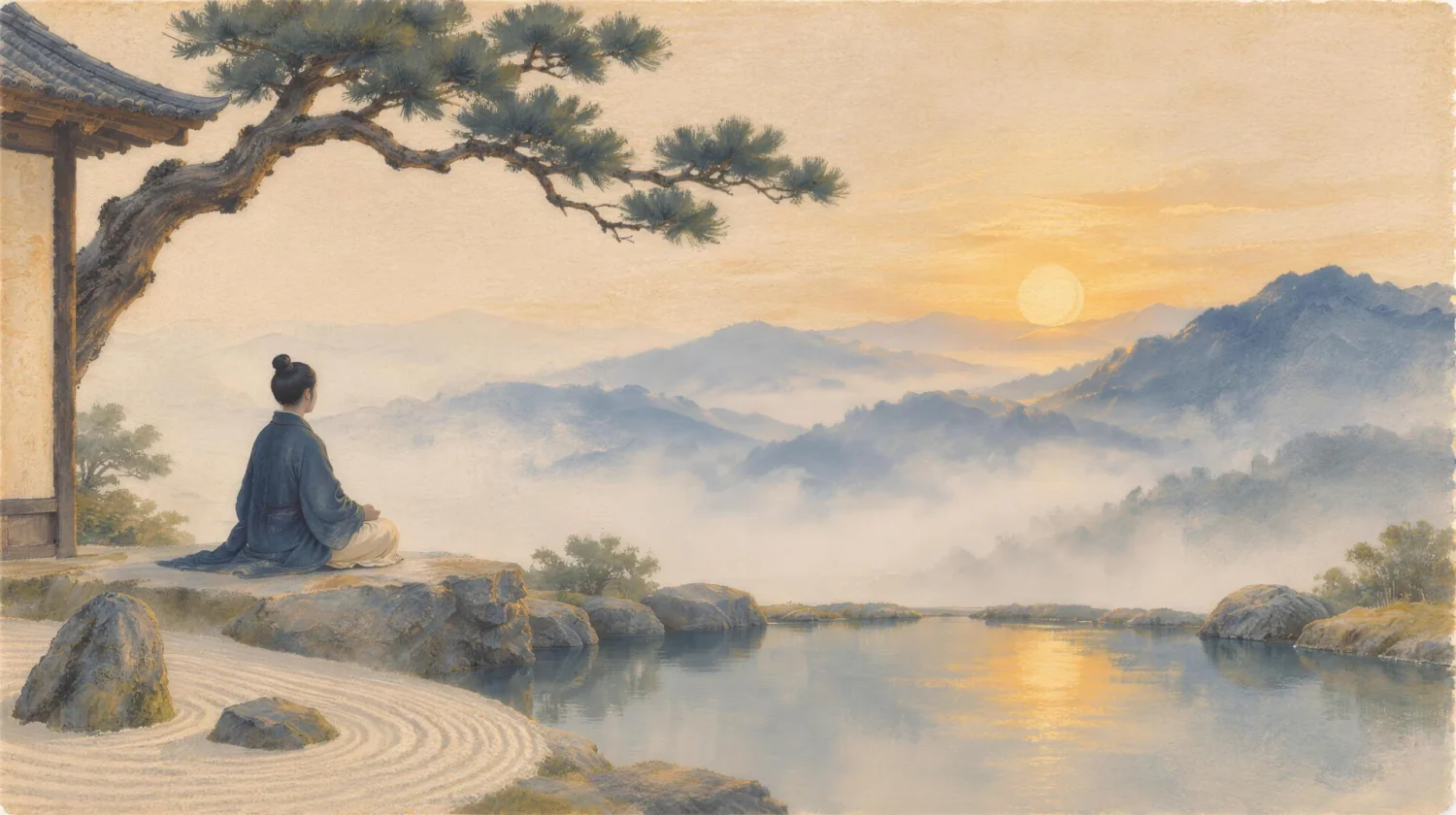
Zen meditation is a simple, direct practice of sitting still, following the breath and letting thoughts rise and pass without chasing them. It comes from the Zen school of Buddhism, which developed in China and then Japan, and it is often practiced as zazen, which means seated meditation. This guide explains what Zen meditation is, where it comes from, how to sit, how to breathe and how to build a steady beginner practice.
Key Takeaways
- What it is: a seated practice of attention to posture, breath and the present moment.
- Origin: Zen grew out of Chan Buddhism in China and became established in Japan.
- Two main styles: Soto (just sitting) and Rinzai (often paired with koan study).
- Beginner routine: 5 to 10 minutes a day, counting breaths from one to ten.
- Key idea: you do not try to stop thoughts. You notice them and return to the breath.
What Is Zen Meditation?
Zen meditation is a form of Buddhist meditation centered on sitting upright, breathing naturally and resting attention in the present. In Japanese the seated practice is called zazen, written with characters that mean sitting and Zen. Our glossary entries on zazen and Zen Buddhism give short definitions, and our guide to types of meditation shows how Zen compares with other methods.
What sets Zen apart is its plainness. There are no elaborate visualizations or mantras in the basic practice. You sit, you breathe and you notice what is here. Teachers often say the practice is simple but not easy, since the mind tends to wander and the body tends to fidget.
Where Zen Meditation Comes From
Zen traces its roots to Chan Buddhism in China, which blended Indian Buddhist meditation with Chinese culture. Tradition credits a monk named Bodhidharma with bringing meditation practice to China around the fifth or sixth century, though historians say much of the early story is legend. Chan then traveled to Japan, where it became known as Zen and took root in two major schools. You can read more in Wikipedia’s articles on Zen and Bodhidharma.
| Period | Development |
|---|---|
| 5th to 6th century | Meditation teachings associated with Bodhidharma reach China |
| 7th to 10th century | Chan Buddhism flourishes in China |
| 12th to 13th century | Eisai and Dogen bring Rinzai and Soto teachings to Japan |
| 20th century | Zen teachers establish centers in the West |
Soto and Rinzai: The Two Main Styles
Most Zen practice in the world today follows one of two traditions. They share the same sitting posture but differ in emphasis.
| Feature | Soto Zen | Rinzai Zen |
|---|---|---|
| Main practice | Shikantaza, or just sitting | Zazen with koan study |
| Founder in Japan | Dogen, 13th century | Eisai, 12th century |
| Tone | Quiet, open awareness | Focused, sometimes intense questioning |
| Where you sit | Often facing a wall | Often facing the center of the room |
| Typical teaching style | Patient, steady | Direct, sometimes surprising |
You can read more about the two approaches in Wikipedia’s articles on shikantaza and koans. Our glossary has a short entry on koan too.
How to Do Zen Meditation: Step by Step
You do not need special equipment, though a firm cushion helps. Here is a simple method that most Zen teachers would recognize.
- Find a quiet place. Choose a spot where you will not be disturbed for the length of your session.
- Set a timer. Start with five to ten minutes.
- Take your seat. Sit on a cushion or chair with your spine upright and your shoulders relaxed.
- Place your hands. Rest one hand in the other, palms up, thumbs lightly touching to form an oval.
- Set your eyes. Keep them half open, gazing softly downward at about a forty-five degree angle.
- Breathe naturally. Breathe through the nose without trying to control it.
- Count your breaths. Count one on the exhale, two on the next, up to ten, then start again. If you lose count, begin again at one.
- Return, return, return. When thoughts arise, notice them and gently come back to the breath.
- Close slowly. When the timer ends, take a breath, move your body and rise without hurry.
Zen Sitting Postures
Posture is a major part of Zen teaching, because the body and mind are seen as connected. Choose a position you can hold with a steady spine and comfortable legs.
| Posture | Description | Good for |
|---|---|---|
| Full lotus | Each foot rests on the opposite thigh | Flexible hips and long practice |
| Half lotus | One foot on the opposite thigh, the other beneath | Moderate flexibility |
| Burmese | Both legs folded in front, resting on the floor | Most beginners |
| Seiza | Kneeling, often with a bench or cushion | Those who prefer an upright, kneeling position |
| Chair | Feet flat on the floor, spine away from the back of the chair | Anyone with knee, hip or back limits |
Many teachers say the position matters less than the alignment: hips slightly higher than knees, spine long, chin gently tucked and shoulders soft. If you have a health condition, choose what feels safe, and ask a teacher or doctor if you are unsure.
Working With the Breath
Breath counting is the classic entry point because it gives the mind a clear, measurable task. You are not trying to breathe in any special way. You are simply noticing the breath and counting exhales.
| Stage | Method | When to use it |
|---|---|---|
| Counting | Count each exhale from one to ten, then repeat | Early practice, or any time the mind is busy |
| Following | Follow the whole breath without counting | When counting feels steady |
| Just sitting | Rest in open awareness with no technique | With more experience, often with a teacher |
If you are curious about the more open style, look into shikantaza, which Soto teachers describe as sitting with full attention and no fixed object. Most beginners begin with counting and move on when it feels natural.
What to Do With Thoughts
A common beginner worry is that the practice is failing because the mind keeps wandering. Zen teachers say the opposite. The moment you notice you have drifted is the moment of practice. The key steps are simple.
- Notice. Realize that you have been thinking.
- Label lightly. You can silently say thinking, if it helps.
- Return. Come back to the breath without scolding yourself.
Over time, many people find that thoughts become less sticky. They still arise, but they have less pull. Our glossary entry on mindfulness explains the same skill of noticing without judging.
Koans: Questions That Point Beyond Answers
In the Rinzai tradition, students may work with koans, which are short stories or questions that cannot be solved by ordinary reasoning. A teacher gives a koan and the student sits with it, bringing a response to private meetings. Two of the best-known examples are listed below.
| Koan | Where it comes from | What it invites |
|---|---|---|
| What is the sound of one hand? | Attributed to the Japanese teacher Hakuin | Letting go of ordinary thinking about sound and self |
| Does a dog have Buddha nature? (Mu) | A story about the Chinese master Joshu | Direct, wordless attention to the question itself |
Koans are not riddles with a clever answer. They are tools for turning attention inward, and students usually work with them under a teacher. If you are new to Zen, it is fine to leave koans for later.
Walking Zen Meditation (Kinhin)
Zen practice includes walking meditation, called kinhin, which usually follows a period of sitting. Practitioners walk slowly in a line, hands folded at the chest, coordinating each step with the breath. You can practice it at home by walking slowly in a hallway or garden. For a broader introduction, see our guide to walking meditation.
- Keep your gaze soft and a few feet ahead.
- Take one step with each breath, or slightly slower.
- Feel the heel, the ball and the toes in turn.
- When thoughts arise, return attention to the soles of the feet.
What Happens at a Zen Center
Many people learn Zen meditation at a local center. A visit usually follows a rhythm like the one below, though details vary.
| Moment | What happens |
|---|---|
| Arrival | You remove your shoes and receive simple instructions |
| Bowing | People bow toward the room and their cushion |
| Sitting | A bell signals the start of a period, often 25 to 40 minutes |
| Walking | A short period of kinhin helps loosen the legs |
| Talk or discussion | A teacher may give a talk or answer questions |
| Tea or close | Many centers end with tea or a short chant |
Longer retreats, called sesshin, are held at many centers. They involve several days of structured sitting, walking, meals and silence. If you are new, it is wise to build a home practice first and try a one-day event before a longer retreat.
Common Beginner Challenges and Fixes
| Challenge | Why it happens | What to try |
|---|---|---|
| Restless mind | The mind is used to constant stimulation | Count breaths and keep sessions short |
| Sleepiness | The body relaxes and energy drops | Sit earlier in the day, open the eyes slightly and sit upright |
| Knee or back pain | The posture is unfamiliar | Raise your cushion, try a chair or change position |
| Boredom | Nothing seems to be happening | Notice small sensations and return to counting |
| Strong feelings | Stillness lets emotions surface | Breathe, label gently and take a break if you need to |
| Skipping days | Life gets busy | Anchor practice to an existing habit, such as morning coffee |
Benefits People Report From Zen Meditation
Research on meditation in general suggests that regular practice can support stress reduction, attention and emotional regulation, though results vary and studies differ in quality. Zen has been studied less than some other methods, so it is best to hold specific claims lightly. Here is what practitioners commonly describe.
- Steadier attention. Counting and returning builds the habit of noticing distraction.
- Calmer reactions. Many people feel less hijacked by irritation or worry.
- Better rest. A short sit in the evening can help some people unwind.
- Clearer values. Quiet time often makes it easier to hear what matters to you.
- Appreciation. Ordinary moments, such as tea or a walk, feel fuller.
Meditation is not a replacement for medical or mental health care. If you live with anxiety, depression or trauma, talk with a professional, since sitting in silence can sometimes bring up difficult feelings.
Zen Meditation Compared With Other Practices
| Practice | Main focus | Technique | Best for |
|---|---|---|---|
| Zen (zazen) | Posture, breath, presence | Counting breaths or just sitting | Those who like simplicity and structure |
| Mindfulness | Noticing the present moment | Body scans, breath and daily awareness | Beginners and secular settings |
| Vipassana | Insight into sensations | Systematic observation of the body and mind | Those who want a detailed, structured method |
| Transcendental Meditation | Effortless mantra repetition | A personal mantra taught by a certified teacher | Those who like a mantra-based method |
| Loving-kindness | Compassion | Silent phrases of goodwill | Those who want to soften the heart |
Our guide to types of meditation goes further into these options and how to choose among them.
A 30-Day Beginner Plan
Consistency matters more than length. This plan builds gradually, and you can repeat any week that feels right.
| Week | Daily time | Focus |
|---|---|---|
| 1 | 5 minutes | Count breaths from one to ten and return to one when you lose count |
| 2 | 10 minutes | Add an upright posture and half-open eyes |
| 3 | 15 minutes | Add a short period of walking meditation afterward |
| 4 | 20 minutes | Try following the breath without counting for part of the time |
- Sit at the same time each day.
- Keep a short note after each sit: how long, how it felt and one observation.
- If you miss a day, simply begin again.
Zen in Daily Life
Zen teachers say the practice does not end when you leave the cushion. Ordinary tasks, such as washing dishes, walking and cooking, can become meditation when done with full attention. The Vietnamese Zen teacher Thich Nhat Hanh is well known for teaching this approach, and many people find it a gentle way to bring practice into a busy day.
- Eat one meal slowly, noticing taste, texture and gratitude.
- Do one chore mindfully, paying attention to hands, water and movement.
- Pause before opening your phone, taking one breath.
- Listen fully in one conversation each day, without planning your reply.
Beginner’s Mind
The Japanese Soto teacher Shunryu Suzuki popularized the phrase beginner’s mind in the West through his talks and the book Zen Mind, Beginner’s Mind. The idea is to approach practice, and life, with openness and curiosity, as if for the first time. Experts and beginners alike are invited to drop expectations, since the practice is always happening now. You can read more about him on Wikipedia’s page on Shunryu Suzuki.
The Spiritual Side of Zen Meditation
Zen emphasizes direct experience over doctrine. Teachers often say that the point of sitting is not to reach a special state but to wake up to what is already here. Some use the word satori to describe a flash of insight, and our glossary has an entry on satori. Others avoid the idea of attainment altogether and simply emphasize steady practice.
You do not need to be a Buddhist to practice. Many people of different faiths and of none use Zen methods for calm and clarity. If you are drawn to the deeper path, a local teacher and a regular community can help you see how the practice fits your life.
Common Myths About Zen Meditation
- “You must empty your mind.” Zen teachers say the goal is to notice thoughts without following them.
- “You must sit in lotus.” Any stable, upright posture works, including a chair.
- “It is only for monks.” Zen centers welcome lay practitioners, and home practice is common.
- “Zen is about being emotionless.” Practitioners often describe feeling more present to emotion, not less.
- “Longer is better.” Short, regular sits tend to work better than rare long ones, especially at first.
Setting Up a Space for Zen Meditation
A dedicated corner makes it easier to practice every day. You do not need much, and many Zen teachers favor simplicity.
| Item | Why it helps | Simple option |
|---|---|---|
| Cushion (zafu) | Raises the hips so the spine can stay upright | A firm round cushion or folded blanket |
| Mat (zabuton) | Cushions the knees and ankles | A folded towel or yoga mat |
| Timer | Keeps you from checking the clock | A phone timer with a soft bell |
| Wall or blank space | Reduces visual distraction | Face a plain wall about an arm’s length away |
| Light and air | Supports alertness | Soft light and a slightly cool room |
Basic Zen Etiquette
If you visit a Zen center, a few customs show respect for the space and the people in it.
- Bow toward the cushion before and after sitting, with palms together (gassho).
- Stay quiet in the meditation hall and silence your phone.
- Dress simply in comfortable, modest clothing.
- Follow the schedule and ask a host if you are unsure what comes next.
- Remain still during sitting, and use the walking period to stretch.
The Ethical Side: Zen Precepts
Zen practice is rooted in ethics as well as meditation. Many centers teach the Buddhist precepts, which are guidelines such as not harming, not stealing, speaking truthfully and living with care. You can think of them as a way of keeping daily life in line with what you notice on the cushion. They are not rules imposed from outside, but invitations to live in a way that supports a calm mind.
Zen Meditation for Different Lives
| If you are… | Try this |
|---|---|
| A busy parent | Sit for five minutes after the kids are asleep, or practice while waiting in the car |
| Working at a desk | Take three conscious breaths between meetings and walk slowly at lunch |
| A student | Sit for ten minutes before studying to sharpen focus |
| Retired or between jobs | Build a longer morning sit and add a weekly group |
| Dealing with grief or stress | Keep sessions short, pair them with walking and talk to a professional if feelings feel too heavy |
| Living with chronic pain | Use a chair, change positions and focus on kindness toward the body |
Mistakes to Avoid
- Trying too hard. Effort is useful, but gripping the practice creates tension.
- Judging sessions. A restless sit is still a sit.
- Chasing special states. Calm may come and go, and that is fine.
- Skipping guidance. A teacher or group can help you avoid common traps.
- Sitting in pain. Discomfort is normal, but sharp pain is a signal to adjust.
Journal Prompts for Zen Practice
- What did I notice most often during my sit today?
- Where in my day can I bring one breath of attention?
- What expectations do I carry into practice, and what would it feel like to set them down?
- Which tasks do I rush through, and what would change if I slowed them?
- What does beginner’s mind look like in one area of my life?
Notable Zen Teachers Worth Knowing
Learning about the people who shaped the tradition can add depth to your practice. The table lists a few names that often come up in introductions to Zen.
| Teacher | Tradition | Known for |
|---|---|---|
| Dogen (1200 to 1253) | Soto | Founding Soto Zen in Japan and writing the Shobogenzo |
| Eisai (1141 to 1215) | Rinzai | Bringing Rinzai teachings to Japan |
| Hakuin (1686 to 1769) | Rinzai | Reviving koan practice and teaching a famous koan about one hand |
| Shunryu Suzuki (1904 to 1971) | Soto | Founding the San Francisco Zen Center and popularizing beginner’s mind |
| Thich Nhat Hanh (1926 to 2022) | Vietnamese Zen | Teaching mindfulness in daily life and engaged Buddhism |
You can read about Dogen’s life and work on Wikipedia’s page on Dogen, and our glossary entry on Zen Buddhism offers a short overview.
Zen and the Arts
Zen influenced many Japanese arts, which are often practiced as meditation in motion. They are a way to see how attention and simplicity show up outside the meditation hall.
| Art | How attention shows up |
|---|---|
| Tea ceremony | Each movement is slow and deliberate, from preparing the tea to serving it |
| Calligraphy | A single brushstroke leaves no room for hesitation |
| Rock gardens | Raked gravel and stones invite quiet, spacious attention |
| Ink painting | Empty space matters as much as the marks |
| Archery and martial arts | Posture, breath and presence are trained together |
You do not need to study these arts to benefit from the idea behind them. Doing one thing at a time, with care, turns ordinary tasks into practice.
How to Find a Zen Center or Teacher
- Search locally. Many cities have Soto and Rinzai centers that offer beginner instruction.
- Attend an introduction. Look for a free or low-cost orientation evening.
- Ask about lineage. A teacher should be able to explain who trained them.
- Notice the atmosphere. A good center feels respectful, welcoming and not pressured.
- Check boundaries. Be cautious of any group that demands large sums or isolates you from friends and family.
Preparing for a First Retreat
A one-day sit is a gentle introduction to retreat life. A few preparations help it go smoothly.
- Build a base. Practice at home for a few weeks before you go.
- Read the schedule. Know when sitting, walking, meals and rest happen.
- Pack simply. Bring loose clothing, socks and any cushion you prefer.
- Tell loved ones. Let family know you will be out of contact.
- Be kind to yourself. Expect restlessness and tiredness, and rest when you need to.
Deepening Your Practice Over Time
After a few months of steady sitting, many people look for ways to go deeper. Options include longer sits, a weekly group, reading a classic text or working with a teacher. Some practitioners add a short chanting or bowing practice, while others explore related paths such as loving-kindness or movement-based meditation. There is no single route, and the right next step is the one that keeps you practicing with curiosity and care.
| Stage | Typical focus |
|---|---|
| First month | Show up daily and learn the basics of posture and breath |
| Three months | Extend the sit and begin to notice patterns in your thinking |
| Six months | Join a group or attend a one-day retreat |
| One year | Consider working with a teacher and exploring related practices |
Bringing It Together
Zen meditation asks for very little: a place to sit, an upright spine, a few minutes and the willingness to return to the breath again and again. Its value comes from repetition, not intensity. Whether you sit for five minutes at home or join a group at a local center, the practice invites a simple question that is worth carrying through the day: what is here, right now, and can I meet it with attention and care?
Go Deeper with NLS Mastery: Ancient Meditation for Inner Stillness
Build a steady meditation practice rooted in ancient teachings on stillness, breath and awareness. Acharya Shunya teaches Vedic meditation step by step in Ancient Meditation for Inner Stillness, part of NLS Mastery. Watch the course preview below.

Frequently Asked Questions
What is Zen meditation?
Zen meditation, or zazen, is a seated Buddhist practice of attending to posture, breath and the present moment. It comes from the Zen school that developed in China and Japan.
How do I start Zen meditation?
Sit upright on a cushion or chair, rest your hands in your lap and breathe naturally. Count each exhale from one to ten, return to one when you lose count and start with five to ten minutes a day.
What is the difference between Zen meditation and mindfulness?
Mindfulness is a general skill of noticing the present moment without judgment. Zen meditation is a specific Buddhist practice with set postures, breath counting and, in some schools, koans.
How long should a beginner meditate?
Five to ten minutes a day is a good start. Many teachers suggest building slowly to twenty minutes and sitting regularly rather than rarely and for long.
Do I have to sit in the lotus position?
No. Any stable, upright posture works, including a chair, a Burmese seat or kneeling with a cushion. What matters is a straight spine and a comfortable, steady position.
What is shikantaza?
Shikantaza means just sitting. It is the main practice in Soto Zen, in which you rest in open awareness without counting or using a fixed object.
What is a koan?
A koan is a short Zen story or question, such as asking for the sound of one hand, that points beyond ordinary reasoning. Students usually work with koans under a teacher in the Rinzai tradition.
Can Zen meditation help with stress?
Many people report feeling calmer with regular practice, and research on meditation suggests benefits for stress for some people. It is not a replacement for medical or mental health care.
What is the difference between Soto and Rinzai Zen?
Soto emphasizes shikantaza, or just sitting, with a quiet and steady tone. Rinzai often pairs zazen with koan study and can feel more direct and intense. Both use the same basic sitting posture.
Where should I look when doing Zen meditation?
Most teachers suggest keeping the eyes half open and gazing softly downward at about a forty-five degree angle, a short distance in front of you. Many Soto practitioners face a plain wall to reduce distraction.
Can I do Zen meditation lying down?
Zen practice traditionally uses an upright posture to keep the body alert. If you cannot sit because of health reasons, a supported chair or a reclined position is fine, though you may find it easier to fall asleep.
Is Zen meditation religious?
Zen comes from Buddhism, but you do not need to be a Buddhist to practice. Many people use its methods for calm and focus, and many centers welcome people of any faith or none.
What is the best time of day for Zen meditation?
Many people prefer the morning, before the day fills up, while others sit in the evening to unwind. The best time is the one you can keep consistently, so choose a slot you can protect.
Sources and Further Reading
Spirituality for the Rest of Us™
Movies, series, documentaries, audiobooks, audio courses and guided meditations on awakening and consciousness, all in one place. 14-day money-back guarantee.


