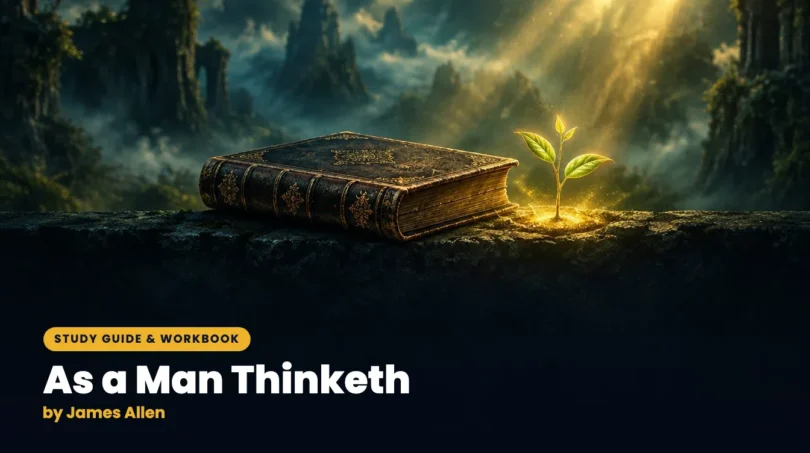
As a Man Thinketh is James Allen’s short book on how the thoughts we choose shape our character and our life. It was first published in 1903 and has stayed in print ever since. This study guide walks through all 7 chapters in plain language, then hands you a workbook to try the ideas on your own life.

Listen While You Study
The audiobook is available on Next Level Soul TV. Play a chapter, then come back here for the notes and the workbook prompt.
Key Takeaways
- Your thoughts are seeds, and Allen says the life you live grows from the ones you keep watering.
- Circumstances reveal you, rather than make you, according to the author, which puts the power to change back in your hands.
- Body and mind are linked, and Allen argues that fear, anger and calm each leave a mark on health.
- A clear purpose steadies the mind, and Allen says a person with an aim stops being tossed around by worry.
- Calm is a kind of strength, and the book closes on serenity as the fruit of patient self-control.
The Book at a Glance
| Detail | What to Know |
|---|---|
| Author | James Allen (1864 to 1912), British writer |
| First published | 1903 |
| Chapters | 7 |
| Tradition | Self-help and New Thought style spiritual writing |
| Audiobook | Available on Next Level Soul TV |
What Is As a Man Thinketh About?
As a Man Thinketh is a very short book with one big claim. Allen argues that a person is the product of their own thoughts. Inner habits of thinking, he says, slowly become character, and character shapes the conditions of a life.
The title points to a line from the Book of Proverbs about how a person’s inner thoughts define them. Allen turns that idea into practical advice. He compares the mind to a garden, and he asks the reader to weed out harmful thoughts and plant useful ones. The tone is calm, direct and encouraging.
The Board: 7 Chapters
Each square is a chapter. Tap one to jump to its study notes.
Chapter-by-Chapter Study Notes
These notes are our own summary, written to help you follow the book. Each one ends with a small practice you can try this week.
Thought and Character
Allen opens with his main picture: the mind is like a garden. It can be tended with care or left to run wild, but something will grow either way. He argues that a person’s character is simply the total of their thoughts, built up over time. Nothing in a life is accidental, he says, because inner habits slowly show up in outer ways. The chapter asks you to take charge of the gardener’s job and decide what grows.
Effect of Thought on Circumstances
Here Allen argues that our circumstances grow out of our thinking, not the other way around. He describes how a person’s outer conditions tend to mirror what is going on inside. He also says that changing inner habits changes the outer picture, though not always overnight. The chapter does not blame people for hard times. It points to where he believes the starting point for change always sits, which is the mind.
Effect of Thought on Health and the Body
Allen teaches that the body acts as the servant of the mind. He describes how fear, worry and anger can weigh on a person, while cheerful and pure thoughts support a lighter, healthier life. He urges the reader to watch their inner talk as carefully as their diet. This is the author’s view, not medical advice, but the chapter makes a simple point: how you think and how you feel in your body are connected.
Thought and Purpose
Allen says that a life without a chosen purpose drifts into worry and self-pity. He invites the reader to pick a worthwhile aim and make it the center of their thinking. Failures, he says, are teachers along the way, and the person with a firm aim grows steadier because of them. The chapter treats purpose as an anchor. It gives your thoughts a direction, so they stop scattering in every direction at once.
The Thought-Factor in Achievement
This chapter links every achievement to the thinking behind it. Allen argues that those who rise do so by building up their own inner qualities, and that those who fall do so by neglecting them. He says that no one can climb higher in life without first climbing in thought. The lesson is that effort needs a steady mind behind it. Gains come from patient work on yourself, not from wishing or luck.
Visions and Ideals
Allen calls dreamers the saviors of the world, and he asks the reader to hold on to their highest vision. He says the ideal you carry within you is the seed of what you will become. The chapter encourages patience and faith in your own ideal even when daily life looks far from it. His view is that what we cherish in our hearts, we slowly move toward, so it pays to choose a worthy dream and to keep it alive.
Serenity
The book ends with calm. Allen describes serenity as one of the ripest fruits of wisdom, earned by long practice in self-control. He says a calm person is no longer thrown about by every storm of mood or event, and that others naturally seek out such a person for steadiness. The final chapter ties the earlier ideas together: guard your thoughts, hold a purpose, and let peace become the quiet result of that daily work.
Key Ideas in Plain Language
| Idea | What It Means | Chapter |
|---|---|---|
| The mind as a garden | Allen’s main picture. The mind grows something either way, so you choose to plant useful thoughts or let weeds take over. | 1 |
| Thought becomes character | Habits of thinking slowly harden into who you are, according to the author. | 1, 2 |
| Circumstances mirror the inner life | Allen argues that outer conditions tend to reflect inner habits, so change starts within. | 2 |
| Body follows mind | The author says fear, anger and calm each leave a mark on health and energy. | 3 |
| A chosen purpose | An aim gives the mind a direction and steadies it against worry and drift. | 4, 5 |
| Self-mastery | Rising in life, Allen says, begins with ruling your own thoughts and impulses. | 5, 7 |
| The power of an ideal | The vision you cherish in your heart is the seed of what you grow into. | 6 |
| Serenity as strength | Calm, in Allen’s view, is the ripe fruit of long self-control and wisdom. | 7 |
| Personal responsibility | Because thoughts are yours to choose, Allen says the results are yours too. | 1, 2, 4 |
Who This Book Is For
This guide is for anyone who wants a short, clear introduction to the idea that attitude shapes life. It suits beginners who have never read a self-help book, and it suits long-time readers who want to slow down and practice. If you like small books with big questions, and you are willing to look at your own habits of thought with honesty and kindness, you will find plenty to work with here.
A 7-Day Way to Use It
- Days 1 to 3: Read or listen to one or two chapters a day, then do the “try it” practice for each one.
- Days 4 to 6: Finish the remaining chapters, and keep a short daily note of the thoughts you catch yourself repeating.
- Day 7: Look back over your notes, choose the single thought pattern you most want to change, and write one new thought to replace it.
- On day 8, reread the chapter that spoke to you most and notice what stands out now that you have practiced.
Your Workbook
Your answers save on this device as you type. They are not sent anywhere. Use the copy button to move them into your own notes.
Watch More on Next Level Soul TV
Next Level Soul TV brings together full episodes, courses, movies, series and audiobooks, ad-free. Join Next Level Soul TV and keep exploring.
Keep Going
- Manifestation vs Law of Attraction: The Difference, History and More
- Mindfulness in Daily Life: A Complete Guide to Everyday Awareness
- Law of Attraction Tips: 15 Grounded Ways to Apply It
Sources and Further Reading
Go Deeper with NLS Mastery: Connect to Your Higher Self
Allen shows that a calm, well-trained mind is where lasting change begins. If you want to take that idea further, Genevieve Taeger teaches it in Connect to Your Higher Self, part of NLS Mastery. Watch the course preview below.

Frequently Asked Questions
What is As a Man Thinketh about?
It is a short book arguing that our thoughts shape our character, our circumstances and even our health. Allen uses the image of the mind as a garden and urges readers to tend it with care and patience.
Who wrote As a Man Thinketh and when?
It was written by James Allen, a British author who lived from 1864 to 1912. The book was first published in 1903 and is his best-known work.
What kind of book is As a Man Thinketh?
It is an early self-help and spiritual essay. It draws on Christian language and New Thought style ideas, but it is written in a plain way that readers from many backgrounds can use.
How many chapters does As a Man Thinketh have and what are they?
There are 7 chapters: Thought and Character; Effect of Thought on Circumstances; Effect of Thought on Health and the Body; Thought and Purpose; The Thought-Factor in Achievement; Visions and Ideals; and Serenity.
What does Allen mean by the mind as a garden?
He says the mind will grow something whether you tend it or not. If you plant useful thoughts and pull out harmful ones, you get a good harvest. If you do nothing, weeds take over.
Does Allen say our circumstances come from our thoughts?
Yes. The author argues that outer conditions tend to mirror inner habits of thought. He presents this as a reason for hope, because it means a person can begin changing their life from within.
What does the book say about health and the body?
Allen teaches that the body serves the mind, so fear and anger weigh on a person while calm and cheerful thoughts support wellbeing. This is his view and not medical advice.
Why does Allen end the book with serenity?
He sees calm as the fruit of long self-control and wisdom. A serene person is steady in changing times, so the final chapter shows where the earlier chapters on thought and purpose are meant to lead.
How should a beginner study As a Man Thinketh?
Take one or two chapters at a time. After each, stop and write down one idea in your own words, then try the small practice for that chapter before moving on.
Is As a Man Thinketh hard to read?
No. It is short and written in clear, steady sentences. The older style can feel formal at first, but the ideas are simple, and a study guide can help you keep your place.
How long does it take to read or listen to?
It is a very short book, and many people finish it in a single sitting. Most readers get more from it by taking a chapter a day and practicing between sessions.
Where can I listen to the audiobook, and what should I read next?
The audiobook is available on Next Level Soul TV. For what to explore next, look for other classic writings on the power of thought, mindfulness, and personal growth.
Spirituality for the Rest of Us™
Movies, teachings and community on Next Level Soul TV.