Mystic Christianity is the 1908 book by Yogi Ramacharaka, a pen name attributed to William Walker Atkinson, that offers a mystical reading of the life and teaching of Jesus. This study guide walks through all 12 lessons in plain language, then hands you a workbook to try the ideas on your own life.
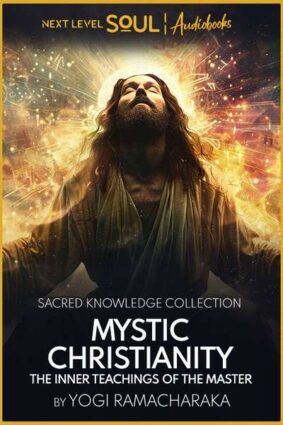
Listen While You Study
The audiobook is available on Next Level Soul TV. Play a lesson, then come back here for the notes and the workbook prompt.
Key Takeaways
- The book reads the life of Jesus as a path of inner growth, not only as a history of events.
- The author says there were two layers of teaching, a public message for everyone and an inner message for those ready for more.
- Love, brotherhood, and the divine spark in each person are presented as the heart of the message.
- Many claims are the author’s own reading, and the book works best when you weigh them with curiosity.
- Each lesson can be turned into a small practice, so the ideas become part of daily life.
The Book at a Glance
| Detail | What to Know |
|---|---|
| Author | Yogi Ramacharaka, a pen name attributed to William Walker Atkinson (1862 to 1932) |
| First published | 1908, Yogi Publication Society, Chicago |
| Lessons | 12 |
| Tradition | New Thought and esoteric Christianity |
| Audiobook | Available on Next Level Soul TV |
What Is Mystic Christianity About?
Mystic Christianity: The Inner Teachings of the Master is a book of twelve lessons about the life and message of Jesus. The author does not write as a church historian. He writes as a teacher of esoteric ideas, and he asks what the familiar stories might mean beneath the surface. He follows the story from the Master’s coming to his final message.
The author’s main claim is that the teaching of Jesus had an outer form and an inner meaning. The outer form was simple and open to all. The inner meaning, he says, was shared with those who were ready. This guide explains each lesson plainly, so you can follow the author’s argument and then make up your own mind.
The Board: 12 Lessons
Each square is a lesson. Tap one to jump to its study notes.
- 1The Master Comes
- 2Virgin Birth
- 3Mystic Youth
- 4Ministry Begins
- 5The Foundation
- 6Organization
- 7Beginning of End
- 8Life Work Ends
- 9Inner Teachings
- 10Secret Doctrine
- 11Ancient Wisdom
- 12The Message
Lesson-by-Lesson Study Notes
These notes are our own summary, written to help you follow the book. Each one ends with a small practice you can try this week.
The Coming of the Master
The author opens with the world Jesus was born into. He describes John the Baptist as a forerunner, the Essenes as a quiet community of spiritual students, and the baptism as a turning point. He also treats the Magi and the Star in the East as signs of a wider tradition of hidden teachers. The point is that Jesus did not appear from nowhere. In this telling, a long line of seekers and teachers prepared the ground.
The Mystery of the Virgin Birth
This lesson looks at the virgin birth from two angles, the orthodox view and the critical view, then offers a third. The author argues that the real mystery is spiritual rather than physical, and that it points to the birth of the divine spark in a person. He asks the reader to look past the literal story to what it may symbolize. Whatever you believe, the lesson invites you to ask what a story is trying to say.
The Mystic Youth of Jesus
Here the author describes the boyhood of Jesus in Nazareth. He says the boy met travelling teachers of occult wisdom and showed unusual depth when he visited Jerusalem at thirteen. The author also discusses the silent years that the Gospels do not cover, and suggests they were years of study and travel. These are the author’s claims and his reading, not settled history. The lesson asks how a quiet, hidden season of growth can shape a whole life.
The Beginning of the Ministry
The author follows Jesus as he leaves private life and begins public work. He describes the time with the Essenes, the baptism by John, and the period in the wilderness, which he reads as an inner test of spiritual power and purpose. The lesson suggests that every real calling is tested in solitude before it is shared. Temptation here is less a villain outside than a struggle within the self.
The Foundation of the Work
With the ministry underway, the author turns to the groundwork of the teaching. He describes the core message in simple terms: the love of God, the unity of people, and a living faith over empty ritual. He presents these as the base on which everything else rests. The lesson asks the reader to look at what is truly basic in their own beliefs, and to ask what they would keep if all the outer forms were stripped away.
The Work of Organization
This lesson describes how the Master gathered helpers and shaped a circle around him. The author discusses the chosen disciples, how they were taught, and how a movement begins to take form. He also hints at a tension between the simple inner message and the structures that grow around it. It is a useful lesson for anyone who has watched a spiritual idea become a group, and wondered what is gained or lost along the way.
The Beginning of the End
The mood turns serious as the story moves toward Jerusalem. The author describes growing opposition, the pressure of religious and political powers, and the way the Master prepared his closest followers for what was coming. He reads these events as part of a plan, not only a tragedy. The lesson invites you to think about courage, about facing a hard road with clear eyes, and about what it means to stay true under pressure.
The End of the Life Work
This lesson covers the closing events of the earthly life of Jesus. The author gives his own mystical reading of the crucifixion and what followed, and he questions some of the literal, bodily ways these events have been taught. He treats the ending as a completion of the work, not a defeat. For the beginner, it is a chance to notice how the same event can be read in more than one way, and to hold your own view gently.
The Inner Teachings
Now the author turns to what he calls the inner, or esoteric, teaching. He says the Master gave one message to the crowds and a deeper one to those prepared to receive it. The lesson describes the idea that spiritual truth has layers, and that understanding grows as the student does. It encourages the reader to treat the familiar words of scripture as doors to something deeper, and to read slowly, with curiosity.
The Secret Doctrine
In this lesson the author discusses what he calls the secret doctrine behind the public teaching. He links it to ideas found in many traditions, including the unity of all life and the divine spark in every person. He presents these as the heart of the mystic path. Remember that this is the author’s view of the tradition. The lesson works best as an invitation to compare, ask, and decide for yourself.
The Ancient Wisdom
The author places the teaching of Jesus inside a much older stream of wisdom. He describes parallels with other spiritual traditions and argues that the great teachers pointed toward the same truths in different languages. The lesson invites the reader to look for common ground between faiths rather than only differences. It is a gentle case for curiosity across traditions, and a reminder that wisdom is not owned by any one group.
The Message of the Master
The final lesson gathers the threads. The author sums up what he sees as the Master’s message: love, brotherhood, and the awakening of the spirit within. He presents it as a call to live differently, not just to believe differently. The lesson ends by turning the reader back toward daily life, asking what it would look like to carry these ideas into work, family, and the quiet hours.
Key Ideas in Plain Language
| Idea | What It Means | Lesson |
|---|---|---|
| Inner and outer teaching | The author says spiritual truth has layers. A public message reaches everyone, and a deeper message waits for those who are ready. | 9, 10 |
| The spiritual virgin birth | The author reads the virgin birth as a symbol of the divine spirit awakening in a person, not only as a physical event. | 2 |
| The silent years | The Gospels say little about the youth of Jesus. The author suggests those years were spent in study and travel. This is his claim, not settled history. | 3 |
| The inner test | The wilderness is read as a private trial of purpose and spiritual power that comes before public work. | 4 |
| Faith over ritual | The author presents a living, inner faith as more important than empty form, rank, or ceremony. | 5, 6 |
| Courage under pressure | The road toward Jerusalem is read as a lesson in facing a hard path with clear eyes. | 7, 8 |
| The divine within | The book teaches that a spark of the divine lives in every person, and that the mystic path is about awakening it. | 10, 12 |
| Common ground between faiths | The author places Jesus inside an older stream of wisdom, and invites readers to look for what traditions share. | 11 |
| Living the message | The closing lesson turns ideas into action: love, brotherhood, and daily practice. | 12 |
Who This Book Is For
This guide is for curious readers who want to explore the mystical side of the Christian story without needing a theology degree. It suits anyone who likes comparing traditions, anyone drawn to New Thought and esoteric ideas, and anyone who wants a gentle, structured way into a book written over a hundred years ago. You do not need to agree with the author. You only need to bring curiosity and an open notebook.
A 12-Day Way to Use It
- On day 1, read or listen to Lesson 1 and its entry here. Do the try-it practice, then write three sentences about what stood out.
- On days 2 to 6, take one lesson a day. Read the entry, listen to the lesson, and try the small practice for that lesson.
- On days 7 to 12, continue one lesson a day. Each evening, note one idea you agree with and one you want to question.
- On day 13, reread your notes from all 12 days. Circle the practices that helped most, and choose one to keep.
Your Workbook
Your answers save on this device as you type. They are not sent anywhere. Use the copy button to move them into your own notes.
Watch More on Next Level Soul TV
Next Level Soul TV brings together full episodes, courses, movies, series and audiobooks, ad-free. Join Next Level Soul TV and keep exploring.
Keep Going
- Gospel of Thomas Explained: The Hidden Sayings of Jesus
- The Gnostic Gospels Explained: Nag Hammadi, Thomas and the Lost Teachings
- Jesus of Nazareth: Life, Teachings and Legacy as an Ascended Master
Sources and Further Reading
Go Deeper with NLS Mastery: The True Teachings of Jesus
The book invites you to look for the divine within, past outer forms and into direct inner experience. If you want to take that idea further, John Davis teaches it in The True Teachings of Jesus, part of NLS Mastery. Watch the course preview below.
Frequently Asked Questions
What is Mystic Christianity about?
It is a book of twelve lessons that reads the life and message of Jesus through a mystical lens. The author describes an inner teaching beneath the public one and asks readers to look for the spiritual meaning in familiar stories.
Who wrote Mystic Christianity and when?
It was published in 1908 under the name Yogi Ramacharaka. That name is attributed to William Walker Atkinson (1862 to 1932), a New Thought writer from Baltimore who used several pen names. The Yogi Publication Society of Chicago issued it.
What kind of book is Mystic Christianity?
It belongs to the New Thought and esoteric tradition of the early twentieth century. It is not a church history or a formal theology text. It is a teacher’s personal interpretation, written for general readers who are curious about inner meaning.
How many lessons are in Mystic Christianity?
There are twelve lessons. They begin with The Coming of the Master, move through the birth, youth, ministry, and closing events, and end with the inner teachings, the secret doctrine, the ancient wisdom, and The Message of the Master.
What does the book mean by inner teachings?
The author says the Master gave a simple message to crowds and a deeper one to those prepared for it. Inner teaching here means the layer of meaning beneath the surface of the stories. It is the author’s claim, offered for readers to weigh.
How does the book read the virgin birth?
The author treats it as a spiritual event rather than a physical one. In his reading, it points to the divine spirit awakening in a person. Readers from different backgrounds may see it differently, and this guide simply explains his view.
What does the book say about the years of Jesus not covered in the Gospels?
The author suggests that Jesus spent those years studying and travelling, and that he met teachers of older wisdom traditions. This is the author’s claim and reading, and it is not presented here as established history.
How should a beginner read Mystic Christianity?
Go one lesson at a time. Read the short entry in this guide first, then read or listen to the lesson, then try the small practice. Keep a notebook for questions. You do not have to agree with every claim.
Is Mystic Christianity hard to read?
The language is plain and the lessons are short, but the style is from 1908, so some sentences feel formal. Some ideas, such as esoteric readings of scripture, may be new. Taking one lesson a day makes it very manageable.
How long does it take to read Mystic Christianity?
Most people can finish the twelve lessons in a few sittings, but the book rewards slower reading. This guide suggests a twelve day plan, one lesson per day, with a small practice each time. That keeps the pace gentle and the ideas fresh.
How does this study guide and workbook help?
It gives you a plain summary of each lesson, a list of key ideas, and a small practice for every lesson. It also offers a 12 day plan. The goal is to help you understand the book and try its ideas in daily life.
Where can I listen to Mystic Christianity, and what should I explore next?
The audiobook is available on Next Level Soul TV. After it, you could explore other writings on Christian mysticism, comparative religion, or the inner life, and see how other traditions speak about the divine within.
Spirituality for the Rest of Us™
Movies, teachings and community on Next Level Soul TV.