The Rosicrucian Mysteries is Max Heindel’s short introduction to the teachings of the Rosicrucian tradition, written in the early twentieth century for readers new to Western esoteric thought. Heindel explains who the Rosicrucians are said to be, why he believes we live many lives, and how he describes the unseen worlds and the layers of the human being. This study guide walks through all 5 chapters in plain language, then hands you a workbook to try the ideas on your own life.
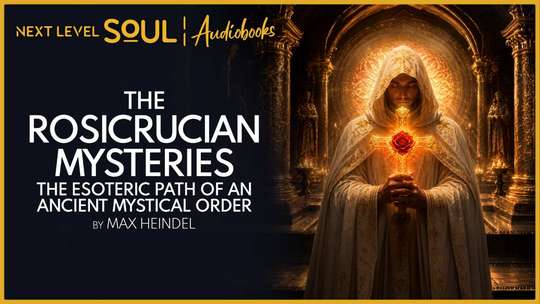
Listen While You Study
The audiobook is available on Next Level Soul TV. Play a chapter, then come back here for the notes and the workbook prompt.
Key Takeaways
- Heindel presents the Rosicrucians as a Western mystery school, a quiet spiritual order he says was founded by Christian Rosenkreuz to join religion with science.
- Rebirth is the answer he gives to life’s riddle, teaching that the spirit returns again and again and learns through the law of cause and consequence.
- The world is more than what we can touch, and the book describes physical, desire and thought worlds as layers of one living whole.
- A person is described as several bodies and a spirit, each with its own job in daily life and in the passage through death.
- Death is treated as a transition, not an ending, and the final chapter describes what the author teaches happens as the spirit moves on and prepares to return.
The Book at a Glance
| Detail | What to Know |
|---|---|
| Author | Max Heindel (1865 to 1919), Danish-born Christian occultist and founder of the Rosicrucian Fellowship |
| First published | 1911 in most library listings, though some references give 1916 |
| Chapters | 5, plus a short closing section on Mt. Ecclesia |
| Tradition | Rosicrucian esoteric Christianity |
| Audiobook | Available on Next Level Soul TV |
What Is The Rosicrucian Mysteries About?
The Rosicrucian Mysteries is an elementary exposition of the teachings of the Rosicrucian Fellowship, founded by Max Heindel in 1909. It is meant as a first step: a short, readable overview before the longer Rosicrucian Cosmo-Conception. Heindel asks the reader to test the ideas against reason and experience instead of simply accepting them.
The book moves from the big questions to the details. It begins with the order and its purpose, turns to the problem of life and death, maps the visible and invisible worlds, describes the parts of the human being, and ends with what the author teaches about dying and being born again. It is a window into one man’s esoteric Christian worldview.
The Board: 5 Chapters
Each square is a chapter. Tap one to jump to its study notes.
Chapter-by-Chapter Study Notes
These notes are our own summary, written to help you follow the book. Each one ends with a small practice you can try this week.
The Order of Rosicrucians and the Rosicrucian Fellowship
Heindel introduces the Rosicrucians as a Western mystery school, said to have been founded in the thirteenth century by a teacher known as Christian Rosenkreuz. He describes its quiet work against materialism and its goal of joining heart and mind, then explains why the Rosicrucian Fellowship was begun in 1909. He also separates the seeker of knowledge from the seeker of devotion, and argues the best path combines both.
The Problem of Life and Its Solution
Here Heindel looks at three answers to the mystery of life and death: materialism, the theological idea of one life followed by a fixed fate, and rebirth. He argues that rebirth explains life’s unfairness best, guided by what he calls the law of cause and consequence. The spirit, he teaches, returns to earth many times, learning a little more each round and carrying forward the results of its actions.
The Visible and the Invisible World
This chapter maps existence as layers. Heindel describes a physical world, a desire world of feeling and motion, and a world of thought, the home of the human spirit. He also describes four kinds of ether and the idea that natural forces are guided by living beings. The picture is of one world with many levels, each with its own laws, and with spiritual sight as a faculty that can be trained over time.
The Constitution of Man
Heindel turns from the world to the person. He teaches that a human being is a spirit wearing several vehicles: a dense body, a life body that carries vitality, a desire body of feeling, and a mind that helps the spirit think. In his account each part has a role in health, emotion and growth, and the work of spiritual development is learning to guide the lower parts with the higher self.
Life and Death
The closing chapter describes the passage out of the physical body and back into life as Heindel teaches it. He presents death as a change of state, with a review of the life just lived, a period of learning in the unseen worlds, and then preparation for a new birth. The aim, in his account, is to treat death with understanding instead of fear and to live each life more consciously.
Key Ideas in Plain Language
| Idea | What It Means | Chapter |
|---|---|---|
| Rosicrucian Order | A Western mystery school that Heindel says was founded by Christian Rosenkreuz to bring spiritual teaching to the West. | 1 |
| Rosicrucian Fellowship | The organisation Heindel founded in 1909 to share these teachings and offer study and healing work. | 1 |
| Rebirth | The idea that the spirit returns to earth many times to grow through experience. | 2, 5 |
| Law of cause and consequence | The teaching that what we do shapes what meets us later, in this life and in future ones. | 2 |
| Three worlds | Heindel’s layers of existence: the physical world, the desire world and the world of thought. | 3 |
| Ethers | Four finer grades of matter within the physical world, one of which is said to record all events. | 3 |
| Spiritual sight | A trained inner perception that the author says lets a person see the unseen worlds. | 3 |
| Desire body | The vehicle of feeling and impulse, central to both daily emotion and what follows death. | 3, 4 |
| Spirit and its vehicles | The idea that the true self uses a dense body, a life body, a desire body and mind. | 4, 5 |
Who This Book Is For
This guide is for curious beginners who want to understand Rosicrucian ideas without wading through dense language. It suits readers of esoteric Christianity, reincarnation, theosophy and Western mystery traditions, and anyone who wants to hear a classic esoteric voice and then think for themselves. You do not need any background. Bring an open mind and a notebook, and treat the ideas as claims to explore.
A 5-Day Way to Use It
- On day 1, read the Order and Life’s Riddle entries, then listen to the first two chapters and answer the workbook questions.
- On day 2, study the Two Worlds entry, then listen to Chapter 3 and try the quiet-observation practice.
- On days 3 and 4, work through Human Makeup and Life and Death, one chapter per day, and journal on each practice.
- On day 6, reread your notes and your answers, circle the idea that stayed with you most, and decide what to carry forward.
Your Workbook
Your answers save on this device as you type. They are not sent anywhere. Use the copy button to move them into your own notes.
Watch More on Next Level Soul TV
Next Level Soul TV brings together full episodes, courses, movies, series and audiobooks, ad-free. Join Next Level Soul TV and keep exploring.
Keep Going
- Reincarnation: Beliefs, Research and What Past Lives Really Mean
- Why the Rosicrucians’ Teachings Were Hidden from the Public, a conversation on the Rosicrucian tradition
- Near-Death Experiences (NDEs): The Complete Guide
Sources and Further Reading
Go Deeper with NLS Mastery: Awakening Divine Consciousness
Heindel teaches that the unseen worlds and the soul’s journey through life and death are real and can be explored. If you want to take that idea further, Paul Selig teaches it in Awakening Divine Consciousness, part of NLS Mastery. Watch the course preview below.
Frequently Asked Questions
What is The Rosicrucian Mysteries about?
It is Max Heindel’s elementary introduction to Rosicrucian teachings. It covers the Rosicrucian order, the riddle of life and death, the visible and invisible worlds, the parts of the human being, and what the author teaches about death and rebirth.
Who wrote The Rosicrucian Mysteries and when?
Max Heindel (1865 to 1919) wrote it. Most library listings give 1911 as the first publication, though Wikipedia’s list of his works gives 1916, so editions and dates vary between sources.
What kind of book is it?
It is an esoteric Christian text from the Rosicrucian tradition. Heindel presents it as a spiritual teaching, not as scientific fact, and invites readers to weigh it by reason and personal experience.
How many chapters are in The Rosicrucian Mysteries?
There are 5 chapters: the Order and the Fellowship, the Problem of Life and Its Solution, the Visible and the Invisible World, the Constitution of Man, and Life and Death. A short section on Mt. Ecclesia follows.
What does Heindel teach about rebirth?
He teaches that the spirit returns to earth many times, learning through experience. Present conditions are said to follow from past actions under a law of cause and consequence, which he offers as an answer to life’s apparent unfairness.
What are the three worlds in the book?
Heindel describes a physical world, a desire world of feeling and motion, and a world of thought. He presents them as layers of one reality, each with its own conditions and its own kind of experience.
How does Heindel describe the human being?
As a spirit using several vehicles: a dense body, a life body, a desire body and mind. Each has its own function, and spiritual growth is described as learning to guide the lower parts with the higher self.
Who was Christian Rosenkreuz?
In Rosicrucian tradition, Christian Rosenkreuz is the legendary founder of the order, first named in manifestos from 1614 to 1616. Heindel treats him as a real teacher, while many scholars regard the figure as symbolic or legendary.
How should a beginner read The Rosicrucian Mysteries?
Take it one chapter at a time and keep a notebook. Read or listen first for the big picture, then return to the terms. Treat each claim as the author’s teaching and note what you agree with and what you question.
Is The Rosicrucian Mysteries hard to read?
It is called an elementary exposition, so it is meant to be approachable. Some older phrasing and unfamiliar terms like desire body and ether can take getting used to, which is where a study guide helps.
How does this study guide and workbook help?
It summarizes each chapter in plain language, explains the key ideas, and gives a small practice for every chapter. It also offers a 5-day plan so you can move from understanding to trying the ideas yourself.
Where can I listen to The Rosicrucian Mysteries, and what should I read next?
The audiobook is available on Next Level Soul TV. For what to read next, try other introductions to esoteric Christianity, reincarnation and the Western mystery traditions to compare viewpoints.
Spirituality for the Rest of Us™
Movies, teachings and community on Next Level Soul TV.