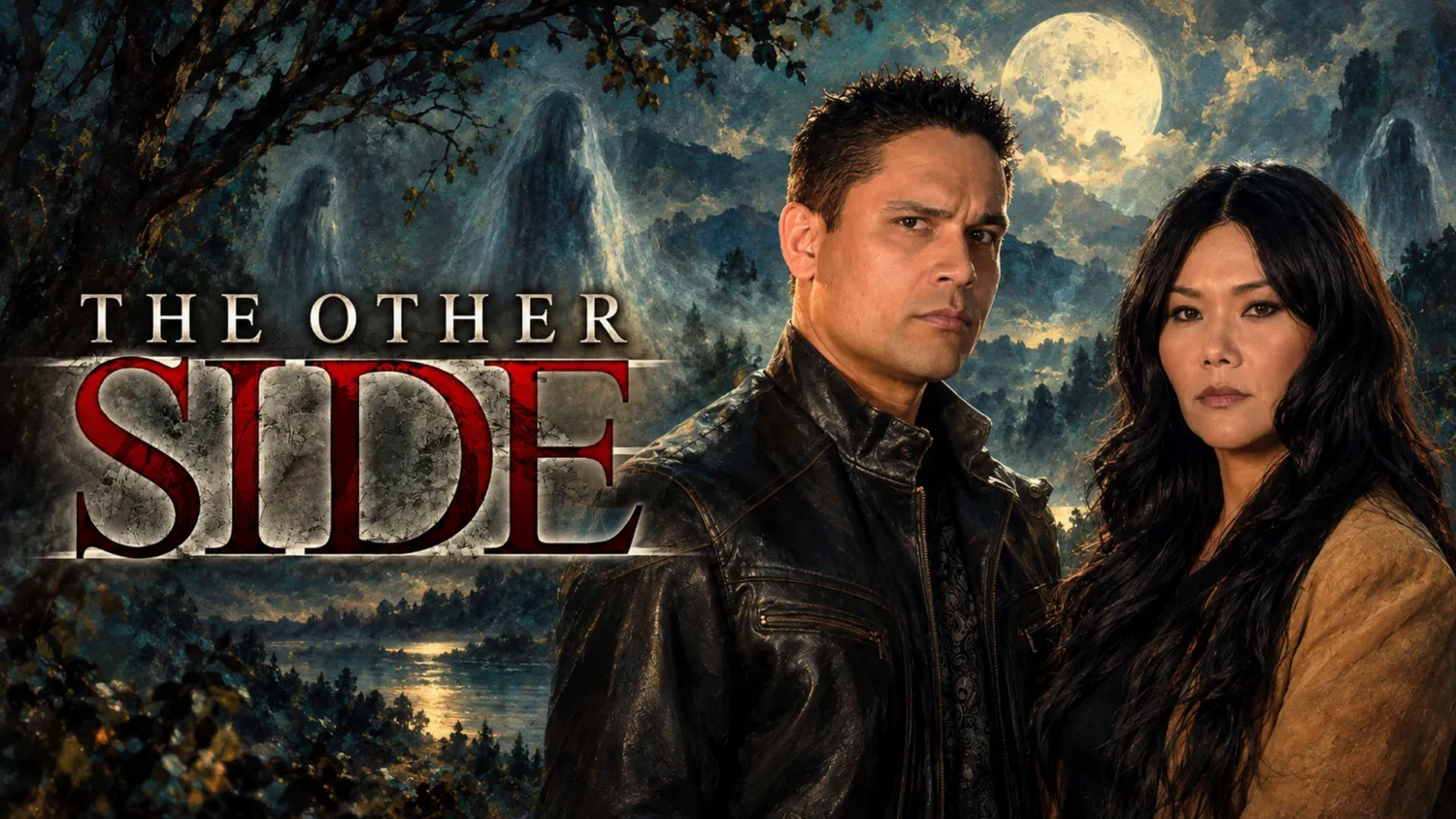

What if the first rule of working with spirits were the same as the first rule of meeting anyone new? Be respectful. Do not provoke. Listen before you ask for anything. That quiet idea runs through The Other Side, a series that follows four people through thirteen haunted places across the Canadian prairies.
The team is intuitive Jeff Richards, investigator Bill Connelly, researcher Priscilla Wolf, and Tom Charles, an Aboriginal Elder who serves as the team’s spirit guide. Jeff opens each episode by saying his gift is no different from what anyone else has, he was simply born with a bit more aptitude and then fine tuned it. That humility sets the tone. This review covers all thirteen episodes, what each case asks of you, and the ideas that stay with you after the credits.
Meet the Team
Each person brings a different way of knowing. Jeff listens, free writes and converses, then hands his pages to Priscilla before anything is verified. Bill brings the equipment, an EMF meter with baseline sweeps, a REM pod, a K-II meter, a spirit box and cameras, and he says he grew up around caskets and has always wondered what happens when we die. Priscilla does the research on properties and neighborhoods, interviews the people who live there, and is the first to admit she is a little scared. She was raised both Catholic and in her mother’s traditional ways, and she carries a holy candle, holy water, a rosary, sweetgrass and sage in case any of it is needed.
Tom is the heart of the series. He opens by saying life has taught him great respect for the other side. He usually joins a case after a night or two, walks the property, and offers impressions and ceremony. The format gives you a rare blend of intuition, evidence gathering and Indigenous practice, and it lets them disagree with each other on screen.
Season One, Episode by Episode
Episode 1: Bekevar Church
Built by Hungarian immigrants over a century ago, the church stands between two cemeteries. The caretaker hears footsteps and slamming doors and has seen a girl in white in the pews. Jeff alone in the church gets two years and the initials ES, and then he and Bill find a single stone in the cemetery for two women named Elizabeth, who died in 1942 and 1933. The most thought provoking scene is Priscilla’s interview with a lifelong member who says her church believes in the Holy Ghost but not in ghosts. It sets up a theme the series returns to, which is the tension between faith and this work. Tom adds a thoughtful note. Without knowing the history between the Aboriginal community and the church’s congregation, he says, he cannot work in the Aboriginal sense.
Episode 2: Western Development Museum Curatorial Center
Here the team explores the idea that spirits attach to objects, starting with a mystery car and a toy room holding about a thousand artifacts from one family farm. Jeff gets a young boy and the initials DS, then finds those initials on the car door, seven or eight feet up, in a spot that a photograph taken earlier shows blank. Fingerprints spelling Hi appear on a side nobody could reach. The spirit box offers the name Daniel. Tom feels a push and sees a little boy crying in the car with his hands up, and he says some spirits do not know they are spirits. His smudging ceremony feels gentle and kind, and it ends with Jeff sensing the boy has moved on.
Episodes 3 and 4: The North Battleford House
These two episodes are the series at its most intense and its most honest. A family reports footsteps, banging, melted plates and a child who woke with a scratch. Bill provokes in the basement, and the K-II answers in ways that turn threatening. Jeff, who says he has done hundreds of contact sessions and never been touched, ends up with scratches rising on his neck. In the aftermath, the team argues openly about whether they went too far. Tom consults Cree elders at Ahtahkakoop and Onion Lake and says that a spirit scratch is very serious and that you have to treat them with kid gloves. His ceremony includes a feast, an offering into the fire, bear claws, and a small bow and arrow so a lost boy can shoot and retrieve it until he is clear of the home. It is moving to watch. It is also the clearest teaching in the series about the cost of provocation.
Episode 5: Return to the Museum
A spirit that touched Jeff’s arm in episode 4 is back. Jeff meets him in a lucid dream, and the team discovers he seems attached to the K-II meter, which Jeff calls a doorway. They seal the meter in a canister with salt and a sigil, wrapped in red cloth. Then the spirit spells a surname and a birth year, which Priscilla verifies as a real man from Ontario who became a mayor and Saskatchewan’s Lieutenant Governor. His name was Robert Hanbidge. Why he is there stays a mystery. I found the debate about helping versus protecting the most human conversation in the season.
Episode 6: Moose Head Inn, Kenosee Lake
Doors open on their own, glasses vanish and an owner saw an old man with keys. The episode is refreshingly honest about its results. Jeff senses a residual imprint, Bill explains residual versus intelligent hauntings, and Tom, after three nights, says the place feels wiped, like it is clean. Nothing is confirmed. A series willing to say so earns trust.
Episode 7: The Gladue Home, Saskatoon
A family moved into a home where earlier occupants had suffered deep loss, and they felt a dark presence. Jeff uses pendulums and gets a one sided headache. The spirit box says the names of the earlier couple, and Donna’s is crystal clear. Priscilla finds teenage notes dated 1990 in the attic. Tom works for more than an hour in a way that was not filmed, out of respect for his traditions. Then the team helps the couple cross, with one of them reluctant to go. It is the most complete resolution of the season, and handled with tenderness.
Episodes 8 and 9: Duck Lake Hotel
Duck Lake carries history. The first shots of the 1885 Resistance were fired near here, and the original hotel burned in the 1950s. Jeff writes the name Miles, and days later Priscilla learns it was a young local hockey player who died in a car accident the Christmas before. A screw that ticks behind them is tossed again from the same place and makes the same sound. In part two, Tom speaks of seeing through the eyes of the dead, and says some spirits tie themselves to a time or place and should be dealt with individually. The episode also gives the Metis story real space, from the buffalo hunting river lots to the surveys that threatened them, to Riel’s hanging. The glass session leaves Priscilla feeling a little disrespectful, and the open ending suits the place.
Episode 10: Kerrobert Courthouse
The mood turns eerie. A doll in a creepy doll room reportedly turned its head. Jeff locks himself in the basement vault and writes the words burn and fire, and the name Jill. He puts out a candle with his bare hand without remembering why. Priscilla finds no record of a fire or a girl’s death. The episode leaves Jill’s story unfinished and links it to Tom’s stone, and I love that nothing is forced.
Episodes 11 and 12: Atlas Coal Mine
The Drumheller valley’s Atlas mine opened in 1936 and closed in 1984, and the valley lost at least 207 miners. An odor, a shape in the attic and a manager who told a visitor that what is buried needs to stay buried set the mood. A grade four boy once named the manager from the doorway. In part two, the team leaves tobacco and sweetgrass at the shaft mouth to honor the dead. Tom explains that spirits cling to artifacts that belonged to them. Bob, a fifth generation miner who started at 16 as a bone picker, serves as a living bridge. The closing scene reunites him with an old friend in a way that is quietly beautiful.
Episode 13: The Nippy Home, Saskatoon
The finale is the most spiritually rich case. After a serious accident, the family says a dark presence took over their home. Tom reads Jeff’s notes and translates a few words from Cree. When he questions the presence in Cree, the K-II lights say she is connected to the family, has good intentions and is not of God. Tom weeps and asks her to let him go, the room turns cold and the lights surge red. Jeff tells her she cannot follow them, and she agrees to leave. In the end Tom tells the family this being protects them and was angry at the team. The lesson is perfect. Tread carefully where spirits live.
What Tom Charles Teaches
If you take one thing from this series, take Tom’s approach. Spirits are around us at all times. Treat them as you would a first meeting, and do not provoke them. Food offered into the fire is carried to the spirits, and the smoke multiplies the offering. Tobacco and sweetgrass honor the dead. Spirits may cling to the objects they owned, and they may not know they have died. Deal with each one individually, give it time and space, and be willing to listen when a spirit protecting a family asks you to leave.
He also models how to keep a tradition sacred. He cannot touch metal when making contact, and in one episode his process is not filmed. He speaks English and Cree so that he can be understood by everyone present. And he consulted Cree elders before an especially serious case. Tom is Woodland Cree and the series makes clear he speaks from his own people’s experience, not for all Indigenous peoples.
Evidence, Faith and Humility
The series leans on validation. Jeff records impressions first, and Priscilla checks them afterward. That produces memorable moments, the double Elizabeth stone, the initials on the car, a surname from a real man’s life, the name Miles, the name Hugh Crawford at the mine. The show presents these as meaningful and as part of a work that is, in the team’s words, not an exact science. You can hold them with an open mind and your own discernment.
Faith appears in nearly every episode. A church member says she believes in the Holy Ghost but not in ghosts. Priscilla has been taught that a glass session is almost like inviting evil. Bill asks a priest for holy water while Jeff is wary of churches. Tom says prayer is powerful regardless of religion. Rather than settle the debate, the series shows several sincere ways of approaching the unseen, which is very much the Next Level Soul way.
A Few Honest Notes
Some of this series is heavy. It touches on a former occupant’s death, children who may have died in fires, a young person’s recent loss, mining deaths and Metis history. It handles them gently, and I would suggest watching with care if grief is close to you. The captions I reviewed are automatic, so I have kept names and details to what is clear. Two episodes show the team arguing about provocation, and the series does not hide that. It never claims to prove anything, and that restraint is its strength.
Questions to Carry With You
- When you meet something unknown, do you lead with curiosity or with provocation?
- Which ritual of respect, an offering, a prayer, a moment of silence, speaks to you most?
- What objects in your home carry the memory of someone you love?
- How do you hold your own faith alongside experiences you cannot explain?
Keep Exploring
If this series stirred something, try connecting with your higher self, step into the sacred sites of Sacred Earth Expeditions, or browse the full Spiritual Cinema collection on Next Level Soul.
Frequently Asked Questions
What is The Other Side about?
The Other Side is a series in which an intuitive, an investigator, a researcher and a Cree Elder investigate haunted places across the Canadian prairies using intuition, equipment, research and ceremony.
Who is on the team in The Other Side?
The team is intuitive Jeff Richards, investigator Bill Connelly, researcher Priscilla Wolf and Aboriginal Elder and spirit guide Tom Charles.
How many episodes are in the first season?
The first season has thirteen episodes. Some cases, such as the North Battleford house, Duck Lake Hotel and Atlas Coal Mine, span two episodes.
Where was The Other Side filmed?
The cases take place in Saskatchewan and Alberta, including Saskatoon, North Battleford, Duck Lake, Kerrobert, Kenosee Lake and the Atlas Coal Mine near Drumheller.
What makes this series different from other paranormal shows?
It centers respect. Tom Charles brings Cree traditions such as smudging, offerings and prayer, and the team openly debates the cost of provoking spirits.
Is The Other Side scary?
It has intense moments, including scratches and a presence that turns cold, but its tone is respectful and reflective. Some episodes touch on grief and loss.
Where can I watch The Other Side?
The Other Side is available on Next Level Soul TV. Watch The Other Side on Next Level Soul TV.