The Ocean of Theosophy is William Quan Judge’s 1893 introduction to Theosophy, written for the ordinary reader who wants a clear outline of the teaching. Judge covers the Masters, the make-up of a human being, reincarnation, karma, life after death, cycles, and psychic phenomena. This study guide walks through all 17 chapters in plain language, then hands you a workbook to try the ideas on your own life.
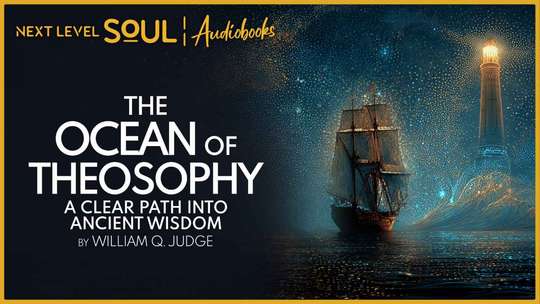
Listen While You Study
The audiobook is available on Next Level Soul TV. Play a chapter, then come back here for the notes and the workbook prompt.
Key Takeaways
- Judge presents Theosophy as an ancient teaching, passed down by wise teachers he calls the Masters, rather than a new invention.
- He describes a human being as sevenfold, made of body, astral form, life force, desire, mind, spiritual soul, and spirit.
- Reincarnation and karma work together in his account, so each life shapes the conditions of the next.
- Judge teaches that death is a passage with stages, including a time of desire and a time of rest called Devachan.
- He treats psychic powers with caution, warning that phenomena and spiritualism can mislead those who chase them.
The Book at a Glance
| Detail | What to Know |
|---|---|
| Author | William Quan Judge (1851 to 1896) |
| First published | 1893 |
| Chapters | 17 |
| Tradition | Theosophy, a late 19th century esoteric movement |
| Audiobook | Available on Next Level Soul TV |
What Is The Ocean of Theosophy About?
The Ocean of Theosophy is a short, orderly outline of Theosophy, the teaching associated with Helena Blavatsky and the Theosophical Society. Judge wrote it in 1893 so that a general reader could follow the main ideas without wading through large, technical books. He says he is passing on what he was taught.
The book moves from big to small. It starts with the Masters and the general principles of the universe, then turns to the make-up of a person, rebirth, karma, the afterlife, cycles of time, and psychic matters. Judge presents all of this as Theosophical teaching, and he asks readers to weigh it for themselves.
The Board: 17 Chapters
Each square is a chapter. Tap one to jump to its study notes.
- 1The Masters
- 2Principles
- 3Earth Chain
- 4Sevenfold Man
- 5Astral Body
- 6Kama
- 7Manas
- 8Reincarnation
- 9Rebirth, Cont.
- 10Arguments
- 11Karma
- 12Kama Loka
- 13Devachan
- 14Cycles
- 15Missing Links
- 16Psychic Laws
- 17Spiritualism
Chapter-by-Chapter Study Notes
These notes are our own summary, written to help you follow the book. Each one ends with a small practice you can try this week.
Theosophy and the Masters
Judge opens by describing Theosophy as an old body of knowledge rather than a fresh idea. He introduces Helena Blavatsky and the Theosophical Society, and he explains who the Masters are in this tradition: wise teachers who, he says, keep this knowledge alive. He also tells you what the book is. It is his own outline, and readers are free to disagree with any part of it.
General Principles
Here Judge lays out the foundations. He describes one underlying reality behind all things, a universe that appears and withdraws in great cycles, and the idea that spirit and matter are two sides of one whole. He teaches that every being unfolds along a path of growth over vast spans of time. Everything later in the book rests on this chapter.
The Earth Chain
Judge describes the Earth as one link in a chain of seven globes, according to the Theosophical account. He explains that life travels around this chain in great rounds, and that each stage prepares the next. The picture is large and strange, but its point is simple: Judge teaches that humanity is on a long journey, and that our present world is only one stop on it.
Septenary Constitution of Man
This chapter introduces the sevenfold human being. Judge lists the parts as the physical body, the astral body, the life force, desire, mind, the spiritual soul, and spirit. He teaches that most of us live mainly in the lower parts without noticing the higher ones. He treats the list as a map, so you can see how the pieces work together and which ones you tend to neglect.
Body and Astral Body
Judge looks at the two lowest parts of the sevenfold human. He describes the physical body as a changing mass of cells, and the astral body as an unseen model or pattern that the physical body follows. He says the astral form can act as a mold for growth and health. He presents this as Theosophical teaching, and he links it to dreams and to claims of seeing at a distance.
Kama: Desire
Kama is the Sanskrit word Judge uses for desire, the energy of wanting. He teaches that it drives our feelings, passions, and appetites, and that it joins the body to the mind. In his account, desire is not evil, but it becomes dangerous when it rules everything else. The chapter asks you to notice what you want, and to ask whether your wants serve your higher aims.
Manas
Manas is the mind, the thinking principle. Judge teaches that it stands between the higher and lower parts of a person, and that it can turn toward desire or toward spirit. He says this is the part that remembers, reasons, and chooses, and that our freedom lies in which way we turn it. For Judge, mind is the meeting place where a person decides what kind of being to become.
Of Reincarnation
Judge begins his long treatment of rebirth. He distinguishes Theosophical reincarnation from the idea that a human soul moves into animals. He teaches that the same inner being returns to live again in a human body, gathering experience across many lives. The chapter explains what he thinks is reborn, and why. He frames it as a teaching that gives life purpose and sets the stage for karma.
Reincarnation Continued
Judge goes deeper into how rebirth works, according to Theosophy. He discusses the long rest between lives, why we do not remember past lives, and how the returning being picks up its character and tendencies. He suggests that personal gifts and troubles can come from earlier lives. The aim is to give a fuller picture of the cycle of return, so the idea feels less like a belief and more like a reasoned account.
Arguments Supporting Reincarnation
In this chapter Judge makes his case. He gathers reasons that, in his view, support the doctrine, such as the unequal starting points of people, the gifts of children who seem to be born skilled, and the sense of justice many feel in life. He also answers common objections. Whatever you conclude, the chapter shows how Judge argues, and invites you to weigh the reasons yourself.
Karma
Karma is Judge’s teaching of cause and effect across lives. He describes it as a law of balance: every thought and act sends out a force that returns to the one who made it. He says karma is not punishment but adjustment, and that it joins with reincarnation to explain why lives differ. The chapter encourages responsibility, since each person shapes their own future through present choices.
Kama Loka
Kama Loka is the first stage after death in Judge’s account. He describes it as a place or state tied to desire, where the lower parts of a person slowly fall away. He says strong desires keep a being there for a time, and that the lingering shell left behind is not the true person. The chapter prepares the reader for the rest that follows, and it frames death as a process with stages.
Devachan
Devachan is the state of rest and bliss that Judge teaches follows Kama Loka. He describes it as a time when the higher mind enjoys the best of the life just lived, free from pain, before returning to birth. He says the length depends on the life lived. The chapter presents death as a gentle pause, and it asks what kind of inner life you are building for yourself.
Cycles
Judge teaches that life moves in cycles, from the rise and fall of nations to the turning of ages and the rhythm of a single life. He says cycles bring back conditions, ideas, and souls at fixed times. In his account, nothing happens once and for all, and knowing the cycle helps you read the present. The chapter widens the view from one lifetime to the great sweep of time.
Differentiation of Species: Missing Links
Judge turns to the origin of living forms. He argues, from a Theosophical standpoint, that humanity has a far older and different history than the science of his day taught, and that gaps in the fossil record, the so-called missing links, point to this. He presents his view as a teaching to consider, not as proven science. The chapter shows how he set Theosophy against the debates of his time.
Psychic Laws, Forces, and Phenomena
Judge discusses powers such as clairvoyance, thought transfer, and unusual forces of the mind. He describes them as natural to human beings, according to Theosophy, and says they have laws like any other part of nature. He cautions that they are not the same as spiritual growth and can distract from it. For him, character matters more than abilities. Care, he says, is the better guide.
Psychic Phenomena and Spiritualism
The final chapter looks at spiritualism and séances, which were very popular in Judge’s time. He gives the Theosophical view of what is happening, saying that much of it involves the left-over shells of the dead and the powers of the living medium rather than the true souls of departed loved ones. He urges caution and clear thinking, and ends the book by returning to the value of steady, ethical study.
Key Ideas in Plain Language
| Idea | What It Means | Chapter |
|---|---|---|
| The Masters | In Judge’s account, wise teachers who keep and share the knowledge of Theosophy. | 1 |
| Sevenfold human | The idea that a person is made of seven parts, from the physical body to spirit. | 4, 5 |
| Astral body | An unseen pattern that Judge says the physical body follows. | 5 |
| Kama | Desire, the energy of wanting that drives feelings and appetites. | 6, 12 |
| Manas | The thinking mind, which can turn toward desire or toward spirit. | 7 |
| Reincarnation | The teaching that the same inner being is reborn in human bodies again and again. | 8, 9, 10 |
| Karma | The law of cause and effect that links one’s acts to what comes back to them. | 11 |
| Devachan | A state of rest and bliss between lives, in Judge’s account. | 13 |
| Cycles | The teaching that time and life move in repeating rounds. | 14 |
Who This Book Is For
This guide suits anyone curious about Theosophy who wants a clear first look. It helps beginners who find esoteric books dense, readers who already know Blavatsky and want a short outline, and listeners who want to follow along in order. You do not need to believe the teaching. You only need to be willing to read it as Judge’s account and think about it.
A 17-Day Way to Use It
- Each day, listen to or read one chapter, in order, and then read the matching short summary in this guide.
- Do the small practice for that chapter and write two sentences in a notebook about what you noticed.
- On days 6, 11, and 14, pause to review the notes from the chapters on desire, karma, and cycles, and look for links.
- On day 18, reread your notes from all 17 chapters and circle the three ideas that mattered most to you.
Your Workbook
Your answers save on this device as you type. They are not sent anywhere. Use the copy button to move them into your own notes.
Watch More on Next Level Soul TV
Next Level Soul TV brings together full episodes, courses, movies, series and audiobooks, ad-free. Join Next Level Soul TV and keep exploring.
Keep Going
- What Is Karma? Meaning, Types, Instant Karma and How It Works
- Reincarnation: Beliefs, Research and What Past Lives Really Mean
- Theosophy: Study Guide and Workbook
Sources and Further Reading
Go Deeper with NLS Mastery: Your Soul’s Blueprint
Judge teaches that choices, desires, and thoughts shape what comes next, in this life and beyond. If you want to take that idea further, Karen Bell teaches it in Your Soul’s Blueprint, part of NLS Mastery. Watch the course preview below.
Frequently Asked Questions
What is The Ocean of Theosophy about?
It is a short outline of Theosophy by William Quan Judge. He covers the Masters, the sevenfold human being, reincarnation, karma, life after death, cycles, and psychic phenomena, written so an ordinary reader can follow the main ideas.
Who wrote The Ocean of Theosophy and when?
William Quan Judge wrote it, and it was first published in 1893. Judge was born in Dublin in 1851 and died in New York in 1896. He was a co-founder of the Theosophical Society alongside Helena Blavatsky and Henry Steel Olcott.
What kind of book is The Ocean of Theosophy?
It is an introduction to Theosophy, a late 19th century esoteric movement that blends Western esoteric thought with Indian religious ideas. Judge writes as a teacher passing on what he was taught, not as a scientist or historian.
How many chapters does The Ocean of Theosophy have, and what are they?
It has 17 chapters. They move from Theosophy and the Masters through general principles, the Earth chain, the sevenfold human, reincarnation, karma, Kama Loka, Devachan, and cycles, and end with psychic laws and spiritualism.
What does Judge teach about the sevenfold human being?
Judge teaches that a person has seven parts: the physical body, the astral body, the life force, desire, mind, the spiritual soul, and spirit. He presents this as a map for understanding which parts of ourselves we use and which we neglect.
How does Judge connect reincarnation and karma?
In his account, reincarnation is the return of the same inner being to new lives, and karma is the law of cause and effect that shapes those lives. Together they explain, he says, why people start from different places and how choices carry forward.
What does Judge say happens after death?
He teaches that death has stages. First comes Kama Loka, tied to desire, where the lower parts fall away. Then comes Devachan, a time of rest and bliss, before the being returns to a new birth. These are Theosophical teachings, not proven facts.
How should a beginner read The Ocean of Theosophy?
Take it one chapter at a time and in order, because each chapter builds on the last. Keep a notebook, note terms like Kama and Manas, and treat the book as one author’s account that you can weigh for yourself.
Is The Ocean of Theosophy hard to read?
It is clearer than many esoteric books, but it still uses unfamiliar terms and 19th century language. The early chapters on principles and the sevenfold human may feel dense. A plain-language guide and a slow pace make them far easier.
How long does it take to go through The Ocean of Theosophy?
Most readers do well with one chapter a day, which is 17 days. If you prefer a steady pace, a few chapters a week works too. Pausing to reflect on each one matters more than finishing quickly.
How does this study guide and workbook help?
It gives a plain-language summary of each chapter, a list of key ideas, and a small practice for every chapter. The guide helps you follow Judge’s outline, and the workbook helps you test the ideas against your own life.
Where can I listen to the audiobook, and what should I read next?
The audiobook is available on Next Level Soul TV. For what to explore next, try other introductions to Theosophy, the writings of Helena Blavatsky, or books on karma and reincarnation from different traditions.
Spirituality for the Rest of Us™
Movies, teachings and community on Next Level Soul TV.