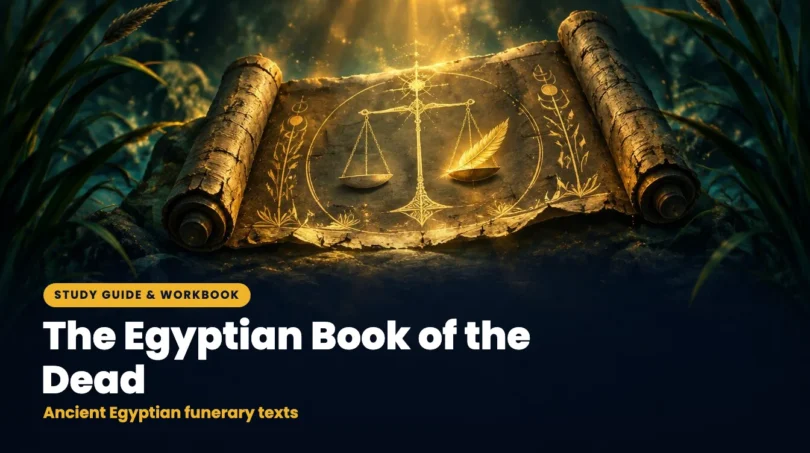
The Egyptian Book of the Dead is the modern name for a body of ancient Egyptian funerary spells, called the Book of Coming Forth by Day by the Egyptians themselves. Scribes copied them onto papyrus for the dead from about 1550 BCE to about 50 BCE, and the spells were meant to guide a person safely through judgment and into the afterlife. This study guide walks through all 9 themes in plain language, then hands you a workbook to try the ideas on your own life.
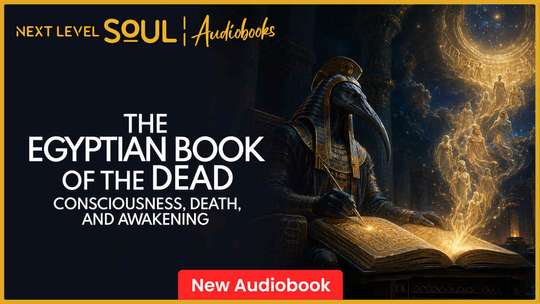
Listen While You Study
The audiobook is available on Next Level Soul TV. Play a theme, then come back here for the notes and the workbook prompt.
Key Takeaways
- The book is a collection, not a single story. No one wrote it from start to finish; scholars count about 192 spells, and no single copy holds them all.
- Its Egyptian title means “Coming Forth by Day.” The spells aim to help the dead person rise, move freely, and return to the light.
- The heart is judged against a feather. In Spell 125, the heart is weighed against the feather of Maat, the Egyptian principle of truth and order.
- The soul has several parts. Egyptian texts speak of the name, the ba, the ka, the shadow, and the heart, and the Book of the Dead tries to protect each one.
- The afterlife is described as a green, peaceful field. The Field of Reeds is pictured as a land of farming and plenty, ruled over by Osiris.
The Book at a Glance
| Detail | What to Know |
|---|---|
| Author | Unknown; compiled and copied by many Egyptian scribes and priests |
| First published | Spells used on papyrus from about 1550 BCE to about 50 BCE |
| Themes | 9 |
| Tradition | Ancient Egyptian funerary religion |
| Audiobook | Available on Next Level Soul TV |
What Is The Egyptian Book of the Dead About?
The Book of the Dead is a collection of spells that ancient Egyptians placed in the tomb with the dead. Its Egyptian title is usually rendered “Spells of Coming Forth by Day.” The name Book of the Dead came later, when the German scholar Karl Richard Lepsius numbered the spells in 1842. There is no single standard version, because each papyrus was made for one person and chose its own spells.
The spells cover many needs. Some protect the body and the heart, some help the dead person travel through the underworld, and some prepare for the judgment before Osiris. Many copies are illustrated with small pictures called vignettes. Readers today often find it moving, because it shows how deeply the Egyptians cared about identity, truth, and what might follow death.
The Board: 9 Themes
Each square is a theme. Tap one to jump to its study notes.
- 1Roots
- 2Coming Forth
- 3Papyrus of Ani
- 4Soul parts
- 5Open Mouth
- 6Night journey
- 7The heart
- 8Weighing
- 9Field of Reeds
Theme-by-Theme Study Notes
These notes are our own summary, written to help you follow the book. Each one ends with a small practice you can try this week.
Roots: The Pyramid Texts and Coffin Texts
Before the Book of the Dead, there were older spell collections. The Pyramid Texts, first used in a pyramid around 2400 BCE, were reserved for kings and later queens. The Coffin Texts, painted mostly on Middle Kingdom coffins from about 2100 BCE, brought similar spells to wealthier private people. Some of these spells were later copied into the Book of the Dead. Seen this way, the book grew out of a long tradition rather than appearing all at once.
Coming Forth by Day: The Title and Purpose
The Egyptians called these texts the Spells of Coming Forth by Day. The phrase suggests moving out of the tomb into daylight, much as the sun rises each morning. Scribes wrote the spells in cursive hieroglyphs on papyrus, with black ink for text and red ink for titles and dangerous names. Copies range from about one metre to forty metres long. The purpose, in the tradition, was to protect the dead and help them live again.
The Papyrus of Ani
The Papyrus of Ani was made around 1250 BCE for Ani, a scribe of Thebes. It is about 24 metres long and is often called the finest surviving Book of the Dead. It was found in 1888 and acquired by E. A. Wallis Budge for the British Museum, where it remains. Because it is so complete and so beautifully painted, it is the version most readers meet first. Scholars note that older translations of it are now considered outdated.
The Parts of a Person
Egyptian texts describe a person as more than a body. There is the name, called the ren. There is the ba, often drawn as a human-headed bird, and the ka, a life force. There is also the shadow, the heart, and the akh, a transfigured spirit linked to light. The number of parts changed over time. Several Book of the Dead spells aim to keep these parts safe, so the person can stay whole after death.
Opening of the Mouth
The Opening of the Mouth was a ritual in which priests touched the mummy, or sometimes a statue, with special tools. The aim was to give back the senses, such as breathing, speaking, seeing, and eating, so the dead could face the afterlife. A priest called the sem priest took the lead. A Book of the Dead spell lets the dead person speak the opening for themselves. It begins with the words “My mouth is opened by Ptah.”
The Duat and the Sun’s Journey
The Duat is the Egyptian underworld, a dark realm of gates, guardians, and gods ruled by Osiris. In Egyptian belief the sun god Ra crosses it each night in twelve sections, one for each hour. He must face the chaos serpent Apep and is reborn at dawn. Other texts, such as the Amduat, describe this in detail. The Book of the Dead lets the dead person join Ra’s voyage and rise with him.
The Heart and the Scarab
For the Egyptians, the heart was the centre of thought, feeling, and character. Spell 30B asks the heart not to speak against its owner at the judgment. The spell was often carved on a heart scarab, an amulet placed on the body and bound under the mummy’s wrappings. In the tradition, the heart could testify, so it needed protection. Modern readers often take this as a picture of conscience and honest self-knowledge.
The Weighing of the Heart
Spell 125 describes the central judgment scene. In the Hall of Maat, Anubis weighs the heart on a scale against the feather of Maat. Thoth records the result. The deceased also addresses forty-two divine assessors, naming wrongs they did not commit. If the heart is light, Osiris receives the person. If not, the monster Ammit devours it. Spell 125 is first known from around 1475 BCE.
The Field of Reeds
After a successful judgment, the dead hoped to reach the Field of Reeds, called Sekhet-Aaru. It was pictured in the east, where the sun rises, as a rich, green land ruled by Osiris. Spells 109, 110, and 149 describe it. In this vision the dead farm, harvest, and live in peace. Small helper figures called ushabtis, with Spell 6 on them, promised to do the work. The Field of Reeds shows the Egyptian hope for a good life continuing.
Key Ideas in Plain Language
| Idea | What It Means | Theme |
|---|---|---|
| Spell | A short ritual text meant to protect or guide the dead person; the book holds about 192 of them. | 2 |
| Vignette | A small painted picture that goes with a spell and shows the scene it describes. | 2, 3 |
| Ba and ka | Two parts of the person in Egyptian belief: the ba as personality, the ka as life force. | 4 |
| Akh | The transfigured spirit of the dead, formed when the ba and ka are joined, often linked with light. | 4 |
| Maat | The Egyptian principle of truth, balance, and order, shown as a goddess with a feather. | 8 |
| Ammit | The creature said to devour the heart of someone who fails the judgment. | 8 |
| Duat | The Egyptian underworld, crossed by Ra each night and ruled by Osiris. | 6 |
| Sekhet-Aaru | The Field of Reeds, the green paradise where the justified dead hoped to live. | 9 |
| Ushabti | A small servant figure placed in the tomb to do the dead person’s work. | 9 |
Who This Book Is For
This guide is for anyone curious about ancient Egypt, death and the afterlife, or the roots of ideas about judgment and rebirth. You do not need to know hieroglyphs or Egyptian history. We keep to what scholars say about the texts, and we mark clearly when an idea comes from the Egyptian tradition or from later spiritual readers. Use it to listen with more focus, and use the workbook to think about your own life.
A 9-Day Way to Use It
- On days 1 to 3, listen to the audiobook, then read Themes 1 to 3 in this guide and try each practice.
- On days 4 to 6, cover Themes 4 to 6, and write a few lines each night in your workbook.
- On days 7 to 9, cover Themes 7 to 9, the judgment and the Field of Reeds, and answer the reflection questions.
- On day 10, reread the ones that stayed with you and choose one practice to keep.
Your Workbook
Your answers save on this device as you type. They are not sent anywhere. Use the copy button to move them into your own notes.
Watch More on Next Level Soul TV
Next Level Soul TV brings together full episodes, courses, movies, series and audiobooks, ad-free. Join Next Level Soul TV and keep exploring.
Keep Going
- Near-Death Experiences (NDEs): The Complete Guide
- Shared Death Experiences, Deathbed Visions and Terminal Lucidity
- Reincarnation: Beliefs, Research and What Past Lives Really Mean
Sources and Further Reading
Go Deeper with NLS Mastery: Beyond the Veil
The Egyptian texts picture death as a doorway, and the soul as something that continues and is shaped by how we live. If you want to take that idea further, Julie Ryan teaches it in Beyond the Veil, part of NLS Mastery. Watch the course preview below.
Frequently Asked Questions
What is the Egyptian Book of the Dead about?
It is a collection of ancient Egyptian funerary spells meant to protect the dead and guide them through judgment into the afterlife. The Egyptians called it the Spells of Coming Forth by Day.
Who wrote the Egyptian Book of the Dead and when?
No single author wrote it. Egyptian scribes and priests composed and copied the spells over many centuries, and papyrus versions were used from about 1550 BCE to about 50 BCE. Some spells are older.
What kind of book is the Book of the Dead?
It is a funerary text from ancient Egyptian religion. It is not a story or a rulebook for the living. It is a set of spells, hymns, and pictures that were placed in a tomb for one person.
How many themes does this guide cover, and what are they?
This guide covers 9 themes: the older Pyramid and Coffin Texts, the title, the Papyrus of Ani, the parts of a person, the Opening of the Mouth, the Duat, the heart, the weighing, and the Field of Reeds.
What is the weighing of the heart?
It is the judgment scene in Spell 125. The heart of the dead person is weighed against the feather of Maat. If the heart balances, Osiris welcomes the person. If not, Ammit is said to devour it.
What is the Field of Reeds?
The Field of Reeds, or Sekhet-Aaru, is the Egyptian paradise ruled by Osiris. It is pictured as a green land in the east where the justified dead farm and live in peace.
Why did the Egyptians protect the heart so carefully?
They saw the heart as the centre of thought, feeling, and character. Because it was weighed at judgment, spells such as 30B asked it not to testify against its owner, and scarab amulets carried that spell.
What is the Papyrus of Ani?
It is a Book of the Dead made around 1250 BCE for Ani, a scribe of Thebes. About 24 metres long and richly painted, it is held by the British Museum and is often called the finest surviving example.
How should a beginner read or study the Book of the Dead?
Start with the big scenes, the judgment and the Field of Reeds, and then go back to the smaller spells. Notice what is Egyptian tradition and what later readers add. Take your time and use the workbook to reflect.
Is the Egyptian Book of the Dead hard to read?
It can be, because it is ancient, symbolic, and not a single story. Translations differ, and older ones can be outdated. A guide that explains the themes in plain language makes it much easier.
How long does it take to go through this study guide?
You can read the guide in one sitting, but it is built as a 9-day plan with a short practice each day. Many people spend about 15 minutes a day on it.
Where can I listen to the audiobook, and what should I explore next?
The audiobook is available on Next Level Soul TV. Next, you might explore other writing on the afterlife, near-death experiences, and the mystery traditions of the ancient world.
Spirituality for the Rest of Us™
Movies, teachings and community on Next Level Soul TV.