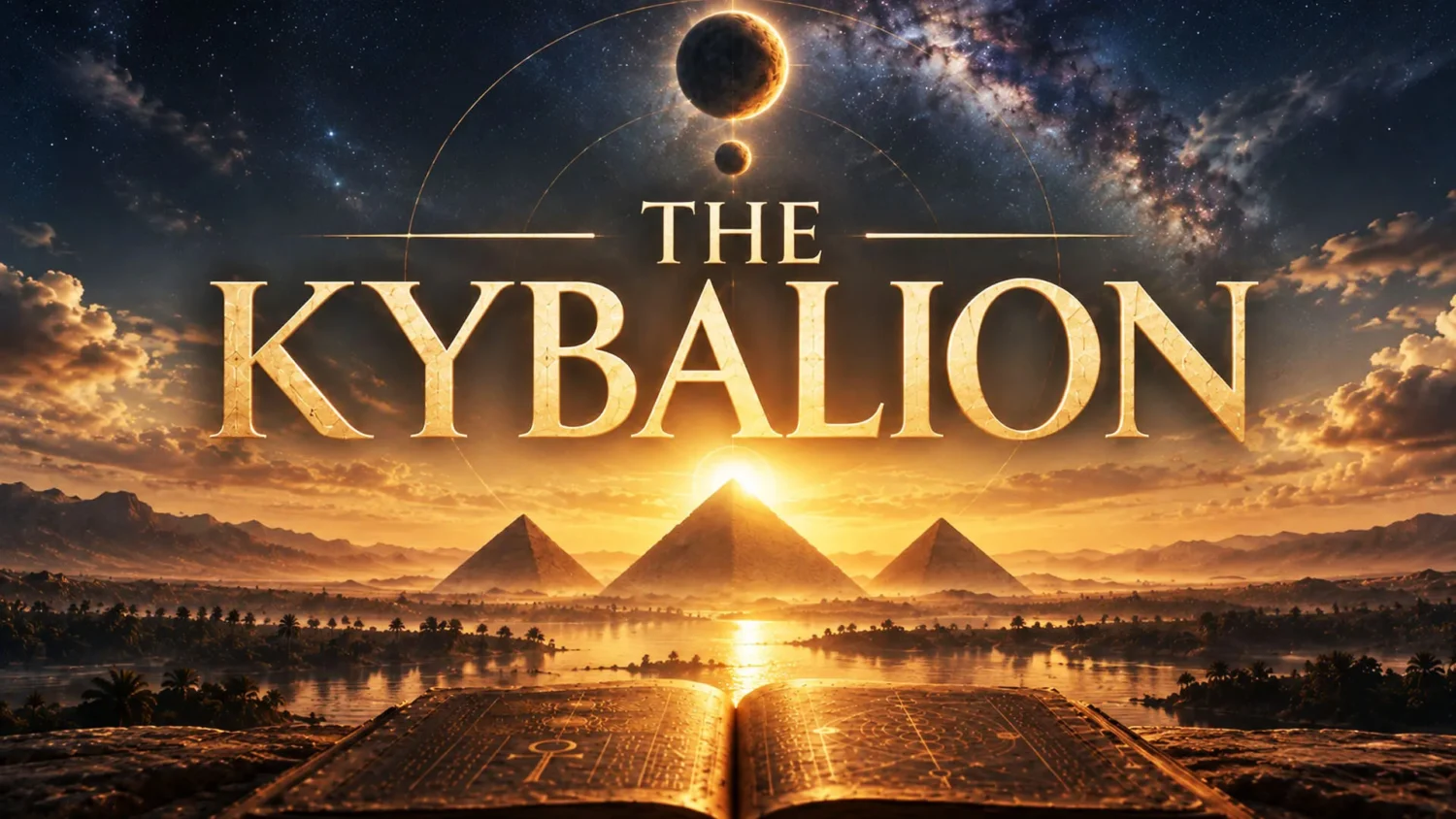

Some books keep returning. A small, strange volume from 1908 has been passed from hand to hand for over a century, and people still argue about what it really is. The Kybalion: Ancient Wisdom takes a clear approach to the question. It sets out the seven principles one by one, then hands each to someone who actually works with it. A medium, an alchemist, a hypnotherapist, a tarot reader, an astrology practitioner.
The result is part history lesson, part field guide, and part invitation. It does not ask you to believe anything. It asks you to look at your own mind as the instrument it describes. This review follows the series in order, so you can see what each principle claims, how the series brings it to life, and what you might take from it on an ordinary Tuesday.
Where the Kybalion Comes From
The series opens with a recitation of the maxims. The All is Mind. As above, so below. Nothing rests, everything vibrates. Everything has its opposite. Every cause has its effect. Then the narrator sets the stage. When the ancient Greeks encountered Egypt, that civilization was already as ancient to them as the Greeks are to us. In late ancient Egypt, a Greek ruling class and its scribes wrote down some of the philosophies and initiatory traditions into what became known as the hermetic literature. The narrator calls it an amalgam of Egyptian and Greek thought, a time capsule of spiritual ideas.
The book itself appeared in 1908, credited to Three Initiates. The series says it was actually written by William Walker Atkinson, a Chicago-based lawyer and New Thought author, and describes it as a brilliant distillation, in seven principles, of ideas that ran through Egyptian hermeticism. The core idea is that the All must be infinite and indivisible, something to which nothing can be added and from which nothing can be removed. The one thing that fits that description, the series says, is mind itself. We are reflections of that higher mind, which the ancients called Nous, and in our own small sphere we can create as it creates on a cosmic scale.
That is the doorway. Everything else in the series walks through it.
How the Series Is Built
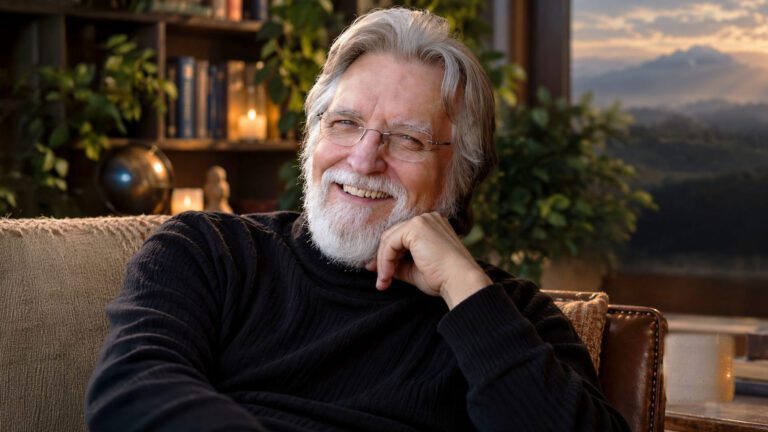
The Kybalion began life as a feature film and was reworked into a series, which suits the way its ideas unfold one principle at a time. The structure is elegant. Each principle begins with the narrator, who explains the idea in plain language and often links it to modern science. Then the series moves to a practitioner who lives it. You hear from an older woman with a psychic gift, an alchemy researcher, medium Lauren Thibodeau, a 74 year old researcher of life, death and near-death experiences, a hypnotherapist, a tarot reader and a hermetic magic and astrology practitioner. Gentle music marks the shifts. Most of the practitioners are not named on screen in the version I reviewed, so I have described them by what they do.
That choice keeps the focus on the ideas. It also means you are listening to lived experience, not credentials, which suits a series about inner knowing.
The Seven Principles, One at a Time
1. Mentalism: The All Is Mind
The narrator says the mind is not just a tool of motor skills and cognition. It is a tool of causation, with a non-local existence, which is how people glean information in ways that go beyond the ordinary senses. He points to psychical research and to mediums, channelers and remote viewers, and adds a hedge worth noticing. We may not fully understand all the laws and forces at work.
The older woman psychic brings this to life. In her Chelsea flat, a housemate laid out letters and a glass, and a spirit named Clive came through. She knew a Clive who had died in a plane crash. She asked his wife’s name without pushing the glass, and it spelled Penelope. She also describes a remote viewing session guided by Ingo Swann, whom she calls the Leonardo da Vinci of the field, in which she went to the moon, saw a door open and felt a sense of hostility until Swann told her to come out. She is gracious about the limits. The mysteries of the universe, she says, she cannot begin to comprehend. She even says reality may possibly be illusion. It is a lovely tone to open on, open hearted and unsure of itself.
2. Correspondence: As Above, So Below
The narrator says the ancients looking at the stars did not see a difference between themselves and the cosmos. They saw themselves as an extension of it. That belief fueled the alchemists, who held that we can transform matter insofar as we are part of its origin. He mentions the golden mean and the ratios that link natural forms.
The alchemy practitioner is the series’ most thoughtful voice. He says the basic theory of creation is the same throughout the universe, and alchemy tries to replicate it on a very small scale. A talisman, he explains, is a made object that is a focal point for an intent. Complete alchemy is both an inner and outer practice, concerned with the ascent of the soul to union with the one. He tells a vivid story. Lying relaxed in bed, he pictured himself as a snake and moved around the house at about two in the morning. He heard a blood curdling scream, woke with a pounding heart, and at breakfast his sister said she had dreamed of a huge snake coming through her room. Then he adds the part that made me trust him. He resists explanations that come too soon, because resolving a mystery too early means you stop looking at it.
3. Vibration: Nothing Rests
The narrator says that all things are in vibration and that through the nature of your thoughts you can raise or lower your own frequency to perceive other realms of being. He admits this might sound like metaphor, then points out that string theory, with its strings on a frequency moving in and out of the worlds we see, makes the idea at least thinkable.
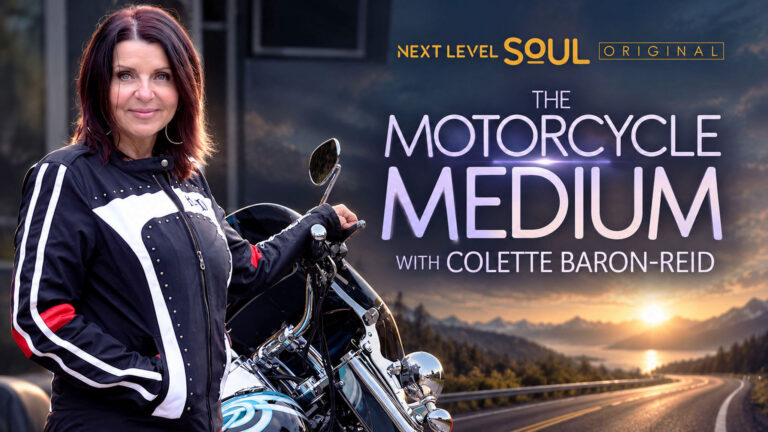
Medium Lauren Thibodeau, a working medium for around 30 years, describes the practice simply. The medium brings her frequency up while the other side brings theirs down, and they meet in the middle. Her stories are the emotional center of the whole series. A grandmother in her 80s sits with her daughter and granddaughter. A spirit says he was the grandmother’s first husband, named Maury. The women insist there was only Howie, until the grandmother admits she married young, divorced within a year and never told anyone. In another, a child who died at about 15 months shows her pictures, such as a day at the beach with a sun umbrella and oxygen. She says there are days mediums cry too. She also speaks honestly about burnout and about wondering what the point of being human is after too much time outside the body. I found that candor more convincing than any claim.
4. Polarity: Everything Has Its Opposite
The narrator calls polarity the most practical psychological principle in the Kybalion. You can transform one emotional state into another if you can identify its opposite. Fear and courage are two ends of one sliding scale, and by concentrating on courage while afraid, you move the scale toward it. This is the one principle you can try right now, and it needs no belief at all.
The 74 year old researcher takes it in a more daring direction. He says the line between life and death is bogus. He describes an aneurysm operation in which the body is cooled and blood drained from the head, with no brain activity recorded, and asks whether the patient was alive or dead during that time. He says medicine is looking at a third state. He also describes a dark mirror experiment with graduate students, based on the ancient Oracle of the dead, and says to his astonishment it works, with participants reporting vivid apparitions. Is it real or not, he asks. Who knows. He summarizes hundreds of near-death accounts, a tunnel, a warm light, a life review, and a being asking how you have learned to love. The ones he spoke with chose to return, mostly because of their children. The series does not claim this proves anything. It simply lets him speak.
5. Rhythm: Everything Flows
Rhythm is closely related to polarity. Day follows night and spring follows winter, and the narrator says every difficulty you face is compensated by a rhythmic swing in which you receive something, learn something or gain a new possibility. That is a hopeful reading of hard seasons, and it fits well with how many seekers already talk about their own paths.
The hypnotherapist describes using past life regression to become the conductor of your own life. His own first regression, guided by his father, showed a young bride left on the Great Plains who died while doing dishes. He connected it to a sibling conflict with his brother and the power and control at its core, and it taught him about breaking an old rhythm. One of his clients, a self described workaholic, regressed to being the camel present at the birth of Christ, which he took as a reminder not to mistake nearness to a thing for the experience of it. He also says yes, of course it is magic, and yes, it is also science.
6. Cause and Effect: Nothing Is Random
Nothing in life is strictly random or accidental, says the narrator. He ties this to quantum mechanics, where a particle exists in superposition until an observer measures it. If that holds for particles, he asks, why not for all life. The argument is that your mind is an actual cause and concrete reality is the effect. He reframes the principle gracefully. Cause and effect is not really a limitation, it is a harmony.
The tarot reader describes cause and effect as a wheel of fortune, where we have agency over the direction and speed. Images have a power to heal, she says, and throwing cards carries a secret wish for transformation. She records her readings and listens again months later, when they take on another dimension. She sees tarot as a cathedral of symbols and says she is just a translator. She admits the effect cannot be measured, and that readings can be scary.
7. Gender: The Active and the Receptive
The narrator is careful to say gender here does not refer to sexual roles. It refers to the framework of creation, with an active force, a passive force and a reconciling result. In the mind, conscious thoughts are the active side, the subconscious is the passive side capable of giving birth, and the result is action and reality itself.
The astrology practitioner extends this. He says hermetic thinking asks us to think of gender as something outside the body, the mode of manifestation. He gives the analogy of binary code, where a one and a zero can create anything. He notes that the gender of planets and signs is arbitrary, pointing out that Saturn is an old man in European art yet in Kabbalah its highest expression is the great mother, and Mars is coded masculine while Kali in the Vedic tradition is very much martial. For him manifestation needs the solar impulse of will and then the lunar impulse that shapes it. He prefers the word metaphysical over occult, because everybody is functioning magically. Astrological influences are only probable until processes make them real.
The Closing Idea
The series ends by saying we have lost the sense that nature and psyche are one. The Kybalion, it says, brings this ancient psychology back, and invites you to rediscover yourself as you really are, infinite. For a seeker, that is the real gift. Not a system to join, but a mirror.
Honest Notes on the Series
The series does not include any outside critics of the book or of Atkinson, so you will not hear the case against it here. The caveats come from inside, such as the narrator’s remark that this might seem like metaphor, the older woman’s doubts and the alchemist’s patience with unanswered questions. Claims about string theory and quantum measurement are offered as analogies, not proof, and are best held that way.
It helps to watch with a notebook. The principles are most useful when you test them gently. Try polarity the next time fear shows up. Notice rhythm in a hard season. Ask what cause you might be placing in the world today. And let the mysteries stay a little unresolved.
Questions to Carry With You
- Which of the seven principles do you already live by without having a name for it?
- When did you last turn fear toward courage, and what did you notice?
- What difficulty in your life might be a swing in a larger rhythm?
- What would change if you treated your mind as a cause, not only an effect?
Prefer to listen? The Kybalion audiobook on Next Level Soul lets you take the seven principles with you on a walk or a drive.
Keep Exploring
Keep exploring with Law of Attraction tips, spiritual enlightenment and connecting with your higher self.
Frequently Asked Questions
What is The Kybalion about?
The Kybalion: Ancient Wisdom explores the seven Hermetic principles from the 1908 book, and shows how mediums, alchemists, hypnotherapists, tarot readers and astrology practitioners work with them today.
What are the seven principles of the Kybalion?
They are Mentalism, Correspondence, Vibration, Polarity, Rhythm, Cause and Effect, and Gender. The series walks through them in that order.
Who wrote The Kybalion?
The book appeared in 1908 under the name Three Initiates. The series says it was written by William Walker Atkinson, a Chicago-based lawyer and New Thought author.
Do I need to know Hermetic philosophy before watching?
No. The narrator explains each principle in plain language before a practitioner brings it to life.
Which principle is the easiest to try?
The series calls polarity the most practical. It suggests you can shift an emotion by identifying its opposite, such as moving from fear toward courage.
Does the series include skeptical voices?
No outside critics appear. The caveats come from the speakers themselves, who often say they do not fully understand what they describe.
Where can I watch The Kybalion?
The Kybalion: Ancient Wisdom is available on Next Level Soul TV. Watch The Kybalion: Ancient Wisdom on Next Level Soul TV.