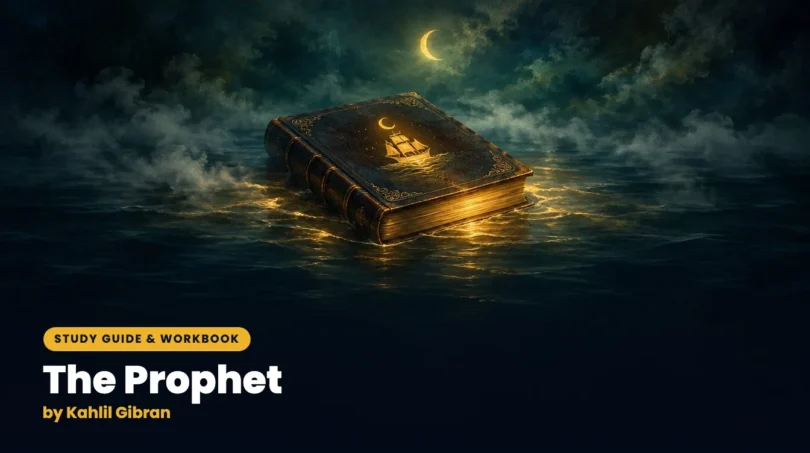
The Prophet is Kahlil Gibran’s 1923 book of 26 prose poems, in which a wise man about to sail home answers the questions of a town on love, work, pain, time and death. It has stayed in print for a century because it speaks about ordinary life in a calm, poetic voice. This study guide walks through all 26 poems, grouped into 10 themes, in plain language, then hands you a workbook to try the ideas on your own life.
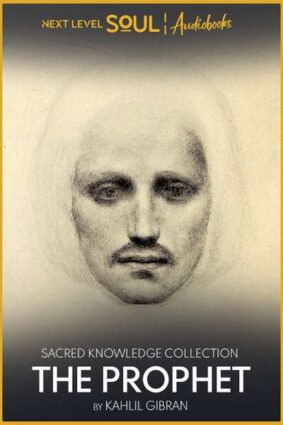
Listen While You Study
The audiobook is available on Next Level Soul TV. Play a theme, then come back here for the notes and the workbook prompt.
Key Takeaways
- Love asks for freedom, not ownership, so Gibran describes closeness that leaves room for each person to grow.
- Children come through you, not from you, so the author urges parents to guide with care and let kids become themselves.
- Joy and sorrow are tied together, and the author teaches that the same heart that holds one can hold more of the other.
- Work can be love made visible, which means the spirit you bring to a task matters as much as the task itself.
- Death is described as a return, not an ending, and the book closes with a gentle farewell that invites you to keep listening for truth in daily life.
The Book at a Glance
| Detail | What to Know |
|---|---|
| Author | Kahlil Gibran (1883 to 1931) |
| First published | 1923, by Alfred A. Knopf, in English |
| Themes | 10 themes covering 26 prose poems |
| Tradition | Spiritual and philosophical poetry |
| Audiobook | Available on Next Level Soul TV |
What Is The Prophet About?
The Prophet is a short book built around one simple scene. A man named Almustafa has lived in the city of Orphalese for twelve years. A ship has arrived to carry him home. Before he leaves, the townspeople gather and ask him to share his wisdom, and a woman named Almitra speaks for them.
He answers their questions one by one, on love, marriage, giving, work, freedom, friendship, prayer, death and more. Each answer is a short prose poem. The author does not give rules. He offers images and gentle challenges, then says goodbye and sails away. Many readers return to it again and again for comfort.
The Board: 10 Themes
Each square is a theme. Tap one to jump to its study notes.
- 1Love
- 2Family
- 3Giving
- 4Work and Joy
- 5Home and Trade
- 6Law and Freedom
- 7Heart and Mind
- 8Friends and Time
- 9Good and Beauty
- 10Faith and Death
Theme-by-Theme Study Notes
These notes are our own summary, written to help you follow the book. Each one ends with a small practice you can try this week.
Love
The first poem answers Almitra’s request to speak of love. The author describes love as something that calls you, shapes you and sometimes hurts you, and he asks you to follow it anyway. He says love gives itself and takes nothing but itself. It does not own and cannot be owned. It sets the tone for the whole book, which treats the heart as the best teacher.
Marriage and Children
These two poems cover the closest bonds. On marriage, the author pictures partners standing together yet apart, like pillars of a temple that do not lean on each other. He asks for closeness with spaces in it. On children, he says they come through their parents but belong to life itself. Parents may give love, he says, but not their own thoughts.
Giving, and Eating and Drinking
The poem on giving says the truest gifts come without a sense of debt, given the way a flower gives its scent. The author says real giving is to give of yourself, not just your things. The poem on eating and drinking asks you to treat food with respect, since every meal comes from the life of the earth. Both poems link daily acts to a deeper kind of gratitude.
Work, and Joy and Sorrow
In the poem on work, the author says work is love made visible. He suggests you should work with care, as if the person you love will wear what you make. In the poem on joy and sorrow, he teaches that they are woven together. The cup that holds your wine was once burned in a kiln. Deeper sorrow, he says, leaves more room for joy.
Houses, Clothes, and Buying and Selling
These three poems look at how we live among things. The author says a house should be a place of peace, not a cage or a display of wealth. Clothes can hide the self as much as protect it. In buying and selling, he asks for fairness and a sense that the earth’s gifts are meant to be shared. Together they invite you to ask what your possessions say about you.
Crime and Punishment, Laws, and Freedom
Here the author questions how we judge one another. He says the wrongdoer and the wronged are both part of one human family, and no one rises alone. Laws, he suggests, can feel like building a sand castle and laughing as the sea washes it away. In the poem on freedom, he teaches that the heaviest chains are often inner ones, such as fear and the wish for approval.
Reason and Passion, Pain, and Self-Knowledge
These poems turn inward. The author compares reason and passion to the rudder and sails of a ship, and says you need both to reach harbor. On pain, he says it is the breaking of the shell that holds your understanding. On self-knowledge, he teaches that the soul is not a fixed line but a lotus that unfolds in its own time. You cannot rush it.
Teaching, Friendship, Talking, and Time
This group covers how we share life with others. A true teacher, the author says, leads you to the threshold of your own mind and does not hand over wisdom. Friendship is the answer to your needs, and it needs no purpose except to be shared. Talking is for when you cease to be at peace with your thoughts. Time is described as endless, and the present moment as the only place we truly live.
Good and Evil, Prayer, Pleasure, and Beauty
Here the author turns to big questions of right and wrong. He suggests that what we call evil may be good that is hungry or thirsty and has lost its way. On prayer, he asks us to pray with joy as well as need. Pleasure is described as a song of freedom that is not yet freedom itself. Beauty, he says, is not a need but a deep joy, and a life shaped by it keeps the heart open.
Religion and Death
The last two questions reach the deepest ground. On religion, the author says it is found in all your deeds and reflections, not in a set of days or rules. On death, he asks what it is to stop breathing but be freed to rise and seek God without weight. Life and death are one, like the river and the sea. Then he blesses the crowd, boards the ship and leaves a calm farewell.
Key Ideas in Plain Language
| Idea | What It Means | Theme |
|---|---|---|
| Love without ownership | Real love holds on loosely. It supports the other person’s growth and does not try to control it. | 1, 2 |
| Children as their own people | Parents are the bow, and children are the arrows sent into a future the parents cannot see. | 2 |
| Giving from yourself | The most meaningful gifts are your time, attention and care, offered without keeping score. | 3 |
| Work as love made visible | How you do a task shows what is in your heart. Care turns ordinary work into something meaningful. | 4 |
| Joy and sorrow as partners | The two are not enemies. The deeper a sorrow cuts, the more joy a heart can later hold. | 4 |
| Inner freedom | The strongest limits are often inside us. True freedom begins when we face our own fears. | 6 |
| Balance of reason and passion | Thinking and feeling each need the other. Together they steer the soul like the rudder and sails of a ship. | 7 |
| Pain as a teacher | The author describes pain as the breaking of the shell around your understanding, which opens you to growth. | 7 |
| Death as return | Death is shown as a return to the source, as natural as a river joining the sea. | 10 |
Who This Book Is For
This guide is for anyone who wants to read The Prophet with more understanding, whether it is your first time or your tenth. It suits curious beginners, people facing a change in love, work or loss, and readers who like to think slowly about big questions. You do not need any background in poetry or religion. The ten themes and short practices help you take each idea off the page and into your day.
A 10-Day Way to Use It
- On days 1 to 3, read or listen to one theme a day, starting with Love. Then read its summary here and complete the practice.
- On days 4 to 7, continue with one theme a day. Write a few lines in a journal about what stood out to you.
- On days 8 to 10, finish the last themes and look back over your notes. Circle the ideas that felt most true for your life right now.
- On day 11, reread your favorite poem and notice what has changed in how you hear it.
Your Workbook
Your answers save on this device as you type. They are not sent anywhere. Use the copy button to move them into your own notes.
Watch More on Next Level Soul TV
Next Level Soul TV brings together full episodes, courses, movies, series and audiobooks, ad-free. Join Next Level Soul TV and keep exploring.
Keep Going
- Best Spiritual Audiobooks: 10 Essential Listens (Plus 2 Bonus)
- Heart Chakra (Anahata): Meaning, Signs and How to Open It
- Near-Death Experiences (NDEs): The Complete Guide
Sources and Further Reading
Go Deeper with NLS Mastery: The Divine Law of Love
Gibran invites us to meet love, loss and our own inner life with open eyes and a steady heart. If you want to take that idea further, Anjie Hipple teaches it in The Divine Law of Love, part of NLS Mastery. Watch the course preview below.

Frequently Asked Questions
What is The Prophet about?
It tells of a wise man named Almustafa who is about to sail home. The townspeople ask him about life, and he answers in short prose poems on topics such as love, work, pain and death.
Who wrote The Prophet and when?
Kahlil Gibran, a Lebanese-American writer and artist, wrote it. He lived from 1883 to 1931. The book was first published in 1923 by Alfred A. Knopf in the United States, and he wrote it in English.
What kind of book is The Prophet?
It is a work of spiritual and philosophical poetry written in prose. It does not belong to one religion. It draws on ideas about love, the soul and nature that many traditions share.
How many poems are in The Prophet?
There are 26 topics that the people of Orphalese ask Almustafa about, each answered in its own prose poem. This guide groups them into 10 themes, from Love to Religion and Death.
What does The Prophet say about love?
The author teaches that love is a force that calls you and shapes you, even when it hurts. He says love gives of itself and does not own, and that partners should leave space between them.
What does The Prophet say about joy and sorrow?
The author describes them as joined together. He suggests that the same heart can feel both, and that the deeper sorrow carves into you, the more joy you can hold afterward.
What does The Prophet teach about children?
He says children come through their parents but are not owned by them. Parents may offer love and guidance, but should let each child grow into their own person and their own future.
What does The Prophet say about death?
The author presents death as a return rather than an ending, like a river meeting the sea. He invites readers to see life and death as parts of one whole, without fear.
How should a beginner read The Prophet?
Read one theme at a time and give yourself time to think. Notice which lines stay with you. Then write down one small way to try the idea. This guide offers a practice for each theme.
Is The Prophet hard to read?
The language is simple, but the images can be deep. Most readers find it easy to follow and rich to reread. Short poems make it a good fit for small daily sessions.
How long does it take to read The Prophet?
It is a short book. Many readers finish it in a few hours, but it works best when spread over days. The 10-day plan in this guide gives each theme its own quiet time.
Where can I listen to The Prophet, and what should I try next?
The audiobook is available on Next Level Soul TV. After it, you might enjoy other works of spiritual poetry, such as Rumi’s verses, or Gibran’s other books like The Madman.
Spirituality for the Rest of Us™
Movies, teachings and community on Next Level Soul TV.