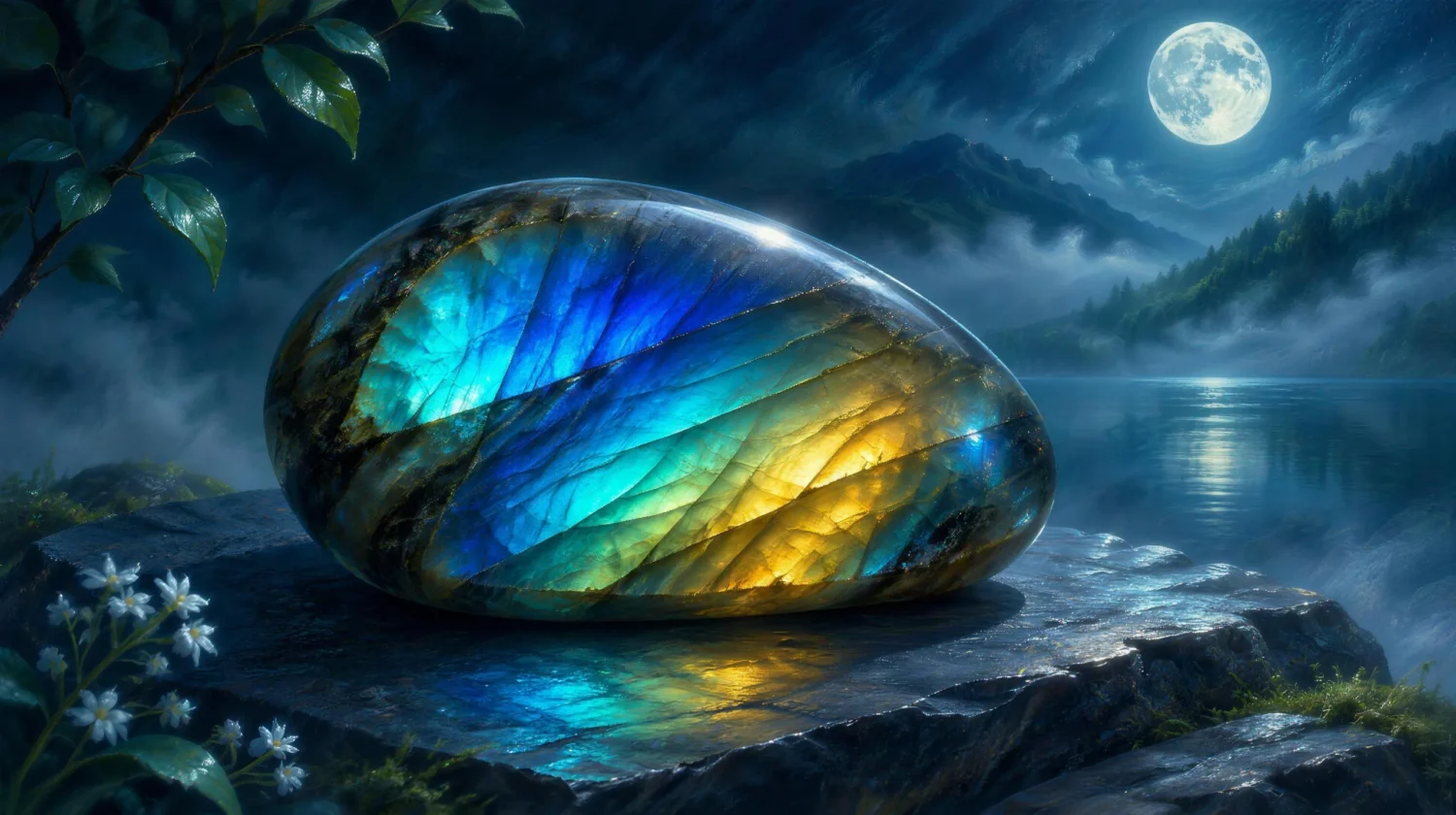
The labradorite crystal meaning most often given in crystal traditions is transformation, intuition and protection during change. Labradorite is a feldspar mineral famous for labradorescence, a flash of blue, green or gold that appears when you tilt the stone in the light. Its meaning is traditional and personal, not medical, so it is best treated as a lovely focus for reflection and not a cure for anything.
Key Takeaways
- What it is: Labradorite is a calcium-rich plagioclase feldspar, with a Mohs hardness of about 6 to 6.5. The flash is a physical effect of thin internal layers, not a coating.
- Traditional meaning: In crystal healing traditions it stands for change, inner knowing and a feeling of being shielded while you move through transitions.
- Chakras: Modern chakra and crystal traditions link it with the third eye and the crown, the centers associated with intuition and spiritual awareness.
- How people use it: Common uses include meditation, bedside or desk stones, jewelry, journaling rituals and crystal grids.
- Honest limits: There is no scientific evidence that crystals heal. Enjoy labradorite for its beauty, symbolism and ritual, and see a professional for health concerns.
What Is Labradorite?
Labradorite is a feldspar mineral, part of the plagioclase series, and one of the more common feldspars in the Earth’s crust. Most of the time it looks dull gray, brown or nearly black. Then you turn it, the light catches a particular angle, and a sheet of peacock blue, green, gold or even orange seems to wake up inside the stone.
That flash is the reason people fall in love with it. In the language of crystal healing, labradorite is a stone of transformation and inner vision. In the language of geology, it is a calcium-rich feldspar with a very particular internal structure. Both stories are worth knowing, and it helps to keep them separate.
Labradorite at a Glance
| Question | Quick answer |
|---|---|
| What is labradorite? | A calcium-rich plagioclase feldspar, (Ca,Na)(Al,Si)4O8. |
| What causes the flash? | Microscopic layers inside the crystal that interfere with light, called labradorescence. |
| How hard is it? | About 6 to 6.5 on the Mohs scale, softer than quartz. |
| Where does the name come from? | Labrador, Canada, where it was first identified near Nain. |
| Traditional meaning | Transformation, intuition, protection during change. |
| Linked chakras | Third eye and crown, in modern chakra and crystal traditions. |
| Where is it found today? | Madagascar, Finland, Canada, Australia, China, Slovakia, Norway and the United States, among others. |
| Does it heal? | No scientific evidence supports healing effects. Its meaning is traditional, symbolic and personal. |
The Science of Labradorescence: Why It Flashes
Labradorescence is not a surface coating and it is not dye. It comes from the way the crystal cooled. As the host rock cooled very slowly, the feldspar separated into extremely thin alternating layers, a process geologists call exsolution. When those layers sit roughly 128 to 252 nanometers apart, they act on light a little like the thin film of a soap bubble, and certain colors are reflected back at certain angles.
This is also why the flash disappears when you turn the stone. The color is directional. It shows brightly from one angle and goes quiet from another, which is part of the quiet drama of holding one. The term labradorescence was coined by the Danish mineralogist Ove Balthasar Bøggild, who studied the effect in the early twentieth century.
| Feature | Detail |
|---|---|
| Mineral group | Plagioclase feldspar |
| Mohs hardness | 6 to 6.5 |
| Typical body color | Gray, brown or near black |
| Flash colors | Blue and green most often; also gold, orange, purple and red |
| Usual cut | Cabochon (a smooth, domed cut), which shows the flash well |
| Typical host rocks | Gabbro, basalt, norite and anorthosite |
| Sensitivity | Feldspars can split along cleavage planes, so knocks and drops can chip or crack it |
Labradorite is often confused with moonstone, another feldspar with a glowing sheen. They are related, but they are different minerals with a different look. Moonstone has a soft, milky glow that floats beneath the surface. Labradorite throws vivid color from a darker body.
What Is Spectrolite?
Spectrolite is a name for particularly vivid labradorite, with flash across a wide range of colors, mined in Finland. The deposit at Ylämaa in south-eastern Finland was found in 1940 by Pekka Laitakari while he was helping to build wartime fortifications, and quarrying began after the Second World War. If a seller describes a stone as spectrolite, it should come from there.
Labradorite History and Origin
The mineral is named for the Labrador coast of Canada, and its type area is Paul’s Island near the community of Nain. For a long time it was known mainly to the people who lived near those outcrops and to collectors who brought pieces back to Europe. It was later found in many other parts of the world.
Because it has no ancient, well-documented ritual history the way some stones do, most of the spiritual meaning attached to labradorite is modern. It grew up alongside the New Age and crystal healing movements of the twentieth century, which borrowed from earlier lapidary lore and from ideas of chakras and energy.
You will sometimes read a popular story that the northern lights became trapped in the rocks of the Labrador coast, and that the stone releases them. It is a lovely image, but we could not trace it to a reliable source, so treat it as modern folklore. It is a good example of why it helps to ask where a claim comes from before you repeat it.
Labradorite Crystal Meaning in Spiritual Traditions
Across modern crystal writing, the same few themes come up again and again for labradorite. They are traditions and personal associations, not facts about the mineral.
- Transformation. It is called a stone of change, often placed near you during endings, moves, new jobs, new chapters and the long in-between.
- Intuition and inner knowing. The flash that appears only at the right angle is read as a symbol of insight that shows up when you look from a different perspective.
- Protection. Some traditions describe it as a stone that shields your energy, especially for sensitive people in busy places. This is a symbolic idea, not a measurable effect.
- Imagination and dreams. People keep it by the bed, in a journaling space, or near art supplies to invite creativity and reflection.
- Mystery. It is associated with the moon and with night, partly because of its moonlit look.
If you are drawn to labradorite, that attraction itself is information. Many people find that the stone works as a reminder to pause before reacting, to look twice, and to trust a quieter kind of knowing. If you want to build that muscle without a stone, our guide to intuition development is a practical place to start.
Labradorite, the Chakras and the Zodiac
In modern chakra systems, labradorite is most often connected with the third eye chakra, the center linked in yogic and New Age traditions with perception and insight, and with the crown chakra, linked with spiritual connection. Our overview of the third eye explains what that center means in its original traditions. These pairings come from twentieth century crystal literature, not from ancient Sanskrit texts, and sources do not always agree.
Zodiac lists vary even more. In astrology and crystal traditions, labradorite is commonly paired with Leo, Scorpio and Sagittarius, and some lists add Pisces. These pairings come from astrology tradition and not from any measurement of the stone, and they carry no predictions.
| Link | What traditions say | Where it comes from |
|---|---|---|
| Third eye chakra | Intuition, insight, inner vision | Modern chakra and crystal writing |
| Crown chakra | Spiritual connection, awareness | Modern chakra and crystal writing |
| Zodiac signs | Often Leo, Scorpio, Sagittarius; lists vary | Astrology and crystal lore |
| Element and moon | Associated with night, moonlight and water | Modern crystal tradition |
How to Use Labradorite: Simple Ways to Begin
You do not need rules, tools or a special room. A few simple ideas are enough to find out whether labradorite becomes meaningful for you.
- Choose one stone. Pick the piece that draws your eye. Hold it in different light until you find the angle that flashes.
- Set an intention in plain words. Something like “I want to move through this change with patience.” Write it down or say it quietly.
- Sit with it for five minutes. Hold it in your palm, breathe slowly and notice the flash appear and disappear as you move your hand. Let that be a lesson in perspective.
- Keep it where you will see it. A desk, a bedside table, a pocket or a journaling space all work.
- Reflect at the end of the day. Write one line about what shifted, even slightly. The practice is the noticing.
If you enjoy structured meditation, try pairing a stone with a guided session from our guided meditations collection, and notice whether holding something physical helps your attention settle. If you like arranging stones with intention, a crystal grid is another traditional way to do it.
Popular Pairings
| Stone | Traditional reason people pair it | Guide |
|---|---|---|
| Amethyst | Calm and spiritual awareness alongside labradorite’s insight | Traditional pairing |
| Selenite | Clearing, cleansing and a soft white-light feeling | Traditional pairing |
| Rose quartz | Gentleness during change | Rose quartz meaning |
| Black tourmaline or obsidian | Grounding and a sense of protection | Traditional pairing |
Real vs. Fake Labradorite and How to Care for It
Labradorite is widely sold and widely imitated. Some pieces are real labradorite with an attractive flash. Others are glass, plastic or dyed stone made to look like it.
- Look for directional flash. Real labradorescence appears at one angle and fades at others. A glossy rainbow that looks the same everywhere is suspicious.
- Check for natural variation. Real stones show gray or dark areas, small fractures and uneven patterns. Perfectly uniform color is a warning sign.
- Feel the temperature and weight. Glass and stone feel cool, and plastic warms quickly and feels lightweight.
- Ask about treatment. Reputable sellers will say if a stone has been polished, coated or dyed. A coating can mimic flash.
- Ask for the source. Madagascar, Finland, Canada and Australia are well-known sources. If a seller cannot say where it comes from, take care.
To care for it, wipe it with a soft damp cloth and dry it. Avoid harsh chemicals and strong heat, and store it apart from harder stones like quartz so it does not get scratched. With a hardness around 6 to 6.5, it is durable enough for everyday jewelry, but knocks can chip it. Many people also like to leave a stone in moonlight on a windowsill as a gentle ritual. That is a tradition, not a required step.
Honest Limits: What the Evidence Says
It is worth saying clearly: there is no scientific evidence that crystals heal, protect or predict. In a placebo experiment reported by psychologist Christopher French and colleagues at Goldsmiths, University of London, volunteers who meditated with a real quartz crystal and volunteers who held a convincing fake reported much the same “crystal effects.” The researchers concluded that the experiences came from expectation rather than from the stones.
That does not make your practice meaningless. A beautiful object, a quiet few minutes and a clear intention can be a real support for reflection. The honest approach is to hold both truths. Enjoy the ritual, and look to a doctor, therapist or other qualified professional for anything involving your health, mental health or safety.
- Misconception: The flash is painted on. It is a physical effect of the crystal structure.
- Misconception: Labradorite is rare and valuable. Common labradorite is plentiful and affordable; only exceptional flash commands high prices.
- Misconception: It must be cleansed in water. Many traditions use moonlight, smoke or sound. Water is not needed, and you can skip cleansing altogether.
- Misconception: A stone can do the inner work for you. At most, it is a reminder to do your own.
Go Deeper with Crystals
If labradorite has caught your attention, the wider world of stones is worth exploring slowly. Our overview of crystals for healing covers the history, the traditions and what research does and does not say.
Choose one stone, spend a month with it, and notice what you learn about yourself. A small piece of labradorite on a desk can be a daily reminder that what we see depends on where we stand. That is a good reason to own one.
Go Deeper with NLS Mastery: Your Soul’s Blueprint
Karen’s course offers a grounded way to explore astrology, the moon and crystals as symbols for self-reflection, which suits a stone as symbolic as labradorite. Karen Bell teaches it in Your Soul’s Blueprint, part of NLS Mastery. Watch the course preview below.

Frequently Asked Questions
What does labradorite mean spiritually?
In crystal healing traditions, labradorite stands for transformation, intuition and a sense of protection during change. These meanings are traditional and personal, not scientifically proven.
What is labradorite good for?
People use it as a focus for meditation, journaling and reflection, and as a jewelry or desk stone. There is no scientific evidence that it treats any condition.
What causes the colorful flash in labradorite?
It is called labradorescence. Thin internal layers formed as the rock cooled slowly, and they reflect certain colors of light at certain angles.
Which chakra is labradorite linked to?
Modern chakra and crystal traditions most often link it with the third eye and the crown chakras. These associations come from twentieth century writing.
Which zodiac signs are connected to labradorite?
Crystal and astrology lists commonly pair it with Leo, Scorpio and Sagittarius, though lists vary. These are traditional associations, not predictions.
Is labradorite the same as moonstone?
No. Both are feldspars, but moonstone has a soft milky glow while labradorite shows vivid color flashes from a darker body.
How can I tell if labradorite is real?
Real labradorite shows flash only at certain angles and has natural variation. Uniform rainbow color that looks the same from every side may be glass or a coating.
Can I wear labradorite every day?
With a Mohs hardness of about 6 to 6.5 it suits most jewelry, but it can chip if knocked. Remove it for heavy work and store it apart from harder stones.
How do I cleanse labradorite?
Wipe it gently with a soft cloth. Some people use moonlight, smoke or sound as a ritual, which is a personal tradition and not a necessity.
Where does labradorite come from?
It is named for Labrador, Canada, and is also found in Madagascar, Finland, Australia, China, Slovakia, Norway and the United States.
Is labradorite a birthstone?
It is not on the standard birthstone lists. Some modern crystal lists connect it with certain zodiac signs instead.
Sources and Further Reading
Spirituality for the Rest of Us™
Movies, series, documentaries, audiobooks, audio courses and guided meditations on awakening and consciousness, all in one place. 14-day money-back guarantee.