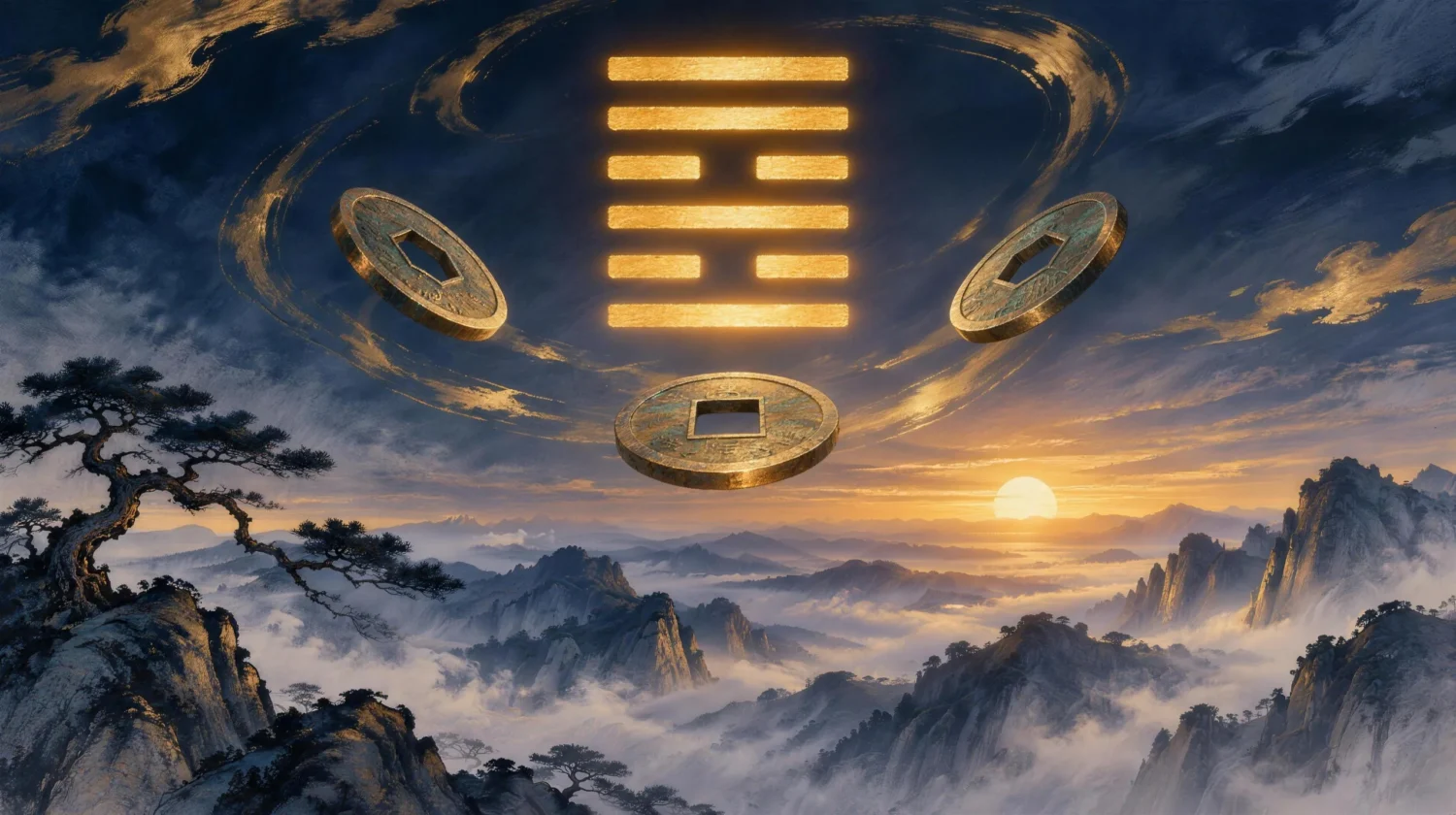
The I Ching, or Book of Changes, is an ancient Chinese text of 64 hexagrams used for divination and reflection, and one of the Five Classics of Chinese philosophy. You consult it by building a hexagram from coin tosses or yarrow stalks, then reading the matching passage for guidance on your question. This guide explains its history, structure and a simple method, with attention to how it compares with other oracles and to its honest limits.
Key Takeaways
- What it is: An ancient Chinese divination text and philosophical classic made of 64 hexagrams built from yin and yang lines
- History: Its core took shape in the Western Zhou period; Emperor Wu of Han called it first among the classics in 136 BC
- How to use it: Ask an open question, toss three coins six times, build the hexagram from the bottom and read the text
- Western reception: Leibniz wrote a commentary in 1703; Wilhelm’s translation, with Jung’s introduction, made it famous
- Honest use: Treat it as a mirror for reflection and timing, not a guarantee about the future
What Is the I Ching?
The I Ching (also spelled Yijing, and often translated as the Book of Changes) is an ancient Chinese text built around 64 hexagrams, each made of six stacked lines that are either solid or broken. It began as a divination manual and grew into one of the foundational books of Chinese philosophy. People today use it as an oracle, a mirror for reflection and a way to think about change.
You ask a question, generate a hexagram by tossing coins or counting stalks, and then read the matching passage. The text rarely gives a yes or no. It gives images, advice and a sense of the situation’s direction, which you then have to interpret in the light of your own life.
This guide covers where the book came from, how the hexagrams are built, how to consult it step by step, and how to use it honestly. We attribute every claim to a tradition, because the I Ching is a living text with many schools of reading.
I Ching at a Glance
| Question | Quick answer |
|---|---|
| What is it? | An ancient Chinese divination text and philosophical classic, also called Yijing or the Book of Changes |
| How old is it? | The core text took shape in the Western Zhou period, roughly 1000 to 750 BC; scholars debate the exact date |
| What is a hexagram? | A figure of six lines, each solid (yang) or broken (yin). There are 64 of them |
| What is a trigram? | A figure of three lines. Eight trigrams combine in pairs to form the 64 hexagrams |
| How do you consult it? | Toss three coins six times, or sort yarrow stalks, to build a hexagram from the bottom line up |
| Does it predict the future? | Tradition says it reveals the pattern of a situation. We treat it as a tool for reflection, not a guarantee |
| Who made it famous in the West? | Richard Wilhelm’s translation, with an introduction by Carl Jung in the English edition |
Where the I Ching Came From
The I Ching began as a manual for diviners in the Western Zhou period, which scholars place at roughly 1000 to 750 BC. Its core is the Zhou yi, or Changes of Zhou. The scholar Edward Shaughnessy dates its compilation in roughly its present form to the last quarter of the ninth century BC, though other scholars propose dates anywhere from the tenth to the fourth century BC.
Chinese tradition credits legendary figures. The mythical sage Fuxi is said to have discovered the trigrams, and King Wen of Zhou is said to have arranged the hexagrams and written their statements. Historians treat these as traditional attributions rather than settled history.
Over time the book gained commentaries. The most important is the Great Commentary, or Dazhuan, from about 300 BC, which presents the I Ching as a miniature of the universe. Ten commentaries together are called the Ten Wings. Later tradition attributed them to Confucius, but modern scholars no longer accept that.
In 136 BC Emperor Wu of Han described the book as the first among the classics, and it became one of the Five Classics of Confucianism. From a practical handbook for diviners it had become a text of statecraft, ethics and cosmology.
| Period | What happened |
|---|---|
| Western Zhou (c. 1000 to 750 BC) | The core divination text, the Zhou yi, takes shape |
| Warring States era | Commentaries such as the Ten Wings add a philosophical layer; the Great Commentary dates to about 300 BC |
| 136 BC | Emperor Wu of Han calls it the first of the classics; it joins the Five Classics |
| Tang dynasty | The coin method of consultation spreads widely |
| 1703 | Gottfried Leibniz writes the first European commentary |
| 1923 | Richard Wilhelm’s German translation appears; the English edition follows in 1950 |
The Zhou Yi and the Ten Wings
It helps to separate two layers. The oldest layer is the Zhou yi: the 64 hexagrams with short judgments and line statements, written in very archaic language and used for divination. The second layer is the Ten Wings, a set of commentaries composed much later. Wikipedia’s entry on the Ten Wings lists them as three commentaries, each split in two: the Commentary on the Judgments (Tuan), the Description of the Images (Xiang) and the Great Treatise (Xici), with further shorter texts making up the ten.
The Wings changed what the book was. Where the Zhou yi offers omens, the Wings read each hexagram as a lesson about conduct, balance and the order of the cosmos. Tradition ascribes them to Confucius, but they were more likely composed by later scholars, and the Wings are also what turned the I Ching from a diviner’s manual into a work of metaphysics and ethics. Most printed editions today bind the two layers together, which is why one hexagram page can feel like two different books.
Archaeology has filled in the picture. In 1973 a manuscript of the I Ching, with previously unknown commentaries, was found in tomb number three at Mawangdui, in Changsha, Hunan, sealed in 168 BC. It arranges the hexagrams differently from the standard order. Later, bamboo slips acquired by the Shanghai Museum and published from the 1990s onward showed that the text was already circulating in close to its present form by about 300 BC.
Trigrams and Hexagrams: How the System Is Built
Everything in the I Ching grows from two kinds of line. A solid line stands for yang. A broken line stands for yin. Yang is the active, bright, initiating principle; yin is the receptive, dark, yielding one. Neither is better. The book is about how they move into each other.
Stack three lines and you get a trigram. There are eight possible trigrams, known as the bagua. Each carries an image from nature and a family role.
| Trigram | Image | Quality |
|---|---|---|
| Qian | Heaven | Creative, firm |
| Kun | Earth | Receptive, yielding |
| Zhen | Thunder | Arousing, movement |
| Xun | Wind | Gentle, penetrating |
| Kan | Water | Abysmal, danger and depth |
| Li | Fire | Clinging, clarity |
| Gen | Mountain | Keeping still |
| Dui | Lake | Joyous, open |
Put two trigrams together, one above the other, and you get a hexagram. Eight times eight is 64. Each hexagram has a name, a short statement called the judgment, and a statement for each of its six lines. The lines are numbered from the bottom up, because a hexagram is built from the ground upward, like a plant or a house.
Readers also look at the “nuclear” hexagram formed by the inner lines, which is said to show the hidden dynamic inside the situation. And they look at how the hexagram would change if its moving lines flipped, which brings us to the heart of the book.
The Idea of Change
The Chinese word yi in the title is usually translated as “change.” The whole system assumes that nothing stays fixed. Winter is already turning toward spring inside the coldest day. A hexagram is a snapshot of a moment in motion, and the book’s advice is nearly always about timing: when to advance, when to wait, when to yield.
This is why many people find the I Ching useful for ordinary decisions. It gives you a vocabulary for asking, “What kind of moment is this?” before you ask, “What should I do?”
How to Cast the I Ching: The Three-Coin Method
Traditional methods use yarrow stalks. The yarrow stalk method is the most common in classical practice and was reconstructed by the Song scholar Zhu Xi from the Great Commentary. The coin method became widespread in the Tang dynasty, and it is the one most people use today because it is quick and needs only three coins.
- Settle and ask. Sit quietly for a minute. Write your question down. Open questions work better than yes or no ones, such as “What do I need to understand about this job offer?”
- Assign values. Let heads equal 3 and tails equal 2. Toss all three coins together and add the total.
- Read the total. A total of 6 is an old (changing) yin line, drawn broken. A total of 7 is a young yang line, drawn solid. A total of 8 is a young yin line, drawn broken. A total of 9 is an old (changing) yang line, drawn solid.
- Build from the bottom. Your first toss is the bottom line. Toss six times, drawing each new line above the last.
- Identify the hexagram. Use the lower three lines as the lower trigram and the upper three as the upper trigram, then look up the pair in a table in your translation.
- Read the text. Start with the hexagram’s name and judgment. If you had any changing lines (6 or 9), read those lines’ statements too.
- Read the second hexagram. Flip each changing line to its opposite. The new figure shows where the situation is heading.
Many people also use free apps or websites that cast for them. That works, but there is something to be said for the tactile ritual of tossing coins. It slows you down. Slowing down is half the point.
The Yarrow Stalk Method
The yarrow method uses fifty stalks, which are divided and counted in a repeated sequence. It takes much longer, often twenty minutes or more, and the probabilities of getting each line differ slightly from the coin method. Those who prefer it value the meditative pace. It is a lovely practice if you have the patience, and beginners lose nothing by starting with coins.
How to Read a Hexagram Without Overreading It
The text of the I Ching is cryptic on purpose. Its wording leaves wide room for interpretation, and that is part of how it works. The passage is a prompt. You bring the situation; the text brings an image; you look for where they touch.
- Read the whole passage slowly, twice, before deciding what it means.
- Notice what jumps out. A single phrase or image often carries the message. Write it down.
- Ask what it is not saying. If a line advises patience, ask where in your life you have been forcing things.
- Look for the action, not the verdict. The book frames outcomes as depending on how you conduct yourself.
- Wait before asking again. Repeating a question until you get an answer you like is considered disrespectful in the tradition, and it defeats the purpose.
Choose a translation you can read comfortably. Different translators bring different emphases: some keep the tone of the Confucian commentaries, others stress the older divination layer. Browsing two or three in a bookshop is time well spent. Our list of top spiritual books is a good place to look for more reading.
The I Ching is a tool for reflection and spiritual practice. It does not predict the future with certainty and is not a substitute for medical, legal, financial or mental health advice. For major decisions, consult qualified professionals as well as your own judgment.
A Few Hexagrams to Know
Learning all 64 takes years. A few examples show how the book thinks. Names vary by translation; these follow the common Wilhelm and Baynes titles.
| No. | Name | Core image |
|---|---|---|
| 1 | The Creative (Qian) | Heaven over heaven: strong initiative, perseverance, correct timing |
| 2 | The Receptive (Kun) | Earth over earth: yielding, supporting, allowing things to grow |
| 3 | Difficulty at the Beginning | Thunder and water: a hard start, like a sprout pushing through soil |
| 11 | Peace | Heaven and earth in harmony: a time of flow, and a reminder to stay alert |
| 29 | The Abysmal (Water) | Water over water: danger repeated, and the advice to keep your sincerity |
| 52 | Keeping Still (Mountain) | Mountain over mountain: stopping at the right time |
| 63 | After Completion | Water over fire: success achieved, with a caution about complacency |
| 64 | Before Completion | Fire over water: the cycle is not finished; the book ends on an open question |
Notice the last entry. The final hexagram is not “Completion.” It is “Before Completion.” Tradition reads this as the book’s way of saying that change never ends. It is hard to imagine a more fitting final note for a text about change.
I Ching Hexagram Chart: Find Any of the 64
Once you have cast a hexagram, you need its number and name. Split the six lines into two trigrams. The bottom three lines (lines one to three) are the lower trigram; the top three are the upper trigram. Find the lower trigram in the left column and the upper trigram across the top. The cell where they meet is your hexagram, listed by its traditional King Wen number with the common Wilhelm and Baynes title.
| Lower \ Upper | Heaven | Lake | Fire | Thunder | Wind | Water | Mountain | Earth |
|---|---|---|---|---|---|---|---|---|
| Heaven lower | 1 Creative | 43 Breakthrough | 14 Great Possession | 34 Great Power | 9 Small Taming | 5 Waiting | 26 Great Taming | 11 Peace |
| Lake lower | 10 Treading | 58 Joyous | 38 Opposition | 54 Marrying Maiden | 61 Inner Truth | 60 Limitation | 41 Decrease | 19 Approach |
| Fire lower | 13 Fellowship | 49 Revolution | 30 Clinging | 55 Abundance | 37 Family | 63 After Completion | 22 Grace | 36 Darkening of the Light |
| Thunder lower | 25 Innocence | 17 Following | 21 Biting Through | 51 Arousing | 42 Increase | 3 Difficulty at the Beginning | 27 Nourishment | 24 Return |
| Wind lower | 44 Coming to Meet | 28 Great Preponderance | 50 The Caldron | 32 Duration | 57 Gentle | 48 The Well | 18 Work on the Decayed | 46 Pushing Upward |
| Water lower | 6 Conflict | 47 Oppression | 64 Before Completion | 40 Deliverance | 59 Dispersion | 29 Abysmal | 4 Youthful Folly | 7 The Army |
| Mountain lower | 33 Retreat | 31 Influence | 56 The Wanderer | 62 Small Preponderance | 53 Development | 39 Obstruction | 52 Keeping Still | 15 Modesty |
| Earth lower | 12 Standstill | 45 Gathering Together | 35 Progress | 16 Enthusiasm | 20 Contemplation | 8 Holding Together | 23 Splitting Apart | 2 Receptive |
For example, if your bottom three lines are solid (Heaven) and your top three are broken (Earth), you land on 11, Peace. Flip them, with Earth below and Heaven above, and you get 12, Standstill. Same two ingredients, opposite moment. That pairing is typical of the book: neighboring hexagrams often read as mirror images of each other.
The grid follows the King Wen sequence, the order used in nearly every printed edition. Titles differ by translator, so if your edition uses another name for the same number, trust the number.
The I Ching in Confucian and Taoist Thought
Few books belong to more than one school. East Asian tradition counts the I Ching as foundational for both Confucianism and Taoism (also spelled Daoism), and the two readings feel quite different.
The Confucian Reading
In the Confucian tradition the I Ching is one of the Five Classics, a guide to the cultivated person. Neo-Confucian thinkers of the Song dynasty pushed this further. Cheng Yi read the book as a guide to moral perfection, and Zhu Xi treated it as a tool for moral self-cultivation, linked to what the Great Learning calls the rectification of the mind. On this view you consult the hexagram to examine your own conduct, not to learn what fate has in store.
The Taoist Reading
Taoist readers tend to emphasize flow, yielding and the natural rhythm of change. The two traditions overlapped in practice. The Mawangdui tomb sealed in 168 BC held an early I Ching manuscript and also two copies of the Tao Te Ching, a reminder that educated readers of the time did not sort their libraries by school. The Great Commentary says that understanding the I Ching lets one “delight in Heaven and understand fate,” a sentence both camps can claim.
What Both Readings Share
Both start from the same premise: that conditions are always turning into their opposites, and that wisdom lies in matching your action to the moment. Act when the moment calls for it, rest when it does not.
The I Ching Travels West: Leibniz, Wilhelm and Jung
The German philosopher Gottfried Leibniz wrote the first European commentary on the I Ching in 1703. He noticed that its broken and solid lines resembled binary numbers, which fascinated him. He saw in them a sign of the universality of binary arithmetic, a reading that tells us more about Leibniz than about the original authors.
The most influential Western version is Richard Wilhelm’s German translation of 1923. Wilhelm was a German sinologist who lived in China for 25 years, and his translation is still regarded as one of the finest. It was rendered into English by Cary Baynes, published in 1950 by Bollingen, with an introduction by the psychologist Carl Jung, who was Wilhelm’s personal friend. The Wilhelm edition, along with John Blofeld’s translation, drew wide interest in the 1960s counterculture, and it remains the version many readers meet first.
Jung used the I Ching to explore archetypes and what he called synchronicity, the idea that a meaningful coincidence can link inner and outer events. If that idea intrigues you, our guide to synchronicity goes deeper. In his introduction he described the book as one long admonition to careful scrutiny of one’s own character, attitude and motives, which fits the inner-work spirit of shadow work. Jung did not claim to prove that the oracle works; he treated it as a way into the unconscious.
That framing is still the safest and most fruitful one. Used well, the I Ching is a conversation with yourself, aided by a very old book.
I Ching Compared With Other Oracles
| Practice | Origin | Structure | Style of answer |
|---|---|---|---|
| I Ching | China, Western Zhou and later | 64 hexagrams, changing lines | Images, advice about timing and conduct |
| Tarot | Europe, 15th century onward | 78 cards in suits and trumps | Symbolic scenes, archetypes, narrative |
| Nordic runes | Germanic cultures | 24 characters in the Elder Futhark | Short symbolic meanings |
| Astrology | Many cultures | Planets, signs, houses | Patterns over time and character |
Each of these traditions offers a different way of paying attention. The I Ching is arguably the most philosophical of them. Where tarot shows you a scene, the I Ching tends to give you a principle.
If you already use another oracle, you do not need to choose. Some people pull a tarot card for the picture and cast a hexagram for the advice. What matters is whether the practice makes you more reflective and more honest, not whether it is correct about the future.
Go Deeper on Next Level Soul
The I Ching rewards slow study. Read one hexagram a week, keep a notebook and see what returns. Our work on intuition development offers complementary ways to listen to your inner knowing.
Next Level Soul brings together teachers and storytellers who explore consciousness, symbolism and the nature of reality. Begin with our free guided meditations, then follow your curiosity wherever it leads.
Go Deeper with NLS Mastery: Awaken Your Psychic Abilities
Nikki’s Mastery course helps you trust and sharpen your intuition, a natural companion to any oracle practice like the I Ching. Nikki Dutta teaches it in Awaken Your Psychic Abilities, part of NLS Mastery. Watch the course preview below.

Frequently Asked Questions
What is the I Ching in simple terms?
It is an ancient Chinese book of 64 symbolic figures called hexagrams, used for divination and as a guide to understanding change. Each hexagram has a passage of advice you read in light of your question.
How do you pronounce I Ching?
It is commonly said “ee jing.” The modern pinyin spelling is Yijing, pronounced about the same way.
What does I Ching mean?
It is usually translated as Book of Changes or Classic of Changes. The word yi refers to change, and jing means a classic or canonical text.
How old is the I Ching?
Its core text, the Zhou yi, took shape in the Western Zhou period, roughly 1000 to 750 BC. Scholars debate the exact date, with proposals ranging from the tenth to the fourth century BC.
What is the difference between the Zhou yi and the Ten Wings?
The Zhou yi is the oldest layer: the 64 hexagrams with their brief judgments and line statements, used for divination. The Ten Wings are later commentaries that read the hexagrams as lessons in ethics and cosmology, and most editions print both together.
How many hexagrams are there?
There are 64. Each is made by stacking two of the eight trigrams, and each has a name, a judgment and statements for its six lines.
How do you cast an I Ching reading with coins?
Toss three coins six times, counting heads as 3 and tails as 2. Totals of 6, 7, 8 and 9 give broken or solid lines, built from the bottom up, and then you look up the hexagram.
What are changing lines in the I Ching?
Changing lines are lines that came up as a total of 6 or 9. Tradition reads their special statements and then flips them to form a second hexagram that shows where the situation is heading.
Can the I Ching predict the future?
Tradition holds that it reveals the pattern of a situation. Treat it as a tool for reflection rather than a guarantee, and use your own judgment and qualified advice for major decisions.
Which I Ching translation should a beginner read?
Richard Wilhelm’s, translated into English by Cary Baynes, is the best known and is still regarded as one of the finest. Try browsing a few and choose the one whose voice you can live with.
What did Carl Jung say about the I Ching?
Jung wrote an introduction to Wilhelm’s translation in which he discussed archetypes and synchronicity. He approached it as a path into the unconscious rather than as proof of prediction.
Is it okay to ask the same question twice?
Tradition frowns on it, since repeating until you like the answer defeats the point. If the situation has changed, you can ask again, or wait a while and ask a different, deeper question.
Sources and Further Reading
Spirituality for the Rest of Us™
Movies, series, documentaries, audiobooks, audio courses and guided meditations on awakening and consciousness, all in one place. 14-day money-back guarantee.