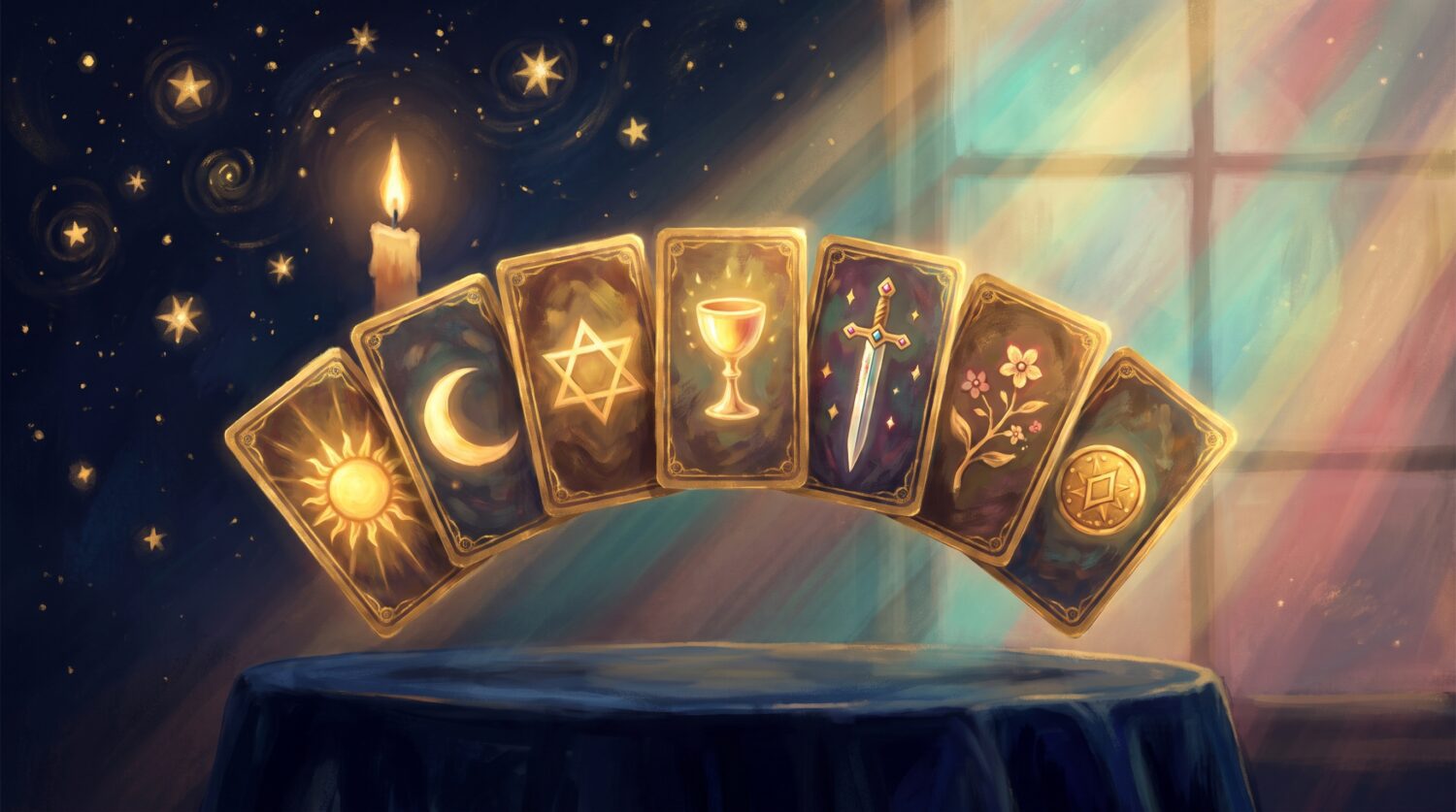
You turn over a card and something in you answers before your mind does. A figure on a cliff edge. A tower struck by lightning. A woman pouring water between two cups. The picture is simple, and yet it seems to know something about your week.
That small jolt is why tarot has lasted for more than five centuries. Tarot cards are a deck of 78 illustrated cards, used today as a tool for reflection, storytelling and spiritual practice. This guide covers the whole path: where the cards came from, how the deck is built, how to read them, simple spreads you can try tonight, how to work with your intuition, and how to stay honest about what tarot can and cannot do.
Key Takeaways
- A tarot deck has 78 cards: 22 Major Arcana and 56 Minor Arcana in four suits.
- Tarot began as an Italian card game in the 15th century. Its use for divination came later.
- The most useful way to read is as a mirror: reflection, not a guaranteed prediction.
- Beginners do well with a one-card daily draw and a simple three-card spread.
- Intuition grows with practice, notes and honesty, and you are already enough to begin.
What Tarot Actually Is
Tarot is a system of symbols. Seventy-eight pictures, arranged in a pattern that people have studied, argued about and loved for generations. Each card shows a scene, a figure or an image: a sun, a sword, a chalice, a king on a throne. Readers shuffle the deck, draw a few cards, and talk through what the images stir up in relation to a question.
What happens next depends on the person. Some readers see tarot as a spiritual tool that connects them with guidance. Others see it as a creative prompt, a kind of structured daydreaming. Many land somewhere in between. Julia Gordon-Bramer, a tarot reader with more than 45 years of experience, describes tarot on our podcast as a mirror to the soul. We will come back to her in a moment.
Here is the plain version. A tarot reading will not carry a message from the universe in a form that anyone has been able to measure. What it does offer is a way to slow down, look at your life from a new angle, and put words to things you already half know. For a lot of seekers, that is plenty. The power is within you, and the cards are only a doorway to it.
Try this tonight: shuffle any deck, draw one card, and look at it for two full minutes before you read any meaning. Write down three things you notice. That is a real tarot reading.
A Short History of Tarot
Game Cards in Renaissance Italy
The first tarot decks appeared in northern Italy in the 15th century, in the courts of cities such as Milan and Ferrara. They were made for a trick-taking card game called trionfi, which means triumphs. Wealthy families commissioned hand-painted decks as luxury objects. The best known surviving examples are the Visconti-Sforza decks, named after the Milanese ruling families. Scattered cards from them are held in collections around the world.
These early decks took an ordinary set of four-suit playing cards and added a run of special picture cards, which acted as permanent trump cards. Those picture cards are the ancestors of today’s Major Arcana. Records from the 1440s mention the game, and the word tarocchi appears in the following century. Nothing in the early sources describes fortune telling.
The Myth of Ancient Egypt
You may have heard that tarot came from ancient Egypt, or from a lost book of wisdom. That story comes from the 1780s, when a French writer named Antoine Court de Gebelin declared that the symbols were Egyptian priestly teaching. He had no evidence for it, and historians have not found any. The idea spread anyway, because it is a beautiful story.
The same decade brought another turning point. A Parisian writer who used the name Etteilla published some of the first guides to using a tarot deck for divination, assigning meanings to each card. From there, the practice slowly spread.
Occult Revival and the Rider-Waite-Smith Deck
In the 19th century, writers such as Eliphas Levi linked tarot to Kabbalah, astrology and ceremonial magic. The Hermetic Order of the Golden Dawn, a late 19th century occult society, developed detailed correspondences between cards, Hebrew letters, planets and the elements. Many modern interpretations trace back to that world.
In 1909, a deck was published in London that changed the way most people learn tarot. Arthur Edward Waite designed it, and the artist Pamela Colman Smith painted it. Its great innovation was a full scene on every card, including the numbered cards of the Minor Arcana. Before that, most decks showed only repeated symbols on those cards. Smith’s illustrated scenes gave beginners a story to read. Today it is usually called the Rider-Waite-Smith deck, and it is the model for a huge share of the decks you will find.
Tarot in Our Own Time
Through the 20th century, tarot spread through counterculture, psychology and spiritual publishing. Many readers now describe the cards in terms of archetypes, a word drawn from the psychologist Carl Jung, who wrote about universal patterns in the human imagination. Jung did not build a tarot system, but the language fits, and it helped tarot move from fortune telling toward self-understanding.
In our conversation on the origins of tarot with Julia Gordon-Bramer, she traces the cards back to the Renaissance and beyond, and clears away some of the fear that still clings to them. She says tarot shows you the path you are on, and that you are free to change direction if you do not like what lies ahead. That is the spirit we recommend bringing to the cards.
Try this tonight: look up an image of one of the early Italian decks, then look at a Rider-Waite-Smith card. Notice what changed, and what stayed.
How the Deck Is Built
A standard tarot deck holds 78 cards. They fall into two groups.
- The Major Arcana: 22 cards, numbered 0 to 21, each with a name and a large symbolic image.
- The Minor Arcana: 56 cards in four suits, closely resembling a deck of playing cards with an extra face card.
The word arcana comes from the Latin for secrets or mysteries. Major means greater and minor means lesser, though that does not mean the minor cards matter less. Think of the Major Arcana as the chapters of a life, and the Minor Arcana as the days inside those chapters.
A quick rule of thumb helps while you learn. If a reading is full of Major Arcana cards, the situation is likely weighty, with large themes in play. If it leans on Minor Arcana, the matter is more everyday and practical.
The Major Arcana: Twenty-Two Big Lessons
The Major Arcana tells a story that readers often call the Fool’s Journey. It begins with The Fool, number 0, a figure stepping out into the unknown, and it ends with The World, number 21, a picture of wholeness. Along the way the Fool meets teachers, temptations, endings and rebirths. The idea of reading the cards as one traveler’s path was popularized by 20th century tarot writers, and it gives the sequence a natural shape you can remember.
Here are the 22 cards with short, traditional keywords. Treat them as starting points. Meanings vary from deck to deck and from reader to reader.
- 0, The Fool: new beginnings, trust, a leap of faith.
- 1, The Magician: skill, focus, turning an idea into action.
- 2, The High Priestess: inner knowing, silence, the unseen.
- 3, The Empress: nurture, creativity, abundance of the senses and the earth.
- 4, The Emperor: structure, authority, boundaries.
- 5, The Hierophant: tradition, teaching, shared belief.
- 6, The Lovers: relationship, alignment, choices made from the heart.
- 7, The Chariot: determination, direction, willpower.
- 8, Strength: courage, patience, gentle power. (In some older decks Strength and Justice swap places, as numbers 11 and 8.)
- 9, The Hermit: solitude, searching, inner light.
- 10, Wheel of Fortune: cycles, change, timing.
- 11, Justice: fairness, truth, cause and effect.
- 12, The Hanged Man: pause, surrender, a new point of view.
- 13, Death: endings and transformation. It rarely means literal death.
- 14, Temperance: balance, blending, moderation.
- 15, The Devil: attachment, patterns that bind, shadow.
- 16, The Tower: sudden upheaval, truth breaking through false structures.
- 17, The Star: hope, healing, renewal.
- 18, The Moon: dreams, uncertainty, the subconscious.
- 19, The Sun: joy, clarity, vitality.
- 20, Judgement: awakening, reckoning, a call to rise.
- 21, The World: completion, integration, arrival.
Scary Cards Are Not Scary
Beginners often brace themselves for Death, The Tower and The Devil. Take a breath. Death usually points to the end of a chapter, a job, a belief or a habit, and the space that follows. The Tower tends to describe a shake-up that clears away something that was never solid. The Devil often asks where you feel stuck, and what you might loosen. None of these cards is a verdict. Each one is a question, and a good reader asks it gently.
If you want to meet a card on your own terms, give it a week. Draw The Tower, or whichever card unsettles you most, and keep it where you will see it. Notice when it speaks to you, and when it does not.
Try this tonight: pull the 22 Major Arcana cards from your deck and lay them in order. Read the Fool’s Journey from left to right, like a comic strip, and notice which card your eye keeps returning to.
The Minor Arcana and the Four Suits
The 56 Minor Arcana cards describe the texture of daily life: work, love, conflict, rest, money, ideas. They are divided into four suits, and each suit has a natural territory. Names differ between decks, so keep an eye on your own.
- Wands: energy, passion, ambition, creativity. Associated with fire.
- Cups: emotion, relationships, intuition, connection. Associated with water.
- Swords: thought, communication, truth, conflict. Associated with air.
- Pentacles: body, work, money, home, health. Associated with earth. Some decks call this suit Coins or Disks.
Those elemental links come from the Golden Dawn tradition, and a few modern decks and teachers assign the elements differently, for example swapping Wands and Swords. Neither is wrong. Choose a system and stay consistent while you learn.
Once you know the suits, you can read a card you have never studied. Seeing the Five of Cups, you already know it concerns feeling and relationship. Seeing the Five of Swords, you know it concerns thought and conflict. The suit tells you the territory, and the number tells you the stage.
Numbers and Court Cards
What the Numbers Say
Each suit runs from Ace to Ten, and the numbers carry a rhythm that repeats in every suit. Many readers use these simple associations.
- Ace: a seed, a beginning, an offering.
- Two: choice, balance, partnership.
- Three: growth, collaboration, first results.
- Four: stability, rest, sometimes stagnation.
- Five: challenge, conflict, loss.
- Six: harmony, recovery, giving and receiving.
- Seven: assessment, testing, reflection.
- Eight: movement, effort, mastery in progress.
- Nine: near completion, resilience, solitude.
- Ten: completion, fullness, the end of a cycle.
A numerology thread runs through all of this. Fives tend to be hard in every suit, because five is the point where the early plan meets resistance. Sixes tend to ease. Learn the ten numbers and you have learned a good part of the Minor Arcana already.
The Court Cards
Each suit also has four court cards: Page, Knight, Queen and King. Some decks use different titles, such as Princess and Prince. Court cards can describe actual people in your life, aspects of yourself, or a way of approaching a situation.
- Pages: students and messengers. Curiosity, new ideas, early steps.
- Knights: action and pursuit. They move toward a goal, sometimes too fast.
- Queens: mastery turned inward. Nurture, depth, emotional command of the suit.
- Kings: mastery turned outward. Leadership, responsibility, authority.
Court cards are often the trickiest for beginners. A useful trick is to ask whether the card describes a person, a quality you are being asked to show, or an approach to the question. When in doubt, try all three and notice which one rings true.
Try this tonight: pick one suit and lay out its fourteen cards in order. Read the Ace to the Ten as a short story, then meet the court. You will learn more in that half hour than in a week of memorizing keywords.
A Tarot Glossary
Every craft has its vocabulary. These are the terms you will meet most often.
- Arcana: from the Latin for secrets. The two divisions of the deck are the Major and Minor Arcana.
- Querent: the person asking the question. If you read for yourself, that is you.
- Spread: the pattern in which cards are laid out, with each position carrying its own meaning.
- Significator: a card chosen to stand for the querent. Many modern readers skip this.
- Upright and reversed: the card’s orientation when drawn. Reversed cards appear upside down.
- Court cards: Page, Knight, Queen and King in each suit.
- Pips: the numbered cards from Ace to Ten in the Minor Arcana.
- Trump: an older term for the Major Arcana cards, from their role in the original card game.
- Clarifier: an extra card drawn to shed light on a card that is unclear.
- Cleansing: any ritual a reader uses to reset a deck, such as shuffling, knocking on it or passing smoke over it. Optional and personal.
- Rider-Waite-Smith: the 1909 deck whose imagery shaped most modern decks.
- Tarot de Marseille: a traditional French pattern with simple, bold images. Number cards show suit symbols only.
- Thoth: a 20th century deck created by Aleister Crowley and Lady Frieda Harris, rich in esoteric symbolism.
- Oracle cards: decks without the 78-card structure. Each one is built to its creator’s own design.
How to Read the Cards
You do not need a perfect memory or a special gift. You need a question, a deck, a little quiet and the willingness to be curious. Here is a simple process that works for most people.
1. Settle and Ask
Take a few slow breaths. If you like, light a candle or hold the deck for a moment. Then choose a question. Open questions work best: What do I need to understand about this situation? or How can I approach this week? Questions that demand a yes or no, or a date, set the cards up to fail. If you want to prepare your mind first, our meditation guide offers a gentle place to begin.
2. Shuffle and Draw
Shuffle in whatever way feels natural. Some readers cut the deck into piles. Others fan the cards and pick. There is no wrong method. When you feel ready, stop and lay down the number of cards your spread calls for.
3. Look Before You Look Up
This step is the one beginners skip. Before you reach for a guidebook, look at the card. What is the figure doing? What colors dominate? Where is the light? What feeling arrives in your body? Your first impression is data, and it usually holds more than you expect.
4. Add the Traditional Meaning
Now consult the keywords, the suit, the number. Combine what you saw with what the tradition says. If the two agree, wonderful. If they differ, notice that too. You are building a personal vocabulary, one card at a time.
5. Read the Cards Together
A single card is a word. A spread is a sentence. Look for repeating suits, which show where the energy gathers. Look for repeated numbers, which hint at a stage. Look for the balance of Major to Minor cards. Notice where figures look toward or away from each other, since in many decks the direction of a gaze points somewhere meaningful.
6. Tell the Story and Write It Down
Say the reading out loud, even if you are alone, as a short story: This is where I am, this is what is in the way, and this is a way forward. Then record the question, the cards and your impressions in a notebook. Notes are the secret of every good reader. A week later you will see patterns you could not see in the moment.
7. Close With an Action
A reading that ends with no action tends to evaporate. Choose one small thing you can do because of what you saw. Make the call. Take the walk. Write the letter. Let the reading earn its place in your real life.
Reversed Cards
When a card lands upside down, it is called reversed. Readers disagree on what to do with that, and the disagreement is healthy.
- Ignore reversals. Many readers read every card as upright. This keeps things simple, and it is a perfectly good way to start.
- Treat it as blocked energy. The card’s theme is present but stuck, delayed or hidden.
- Treat it as inward. The theme is happening inside you rather than out in the world.
- Treat it as the opposite. Some readers read the reverse as the reverse. This can feel too stark, so use it with care.
Whichever route you choose, a reversed card is not a bad omen. It is another shade of meaning. If you feel overwhelmed, leave reversals out for your first few months.
Beginner Tarot Spreads
A spread is a map for your reading. Each position has a job, and the job gives each card a context. Start small. A short spread read well beats a big spread read in a hurry.
The One-Card Daily Draw
Draw a card each morning with the question, What should I notice today? Write the card and a sentence about it. At night, add a sentence about how the day went. Within a month you will have a personal reference book written in your own handwriting, and the cards will start to feel familiar.
The Three-Card Spread
The three-card spread is the workhorse of tarot. The positions can change depending on your question. Here are three popular versions.
- Past, Present, Future: where this came from, where it stands, where it may lead if nothing changes.
- Situation, Challenge, Advice: what is happening, what is in the way, what might help.
- Mind, Body, Spirit: how you are thinking, how you are feeling physically and how you are connecting to something larger.
Notice that the first version says “may lead if nothing changes.” That phrasing matters. A future position is best read as a likely direction, never a promise.
The Five-Card Decision Spread
When you face a choice between two paths, lay out five cards.
- Card 1: the heart of the matter.
- Card 2: what Path A offers.
- Card 3: what Path A asks of you.
- Card 4: what Path B offers.
- Card 5: what Path B asks of you.
This spread does not tell you what to do. It helps you see both options in full. Notice your emotional response as each card appears. Relief, tightness or excitement are all useful information.
The Celtic Cross
The Celtic Cross is the best-known tarot spread, with ten cards. Its exact origins are a matter of some debate, and several versions exist. A common layout runs like this.
- 1: the present situation.
- 2: the challenge crossing it.
- 3: the foundation, or root cause.
- 4: the recent past.
- 5: your goal or best outcome.
- 6: what is coming soon.
- 7: you, your attitude.
- 8: outside influences and other people.
- 9: hopes and fears.
- 10: the likely outcome if the current course holds.
Wait until the three-card spread feels easy before you attempt it. Ten cards at once can feel like ten people talking in a room. If you are patient, though, it teaches how cards in different positions speak to one another.
Try this tonight: do a Situation, Challenge, Advice spread about something small, like how to approach tomorrow. Write one sentence per card, then one sentence of overall meaning. Do not look up anything until you have written your own.
Working With Your Intuition
Memorized meanings are the scaffolding. Intuition is the building. Most experienced readers say the real reading begins once you stop reciting and start listening.
What does that mean in practice? Intuition is often quiet. It can arrive as a feeling in the chest, a word that pops up, a memory, a sense that two cards belong together. It is easy to dismiss because it does not announce itself. Julia Gordon-Bramer says on the podcast that everyone has some degree of psychic ability, a gut feeling that grows with practice. You do not need to take that as settled fact to find it useful. You can treat it as a practical invitation: pay attention to what arises, and write it down.
Five Ways to Strengthen It
- Read the picture first. Spend a full minute with each card before consulting any book. Say what you see in plain language.
- Notice your body. Does a card make your shoulders drop, or your breath catch? Record it. The body often responds before words do.
- Keep a tarot journal. Write the question, the cards, your impression and later, what actually happened. Over time you learn which of your impressions prove useful.
- Practice stillness. Five minutes of quiet before a reading clears away noise. Our guide to intuition development offers more exercises to build that listening habit.
- Test your hunches gently. Before you flip a card, guess what it is or what it will say. Keep score without judgment. The goal is curiosity, not a perfect record.
Intuition and Wishful Thinking
A fair question: how do you tell intuition from what you simply want to be true? Honest readers watch for this constantly. A few signals can help. Intuition tends to be calm, specific and slightly surprising. Wishful thinking tends to be urgent, vague and flattering. Fear dressed up as intuition often arrives loud and repetitive. When you notice a reading that conveniently says exactly what you hoped, slow down and ask what the cards would say if you were hoping for the opposite.
Some seekers also feel that guides or loved ones on the other side communicate through signs, symbols and synchronicity. If that is part of your path, our guide to communicating with your spirit guides explores that world with the same grounded approach. Others prefer to keep tarot purely psychological. Both approaches can be sincere.
Try this tonight: draw a card, and before you look at it, write down one word you think it will carry. Flip it. Note the match or the miss with no judgment.
Ethics and Honest Limits
This is the part of a tarot guide that some people skip. We would rather say it plainly.
What Tarot Cannot Do
There is no scientific evidence that tarot predicts the future, and no mechanism that researchers have identified by which shuffled cards could know what will happen to you. Skeptics point out that the language of a tarot reading is broad enough to fit almost any life, a pattern psychologists sometimes call the Barnum effect, and they have a fair point. We think it is worth taking seriously.
So where does that leave a reader? It leaves tarot in an honest and useful place. The cards work as a mirror. They give you a prompt, a structure and a story to react to, and your reaction tells you something. When a card makes you sigh with relief, or bristle, or tear up, you have just learned what you care about. That is real, even if the cards themselves are ordinary cardboard. If you would like to read about research into the edges of human perception, our conversation with Dean Radin on psychic abilities takes up that question.
For anyone who experiences tarot as spiritual, nothing here needs to change. You can believe that guidance reaches you through the cards and still hold your readings with humility. Holding both is not a contradiction. It is maturity.
Principles for Reading With Care
- Never present a reading as certain. Use language like “this suggests,” “one possibility is” and “you might consider.”
- Do not give medical, legal or financial instructions. Tarot is no substitute for a doctor, a lawyer or a financial advisor. If a reading touches health, point the person toward qualified professionals.
- Avoid fear. Never tell someone they are cursed, doomed or in danger. If a card is heavy, speak about what can be done.
- Get consent. Read for people who have asked. Do not read about third parties behind their backs, such as a partner’s secret thoughts.
- Honor free will. The cards describe tendencies. The person decides.
- Be kind about money. If you charge for readings, be clear about what you offer. Never sell an expensive cure, a protection ritual or a promise of an outcome.
- Know when to refer. If a person seems in crisis, thinking about harming themselves, or facing something beyond a reading, encourage them to reach out to a trusted professional or crisis line.
- Look after yourself. Do not make big decisions from one reading. Sleep on it.
The same standard applies to anyone who reads for you. Be wary of a reader who creates urgency, predicts disaster that only they can fix, or asks for escalating payments. That is not guidance. The deeper lie behind a lot of old, ungrounded spirituality is that the answers live outside of you, with a gifted stranger. We hold the opposite: every reader, book and deck is only a guide to help you remember what you already know. Our guide to spiritual enlightenment explores that theme across the world’s traditions.
Try this tonight: write down your own rules for how you will read, for yourself and for others. Three or four sentences. Keep them in the front of your tarot journal.
Choosing Your First Deck
There are thousands of tarot decks, and the choice can feel dizzying. Here is a calm way to approach it.
The Three Classic Traditions
- Rider-Waite-Smith (and decks inspired by it): a full scene on every card. Most guidebooks, classes and online resources assume this system. This is the easiest place to begin.
- Tarot de Marseille: the traditional French pattern. Bold, simple images, and number cards that show repeated suit symbols instead of scenes. It rewards patient readers who like to build meaning from structure and pattern.
- Thoth: richly symbolic, with ties to astrology and Kabbalah. Wonderful for those drawn to esoteric study, though steeper for a first deck.
What to Look For
- Art you enjoy. You will spend hours with these images. If a deck leaves you cold, you will not pick it up.
- Clear imagery. For a first deck, choose pictures you can describe easily.
- The standard 78 cards. A true tarot deck has the Major and Minor Arcana. Make sure you are not buying an oracle deck by accident.
- Card size and feel. Large cards can be hard to shuffle. Look for a size your hands like.
- A good guidebook. A deck with a clear companion book saves time at the start.
- Your budget. A lovely beginner deck does not need to be expensive. Many readers start with a classic deck and add others over time.
The Gift Question
You may have heard that a first deck must be given to you, never bought. That is folklore, not a rule. Plenty of excellent readers bought their first decks. Choose the deck that calls to you, whether it was a gift or a bookstore find.
Tarot or Oracle?
Oracle decks have no fixed structure. One may have 36 cards, another 52, each with its own themes and messages. They can be warm and approachable, and some people use them alongside tarot. For learning the symbolic language that most readers share, a true tarot deck gives you more to work with. If you are curious, you can have both.
Building a Daily Practice
A little, often, beats a lot, rarely. A sustainable rhythm might look like this.
- Daily: one card, one sentence, two minutes.
- Weekly: a three-card spread about the week ahead or the week behind, written in your journal.
- Monthly: read through your notes. Which cards keep returning? What did you get right, and what did you miss?
- Seasonally: choose one card or one suit to study deeply. Read about its history and symbolism, and draw or journal about it.
Cards that appear again and again are worth a pause. They may be pointing to a theme that wants attention, or simply to the fact that you are still learning to see them. Treat repetition as an invitation to ask a better question.
Tarot also pairs well with other practices. Many people use a card as a theme for meditation, or as a writing prompt, or as a way to open a conversation with a friend. Others draw on astrology alongside the cards, since the two traditions share symbols. Our conversation with astrologer Ricky Williams on evolutionary astrology shows how another symbolic language approaches the soul’s journey.
Common Questions About Practice
Do I Have to Memorize All 78 Cards?
No. Learn the suits, the numbers and the 22 Major Arcana themes, and you have the keys to everything else. Meanings come with repetition. Most readers use a guidebook for years.
What If a Card Does Not Match Its Traditional Meaning?
Trust what you observe, and note both. The tradition is a friend, not a boss. If the Three of Swords, usually about heartbreak, feels like release to you in a given reading, record that. Over time you will see when your read is the better one.
How Often Should I Ask the Same Question?
Repeating a question again and again, searching for a better answer, usually creates anxiety rather than clarity. If you do not like what you see, try changing the question: What can I do about this? instead of Will it work out? Then give it some days.
Is It Wrong to Use Tarot If I Follow a Religion?
Many people reconcile the two without trouble, and others do not. Some traditions discourage divination, and that is a matter of personal conscience. If tarot feels like a conflict, you could use the cards purely as a journaling and storytelling tool, or set them aside. You are the only one who can decide that. Nobody gets to shame you either way.
Can Tarot Help With Grief or Hard Times?
It can provide company, language and a gentle structure for feelings that are hard to name. It is not a replacement for therapy or support from loved ones. If you are struggling, use tarot as one small light alongside real human help.
Books for Your Tarot Shelf
A few well-loved books can guide you further. These are classics and favorites among tarot readers, and you can find each on Amazon.
- Tarot Life Lessons: Living Wisdom from the Major Arcana by Julia Gordon-Bramer. A reflective look at the 22 Major Arcana from our podcast guest.
- The Pictorial Key to the Tarot by Arthur Edward Waite. The original companion to the Rider-Waite-Smith deck, written in an older style.
- 78 Degrees of Wisdom by Rachel Pollack. A beloved, thoughtful guide that treats each card as a window into life.
- Tarot for Your Self by Mary K. Greer. A workbook approach that encourages readers to build their own relationship with the cards.
- Learning the Tarot by Joan Bunning. A gentle, step-by-step introduction for beginners.
If you love reading more broadly, our list of the best spiritual books is a good next shelf to explore. As an Amazon Associate, Next Level Soul earns from qualifying purchases at no extra cost to you.
Where to Go Next
You do not need to do everything at once. You need one card, one notebook and one honest question. A path forward might look like this.
- This week: draw one card each morning and write one sentence.
- This month: learn the 22 Major Arcana through a weekly three-card spread.
- This season: study one suit deeply, and read one book from the list above.
- Along the way: listen to Julia Gordon-Bramer’s conversation on the origins of tarot, and explore our guides to developing intuition and connecting with spirit guides.
Tarot is one of many symbolic languages people have used to understand themselves. It will not do the work for you, and it was never meant to. Seekers who benefit most tend to be those who treat the cards as a conversation partner, not an authority. If you want to go deeper on the inner path, explore Next Level Soul Mastery, our collection of in-depth courses. You are already enough to begin.
Frequently Asked Questions
What Do Tarot Cards Mean?
Each of the 78 cards carries a symbolic meaning that readers use as a prompt for reflection. The Major Arcana point to big life themes. The Minor Arcana speak to everyday situations through four suits. Meanings are traditions and starting points, and your own reading of the imagery matters too.
How Many Cards Are in a Tarot Deck?
A standard tarot deck has 78 cards: 22 Major Arcana cards and 56 Minor Arcana cards. The Minor Arcana are split into four suits of 14 cards each.
Can Tarot Predict the Future?
There is no scientific evidence that tarot predicts the future, and good readers say so. Most modern readers treat tarot as a tool for reflection. It helps you see patterns, name feelings and weigh choices. It does not hand you a fixed outcome.
Is Tarot Evil or Dangerous?
No. Tarot is a deck of illustrated cards with roots in an Italian card game. Some people hold religious objections to divination, and that is their right. For most readers it is a quiet, reflective practice, closer to journaling with pictures.
What Is the Best Tarot Deck for Beginners?
Most teachers suggest a deck in the Rider-Waite-Smith tradition, because every card, including the number cards, shows a clear scene. Many guidebooks and courses are written for it. Choose one whose artwork you actually enjoy looking at.
What Is the Easiest Tarot Spread for Beginners?
Start with a one-card daily draw, then try a three-card spread such as situation, challenge and advice. Both are simple, quick and enough to build real skill before you move to a Celtic Cross.
Do Reversed Cards Mean Something Bad?
Not necessarily. Many readers treat a reversed card as a softer, blocked, delayed or inward version of the upright meaning. Others skip reversals completely. Either approach is valid, so pick what feels clear to you.
Can I Read Tarot for Myself?
Yes. Reading for yourself is a common way to learn. The challenge is honesty, since we tend to see what we hope for. Write down your question first, record the cards, and revisit your notes a week later.
Do I Need to Be Psychic to Read Tarot?
No. Tarot reading is a skill built through study, practice and attention. Many readers describe a growing sense of intuition, and that can be developed like any other awareness. You do not need a special gift to begin.
Should I Let Other People Touch My Deck?
That is a personal choice. Some readers keep their deck private, and some happily let others shuffle. There is no rule. Do what helps you feel comfortable and focused.
What Is the Difference Between Tarot and Oracle Cards?
Tarot follows a set structure of 78 cards with Major and Minor Arcana. Oracle decks have no fixed structure. Each creator chooses the number of cards, the themes and the messages, so oracle decks vary widely.