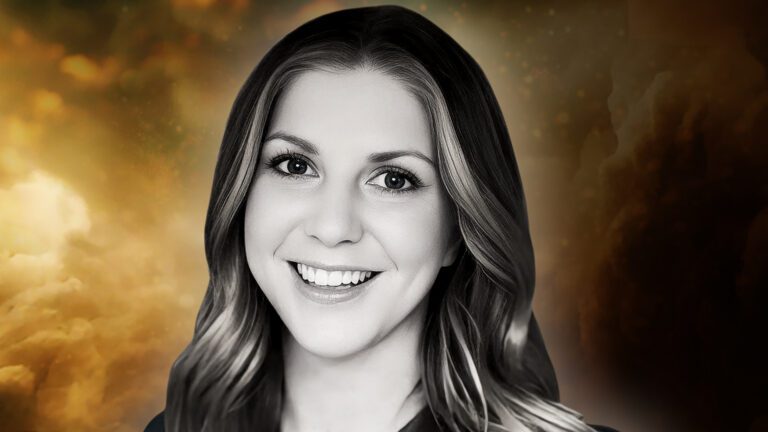
What if death is not a door that closes, but a river we have been preparing to cross our entire lives? We spend so much of our existence avoiding the thought of dying, as though refusing to look at something might somehow prevent it from happening. Yet every sunset reminds us that endings are woven into the very fabric of life. The flower blossoms, the seasons change, and the river continues its journey toward the ocean. Perhaps death is not nature’s greatest mistake, but one of its deepest mysteries. On today’s episode, we welcome Sarah Kerr, a sacred death-care practitioner and founder of the Center for Sacred Death Care, whose work explores the spiritual, emotional, and ritual dimensions of dying. Our conversation takes us into a world that most people rarely discuss openly, where extraordinary experiences can unfold at the bedside of someone preparing to leave this life.
Sarah’s journey into this work began with something deeply personal: her father’s devastating stroke. Watching someone she loved experience such a profound change forced her to confront questions she had never seriously considered. Her father was an educated, practical man who had spent his life studying the physical world. Yet as he approached death, he found himself facing a mystery for which his understanding of material reality offered little guidance. Sarah recognized that while his physical needs were being addressed, something else was missing. He needed emotional and spiritual support. He needed help understanding what was happening to him, and perhaps most importantly, he needed an opportunity to release the unfinished burdens of his life. That realization would eventually transform her personal grief into a calling to help others navigate the sacred threshold between living and dying.
One of the most beautiful stories Sarah shares involves the farewell ritual she created for her father. Rather than waiting until after his death for friends and family to gather and express their love, she invited them to do so while he was still present. Each person brought a tiny symbolic gift, something small enough to fit into an imagined canoe that would carry him across the river toward the village of his ancestors. These gifts were not valuable because of their price. Their meaning came from the memories, relationships, and love they represented. As everyone gathered, her father had the extraordinary opportunity to hear the words that so many people only receive at their funerals. Imagine what might change in our relationships if we stopped waiting until someone was gone to tell them how deeply they mattered. Perhaps the most meaningful preparation for death is learning to express our love while there is still time.
As our conversation deepens, Sarah describes unusual experiences reported by people approaching death. Some speak of seeing relatives who have already passed away. Others experience vivid dreams, mysterious sounds, or sensations that seem difficult to explain through ordinary experience. She recalls a woman dying of cancer who began hearing music that nobody else could hear while playing cards with her family and friends. The woman associated these experiences with her grandmother, who had been an exceptional card player. Sarah also shares accounts from hospice workers and funeral professionals who describe feeling the presence of people who have died. These experiences do not establish what happens after death, and different people may understand them through spiritual, psychological, or medical perspectives. But they raise a fascinating question: What if the process of dying contains experiences that deserve our attention, even when we do not fully understand them?
Sarah introduces a word that carries an ancient and beautiful meaning: psychopomp. It refers to a guide who helps a soul through its transition. Throughout human history, cultures have imagined figures who accompany the dead into the next world. But Sarah approaches this idea as a living practice of care, something that can involve ritual, compassionate listening, spiritual support, and a willingness to sit with the unknown. She works with people who report extraordinary experiences while caring for the dying, helping them explore those experiences while maintaining appropriate boundaries and respect. What struck me was how often people simply need permission to speak honestly about what they have witnessed. We live in a culture that is remarkably comfortable discussing technology, entertainment, and material success, yet often struggles to have an open conversation about the one experience every human being will eventually face.
Perhaps the most profound lesson from Sarah’s work is the importance of community. She explains that the people who approach death with strong relationships and loving support often have something invaluable: the knowledge that they do not have to face the journey alone. She speaks of building community throughout our lives, rather than waiting until our final days to discover that we need one another. In a world increasingly shaped by isolation and distraction, this feels like a message that extends far beyond death care. We were never meant to navigate every challenge alone. The same hands that comfort us through illness, grief, and uncertainty are the hands that remind us we belong. Sarah describes death as a transformation, offering a striking comparison: “It’s like moving to a new neighborhood.” For her, this metaphor gives people a way to imagine the unknown without becoming overwhelmed by fear. Whether we share her spiritual understanding or not, the tenderness of that image invites us to consider how the stories we tell about death influence the way we experience life.
There is also something deeply moving about Sarah’s relationship with her ancestors. Following her father’s illness, she experienced recurring dreams involving members of his family line. These dreams became meaningful companions during a period of grief and spiritual exploration. She describes them as part of her understanding that death may not sever the connections between generations. And perhaps this is where the mystery becomes especially personal. Every one of us carries something from those who came before us. We inherit stories, traditions, gestures, fears, hopes, and forms of love that continue long after the people who first expressed them have disappeared from our sight. Even without knowing what exists beyond physical death, we can recognize that a human life continues to influence the world through the people it touches. We are, in so many ways, living expressions of those who loved us into existence.
SPIRITUAL TAKEAWAYS
- Love deserves to be expressed while we are here. Meaningful farewells, honest conversations, and simple gestures of appreciation can bring peace to relationships before death arrives.
- The mysteries surrounding death deserve compassion. Unusual end-of-life experiences can be approached with curiosity, respect, and care without requiring us to claim certainty about their meaning.
- Community is part of sacred living and dying. The relationships we nurture today may become our greatest source of comfort during life’s most difficult transitions.
What remains with me after this conversation is not simply a collection of extraordinary stories about the boundary between life and death. It is a deeper appreciation for the extraordinary privilege of being alive together. We spend so much time wondering where we go after death that we sometimes forget to ask how we wish to love before it arrives. Sarah’s work reminds us that the final chapter of a human life deserves as much tenderness, dignity, and meaning as its beginning. Perhaps we do not need to solve the mystery of eternity to become more compassionate in the present. Perhaps the real invitation is to hold one another more gently, to speak the words we have been postponing, and to recognize that every ordinary moment of connection is already something sacred. And when the river finally calls us, may we have loved deeply enough to know that whatever waits on the other shore, our journey here was filled with meaning.
Please enjoy my conversation with Sarah Kerr.
[spreaker type=player title=”Death Doula REVEALS the Mysterious Signs That Appear Before We DIE! (NDE) with Sarah Kerr” resource=”episode_id=75989122″ width=”100%” height=”150px” theme=”dark” playlist=”false” playlist-continuous=”false” chapters-image=”true” episode-image-position=”right” hide-logo=”false” hide-likes=”false” hide-comments=”false” hide-sharing=”false” hide-download=”true”]
Right-click here to download the MP3
Take Your Spiritual Journey to the Next Level—Download the Next Level Soul TV App!
Listen to more great episodes at Next Level Soul Podcast
Follow Along with the Transcript – Episode 138
Alex Ferrari 0:00
Tell me what your life was like before you died.
Sarah Kerr 0:08
About 17 years ago, maybe my dad had a stroke, and so that was really the first experience for me. And he had a terrible stroke, and he lived for a while. And but that was at first a social death, and then his actual death. I was living in California. Flew back to Canada. Spent a month or so getting everything. My mom and my family getting. We all got organized again, and then I went home. And it took me about six months before I was even through my own grief. I was just so devastated by just this massive shift in our family. And I was walking down the street, and I can remember I was living in Oakland, and I can remember exactly the street I was walking on, and exactly the place I was walking. When it suddenly clicked, and I had this thought that he needs soul help, and I am the only one in his life that can do that. I don't know exactly how to do it, but I'm the one. And so I began that journey, and I was learning about ritual. I was practicing ritual. I was in school at the time. I was doing my PhD in ritual, so I was in the zone. I was right up, right up immersed in all the ritual, and so I just began working with him and doing these rituals. And what happened was, I started to dream. And I had always been a big dreamer, but I started to dream. And I would say for a year, a year and a half, I dreamt of ancestors in my father's family line three times a week. Never once in that year and a half, did my mom's line come in? Who I've dreamed I've had lots of dreams about my mom's line, but for a year and a half, while I was really in this with him, I really was clear that the ancestors were with me, and I did things. Some of them were really ritual based. Some of them were very, on the outside, very pragmatic. I found a woman who was a social worker. Anyway, she interviewed him. I gave a bunch of photos of his life. He was very well photographed life. He had lots of amazing experiences, and I said, you know, I think here and here and here were some places in his life that are kind of unresolved. So I had her interview him ostensibly for this book that we created of the photos. But at this point, and this point, and this point, I said, just go deeper. And so she did a little therapy with him and helped him process that. I was trying to help him really unburden what he needed to let go before he left. Then we did a big, beautiful goodbye ritual where we had we did two. We did one with family and one with his friends. Where I invited each person to bring a gift no larger than an inch in any direction, and we went around the circle, and it was a gift for him to go in his canoe to cross the river to go to the village of the ancestors. And so people went around, and they had these very concentrated, very symbolic, very highly thought out gifts because it's small. They weren't expensive. They were, you know, a seed, no, or just these tiny things. And people went around, and they got to say goodbye, and he got to hear what people often only hear at their funerals, which is how much he was loved. So that was a real transformational journey for me. I had never had that. I was in my late 30s. Had really never met or met that experience of a close loved one dying. So that made me realize how ill prepared I was and how much he needed not only the medical and physical support, of course, but he needed soul support. He was really struggling with where am I going? What is happening? What am I doing? And he was a he had a Ph.D. in geology. I mean, he studied rocks. He was so material and of this world. And then suddenly he was laid low in a long-term care facility, thinking about where he was going, and he didn't have any map. And so I really thought, okay, there's there's something that's needed here. He's going to need this. Other people in my life are going to need this. I'm going to need this. And I really made this big shift and made this my life's work. It fit with a lot of other experiences and this sensitivity to the other world. So the work I do at the Center for Sacred Death Care is really about meeting death from the perspective that all the things you talk about on your show, the non-ordinary experiences, the spiritual experiences, the energetic experiences, that those are real. I teach people about deathbed phenomena. This might start to happen. You might have this experience. They can be, as you sure you know, they can be quite subtle on the outside, but really deep and emotional on the inside. And people say, "I think my grandmother came to my room last night," and so I really help them validate that. Like, yes, your grandmother came to your room. We are going to take that at face value. So when I work with client families, I really build a culture where this is normalized. And what I find is when I help people build a culture where everybody talks about it and it's normal, it happens more because when there's no space for it. People say, "Well, I just I must have been making that." They diminish, but so, and I think of one woman in particular who was in her mid 40s. She was dying of thyroid cancer, and she was she was very alert. I mean, she was playing crib the day before she died. She was incapacitated, but she was awake and alert. And for the week before she died, and it only happened when she was playing crib, and her grandmother was an incredible crib player. As she was playing crib with her kids, with her friends, she would start to hear music coming out of her cell phone that no one else heard, and it was very pragmatic. She said sometimes it was classical, sometimes it was like African a cappella. It was coming out and. She could talk about it. Didn't weird out the people she was talking about it, and it got richer and richer. So things like that. That how does that happen? She was attuned to something, and she really connected it to her grandmother, who was like she imagined reaching across from the other side to say hello, to be ready to carry her across. People have really powerful dreams. They see things when the body, you know, see things leave the body when the last breath happens. You know, I have. I'm not usually there at the death. Of course, you don't have to be. Not. I've certainly had. I've had dream visitations from clients for sure. Not in the shared death experience. Some of those other ways. And I, for me, that's actually quite validating. It's validating for my students because you can do this without having had those experiences. Sometimes people feel like, "Ooh, I need to have those experiences," and I haven't, just to to be with this process. The movements people make, and really the people that really come to me a lot, are people who are practitioners, like you talked about, hospice nurses, who have been having those all their life. And they, you know, I worked with a client, a funeral director, who she said, "I get home, and my clients, the people I've embalmed, are still in the room with me." And we did some research, like we did some ritual work and exploring, and it was clear that she was the last person who had been kind to some of these people, and they were in that in between zone, and they're like, "Whoa, this my life's been a little hard, but this person's really nice. I'm gonna go home with her. So I often help people untangle those experiences. Or a chaplain I worked with, who she said, you know, when I'm really aligned with my clients, when they die, I feel them. It's a very physical sensation. I feel them put their hand on my shoulder, push as they die. I've been helping them, and they just push me out. Said my training did not cover this. What does this mean? What do I do with it? So that's where I'm working with lots of people, people who have had profound multi-day. I had a woman not long ago talk about this multi-day shared death experience where she was in and with both the person who was dying and his brother, who had died a year before, helping him, he had been a terrible accident, helping him untangle from this world, connect to his brother. She was really this. The word I use a lot is psychopomp. Psyche is soul. Pomp is guide. It's this guiding the soul across. So people who are often helping on that journey, and who often have naturally been helpers on that journey, but haven't known how to tell anybody about that. They think, "Am I weird? Does anybody else do this? Is this okay? Is this wrong?" Or often they have this innate skill, but they haven't really figured out how to put it into place. Maybe you are naturally musically talented, but if you learn, if you learn to play an instrument, you can structure it. And so I help them kind of structure it, understand boundaries, understand consent, permission, ethics around it all. I hear that so often. People say, "Oh, you must be such a good person. You do this work, or you're so amazing." And and it's true. It's it's difficult work to do, but I really feel that everybody has a skill. We all come into the world with gifts. I could not do your job. There are 100,000 jobs in the world I could not do because I don't have that skill. And people, I think, really, when people can line up their innate, it's not even a skill; it's a gift. It's a soul gift. When people line up their soul gift and are able to do what they are just wired to do, it's not hard. And so I think people who are doing this work, certainly with my own experience, my students, it is the thing that feeds us. And this is maybe this is kind of embarrassing. Maybe I shouldn't admit this, but when somebody calls and they say, "Well, somebody's dying," or "Somebody has died," I'm always excited. I really enjoy working. But if they say, "Oh, it was a suicide," or "It was a murder suicide, or there's no body, or all of the different kind of ways it can be terrible. I get a little excited because for me that is not. I'm not excited for their heartbreak. Of course, I'm so moved by what's happening, but it's when it's really interesting and I can really go in, and it's real. It's real, real, real, real. In my experience, the thing that helps you meet death the best is community. Is having people around you and having support. So if you can live a life where you build a community, then when you come to your death, you'll be supported. So that's that's the bigger. You can't start that at the end, but the more community we have around each other, the better we are able to meet death. The more people we have to put their hands on the stern of the canoe and push us across. The more ritual containment we can build with more people who love them. If it's a week before and I meet someone who's dying, you know that they've either got community or they don't at that point. What I really offer them is this sense that there is something and a validation that there is more. That the veil, the river is real. That their ancestors are waiting for them. That life is not a light switch that goes out. It's it's like moving to a new neighborhood, and it's this transformation. And I I often frame that in ways of metaphor that people can understand. And and people say, Oh my God, I will never think about death the same way again. I just try and give them just a. As much of a map as I can, so they have a sense of where they're going because it's so scary. I think that's so much of the reason we're afraid of death in dominant culture is we don't know where we're going. So we're and we think we're leaving. We think we're leaving everything and everybody. But if we can reframe and say, no, actually, you're crossing the river. You're going to where everybody else has gone, and they're there waiting for you. And there are opportunities to continue to be in conversation. I often feel like I'm like handing someone the roadmap. Just that's this is if you don't have anything else, here's where you're going.
Links and Resources
- Center for Sacred Death Care
- YouTube, Facebook and Instagram
- WATCH the Full Episode: Crossing the River: Meeting Death with Ritual with Sarah Kerr
Sponsors
- Next Level Soul TV: Unlock Exclusive Spiritual Films, Series & Events—Join Today!
- Earthing.com: End Inflammation Today – Discover the Science-Based Healing Powers of Earthing/Grounding
If you enjoyed today’s episode, check us out on YouTube at NextLevelSoul.com/youtube and subscribe.