
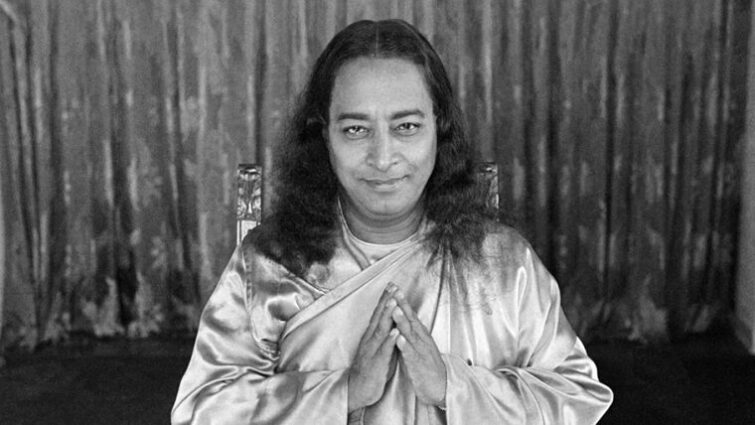
Few documentaries manage to transcend the boundaries of biography and become a spiritual experience themselves. Awake: The Life of Yogananda is one such film. Directed by Paola di Florio and Lisa Leeman, this extraordinary documentary paints an intimate yet expansive portrait of Paramahansa Yogananda, the Indian yogi who brought meditation and Eastern spirituality to the West.
The film doesn’t open with biography at all — it opens with consciousness itself. In a striking narrated sequence, Yogananda describes being aware inside his mother’s womb: “I was conscious in my mother’s womb. Feeling the movements in her body. Aware of my own helpless state.” It’s an audacious first choice, and it sets the tone for everything that follows: this isn’t a film about a man’s achievements, but about a consciousness that claims to have been awake long before the world ever noticed him.
The Man Behind the Movement
The film delves deeply into Yogananda’s journey, from his childhood in India to his life in America as a spiritual teacher. It explores his relentless pursuit to bridge the gap between East and West, introducing meditation and yoga to a world unfamiliar with such practices. His 1946 spiritual classic, Autobiography of a Yogi, remains a powerful catalyst for seekers worldwide — influencing everyone from Steve Jobs to George Harrison.
One of the film’s most memorable threads traces how the book itself has rippled through culture decades after Yogananda’s death. One interview subject recalls being in India with sitar legend Ravi Shankar, who handed her a copy of Autobiography of a Yogi and, in her words, “zapped me with his eyes” the moment she looked at the cover. She’s blunt about what the book meant to her: “If I hadn’t read that, I probably wouldn’t have a life. Really. I probably would have kicked the bucket.” Later in the film, we learn that Steve Jobs reportedly kept only one book on his iPad — Autobiography of a Yogi — and that mourners leaving his memorial service were each handed a copy, per his instructions. His last message to those closest to him, one interviewee recalls, was simply: “Actualize yourself.” That was Yogananda’s message too.
Through archival footage, interviews with spiritual leaders, scientists, and even Hollywood icons, the film crafts a rich narrative. It never feels like a dry history lesson; instead, it immerses the viewer in Yogananda’s inner world — a place of mysticism, devotion, and deep self-inquiry.
The Lineage Behind the Man
Awake takes real care to root Yogananda within a specific spiritual lineage rather than presenting him as a singular, self-made figure. The film traces Kriya Yoga back to Mahavatar Babaji — described in the narration as a “deathless yogi” who revived the practice for the modern world after it had been “buried during the Dark Ages.” Babaji is said to have instructed Lahiri Mahasaya to teach Kriya Yoga to others, beginning a chain of transmission “from guru to disciple” that eventually reached Yogananda himself.
The film includes a detail that gives Yogananda’s entire life a sense of destiny: Lahiri Mahasaya is said to have predicted Yogananda’s birth decades in advance, foretelling that “through this body, many shall receive the spiritual enlightenment of India,” and that “the message of yoga will encircle the globe.” It’s a striking notion — that Yogananda’s life in the West wasn’t simply a personal calling, but something foreseen and set in motion long before he was born. Fittingly, the film also captures his own hesitation when he first learned what was being asked of him: “When I heard the word ‘guru,’ it frightened me. For I knew what that responsibility meant.”
Yogananda’s early years were shaped by his devotion to his guru, Swami Sri Yukteswar. The film highlights the profound influence that this spiritual mentor had on his life. Under his guidance, Yogananda developed the core principles of Kriya Yoga, a practice that emphasizes breath control and meditation as pathways to self-realization. Awake beautifully illustrates this relationship, showing how Yogananda’s path was forged by deep inner experiences and a lifelong commitment to spiritual awakening. When Yogananda returns to India years later as a recognized spiritual teacher, the film lingers on his reunion with Sri Yukteswar, narrated in his own words: “A healing calm descended at the mere sight of my guru… Such spiritual atmosphere I so long missed.”
That bond makes Sri Yukteswar’s eventual death one of the film’s most quietly devastating moments. Yogananda’s grief is rendered almost wordlessly — “The Lion of Bengal is gone,” the narration states, followed by his own raw admission: “Master mine, why did you leave me?” It’s a rare moment where the film allows its central figure simple, unguarded sorrow rather than serene wisdom, and it lands harder for it.
The Personal Cost of a Global Mission
The film also explores Yogananda’s initial resistance to the mission that would later define his life. In one particularly touching sequence, Yogananda reflects on his reluctance to leave India and bring his teachings to the West. This moment underscores his deep connection to his homeland and reveals the personal cost of his global mission. The film notes that Sri Yukteswar sent him to America right after World War I — “the war to end all wars” — with a growing sense that the world was entering “a period of even greater horror,” and that the need for these teachings had never been more urgent. Despite his doubts, Yogananda followed his inner calling, eventually sailing to America and captivating audiences with his spiritual wisdom.
One of the film’s strengths is how it humanizes Yogananda. While revered as a spiritual master, the documentary doesn’t hesitate to explore his struggles. The loss of his mother is treated with particular tenderness: as an eleven-year-old boy temporarily separated from her, he wakes one night convinced she has appeared to him in a vision, saying, “Rush to Calcutta, if you would see me.” A telegram arrives days later confirming she had died of cholera. The film lets this loss echo across his entire life — years afterward, he describes a subsequent vision in which a divine feminine presence tells him, “It is I who have watched over thee, life after life, in the tenderness of many mothers,” reframing personal grief as a doorway into a much larger spiritual understanding. This honest portrayal makes his teachings even more profound; Yogananda didn’t preach from a place of detachment, but from the trenches of human experience.
The Visual Language of Spirituality
Visually, Awake is a meditation in itself. The film employs dreamlike sequences, ethereal animations, and poetic cinematography to illustrate Yogananda’s visions and spiritual insights. Scenes of Himalayan landscapes and serene meditation practices are juxtaposed with Yogananda’s intense personal struggles — from betrayal to health issues — creating a balanced and profoundly human portrait of the revered master.
In one powerful sequence, the film visualizes Yogananda’s profound inner experiences through a kaleidoscope of swirling colors and cosmic imagery, echoing his own description of reality as being like “a motion picture” — light and shadow projected onto a screen, with “one purpose: to get to the beam” behind it. This ambitious visual style aligns with his teachings about the boundless nature of consciousness. Rather than telling the viewer about spiritual awakening, Awake attempts to make them feel it.
The use of archival footage is particularly effective, and one of the film’s most memorable anecdotes comes from a disciple’s account of hearing Yogananda’s recorded voice for the first time, having no idea what to expect before a booming, powerful voice filled the room: “I, Paramahansa Yogananda, am singing. Sing with me.” His presence, even decades after his passing, still carries an undeniable magnetism.
The film also employs a unique blend of music that adds emotional depth. The score weaves together traditional Indian instruments with Western melodies, reinforcing the film’s central theme of bridging cultural divides. This fusion of sound mirrors Yogananda’s message: that spiritual truth transcends geography, language, and social boundaries.
Emotional Depth and Resonance
What makes Awake stand out is its emotional depth. Interviews with disciples and followers convey Yogananda’s warmth and compassion. His ability to connect with people on a deeply personal level — whether they were devout Hindus or skeptical Westerners — underscores his universal message of love and self-realization. As one interviewee puts it, Yogananda “provided us a vocabulary to talk about the human spirit that got away from dogma, and doctrine, and ritual” — a framework meant to work whether someone identified as Hindu, Muslim, Christian, or Jewish.
Equally impactful are the accounts from modern-day spiritual seekers who continue to be inspired by Yogananda’s teachings. These interviews highlight the lasting legacy of his message, demonstrating that his vision transcends generations and cultural divides. From yoga practitioners to neuroscientists, the film shows how his wisdom continues to guide those searching for inner peace.
The filmmakers also include commentary from well-known thinkers, including legendary Beatle George Harrison, who openly credit Yogananda with changing their lives. These perspectives add a contemporary dimension to the film, reminding viewers that Yogananda’s teachings continue to resonate in today’s world.
Science Meets Spirituality
One of the most compelling aspects of Awake is its exploration of the relationship between spirituality and science. Interviews with neuroscientists and meditation experts ground Yogananda’s teachings in modern understanding. Concepts like neuroplasticity and the benefits of meditation on mental health provide tangible evidence supporting his spiritual insights.
By blending spiritual philosophy with scientific inquiry, the film presents Yogananda not just as a mystical figure but as a visionary who understood the profound connection between mind, body, and spirit. This unique approach invites viewers from all walks of life to connect with his message, whether they approach it from a scientific or spiritual perspective.
In exploring the scientific side of Yogananda’s teachings, the filmmakers also showcase the transformative power of meditation. Testimonials from individuals who have experienced increased focus, emotional balance, and even improved physical health demonstrate how relevant Yogananda’s message remains in today’s high-stress world. The film highlights research indicating that consistent meditation practice can rewire the brain, fostering greater empathy, patience, and resilience.
A Timeless Message for Modern Seekers
Yogananda’s teachings feel particularly relevant in today’s chaotic world. His emphasis on self-inquiry, meditation, and inner peace offers a powerful antidote to modern stress and anxiety. The film effectively highlights this by drawing parallels between his life’s struggles and the universal challenges we face today.
One of the film’s most striking messages is Yogananda’s belief that true fulfillment lies not in material success but in discovering the “divine within.” In a world obsessed with external validation, Awake serves as a reminder that the greatest journey is the one inward. One interviewee frames this beautifully, describing Yogananda’s core invitation as the ability to hold two truths simultaneously: recognizing yourself as “this little blip on the planet,” while also carrying “infinite potentialities” as an eternal soul.
The Final Teaching
The film’s closing act is its most quietly extraordinary. On the eve of a banquet honoring the newly appointed Ambassador of India, Yogananda tells a companion, almost in passing, “Do you know, it’s just a matter of hours, and I will be gone.” He had long said he wanted to die “speaking of my America and my India.” The following night, mid-speech, reciting his own poem about India’s sacred rivers and Himalayan caves, he reaches the line “I am hallowed; my body touched that sod” — and collapses. A witness recalls kneeling over his body and feeling “a tremendous force” enter the room, carrying an unmistakable message: “This time you cannot call him back.”
The film treats this not as tragedy but as fulfillment of a teaching central to the yogic tradition it has spent ninety minutes explaining — the idea, as one interviewee puts it, of “knowing when you will leave your body,” so that “consciousness moves to a grander space.” Awake closes on Yogananda’s own recorded voice, distilling everything that came before into three lines: “Everything is Brahma. Everything is Spirit. Everything is Light.” The film closes with a powerful meditation sequence, inviting viewers to experience a moment of stillness. This subtle yet powerful ending reinforces Yogananda’s core teaching: that true peace arises from connecting with the inner self.
More Than a Film, a Spiritual Invitation
Awake: The Life of Yogananda isn’t just a film; it’s an invitation — a call to pause, breathe, and reflect. Whether you’re a longtime spiritual seeker or someone simply curious about Yogananda’s impact, the film leaves an undeniable mark. By the time the credits roll, you feel as if you’ve been on a journey — one that transcends time and space, reaching straight to the heart.
In a cinematic landscape dominated by spectacle, Awake dares to focus on the unseen — the inner world where true awakening begins. This powerful documentary stands as a testament to the enduring power of Yogananda’s teachings and offers a roadmap for anyone seeking deeper meaning in their lives.
For those unfamiliar with Yogananda, this film provides a profound introduction to a man whose influence still ripples through modern spirituality. For longtime followers, it serves as both a tribute and a reminder to embrace the stillness that resides within. Ultimately, Awake is more than a documentary; it’s a meditation, a love letter to inner peace, and a guide for anyone yearning to understand the true nature of the self.
Watch Awake: The Life of Yogananda on Next Level Soul TV →
Experience powerful stories that uplift, inspire, and expand your consciousness. This film, along with many other soul-stirring titles, is available now on Next Level Soul TV — your destination for transformative spiritual cinema. – Click Here to Watch✨
